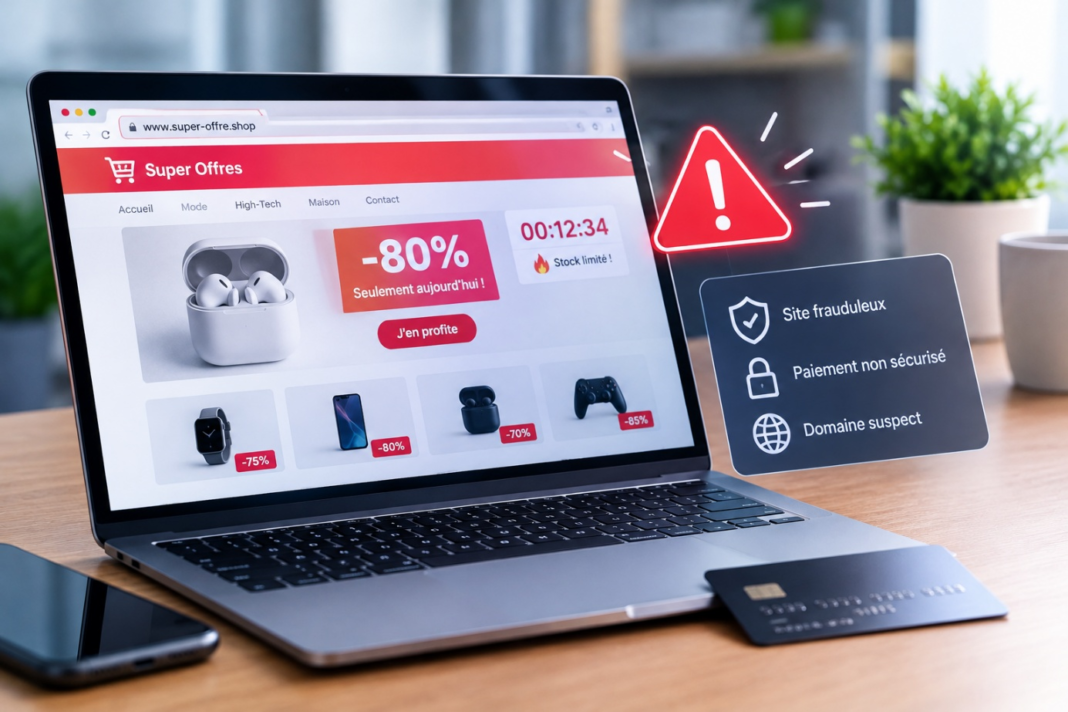
Here is an article inspired by good web journalism practices (in the style of ZDNet) to raise awareness of e-commerce scams and fake websites.
Fake websites and e-commerce scams: how to spot them before buying?
Online shopping has become part of our daily lives, but it also attracts cybercriminals. Creation of fake merchant sites, promotions too good to be true, phishing: the traps are multiplying. ZDNet gives you the keys to unmasking these scams before pulling out your bank card.
As the end-of-year holidays approach, sales periods or simply during impulsive searches on social networks, the risk of coming across a fraudulent e-commerce site is at its highest. Scammers compete in ingenuity: using fake reviews, artificial intelligence technologies and professional site templates, they mislead major brands.
However, a few simple reflexes allow you to identify these scams and avoid losing your money.
1. Analyze URL and domain name
This is the first thing to check, and often the most revealing.
- Typos: Be wary of addresses that copy a major brand by slipping in an extra letter or hyphen (ex: amazon-sale.com instead of amazon.fr).
- The extension of the domain: Be careful with exotic extensions (.xyz, .cc, .top, .club…) for sites supposed to be French or European.
- Age of the site: A site created just two weeks ago should immediately arouse your suspicions. You can use free tools like WHOIS to check the creation date of a domain name.
2. Scrutinize the legal notices (the Achilles heel of scammers)
In Europe, any professional e-commerce site has a legal obligation to display clear legal notices.
- What should be there: The name of the company, the SIRET number, the intra-community VAT number, the address of the head office and a means of contact (email and telephone).
- The classic trap: If the “Legal notices” page is missing, written in broken French, or if the address of the head office refers to a vacant lot on Google Maps, run away.
3. Beware of abnormally low prices
The golden rule remains timeless: If it’s too good to be true, it’s not true.
Scammers lure their victims with massive discounts (-70% to -90%) on highly sought-after products (latest smartphones, high-end headphones, luxury clothing, etc.). On a fake site, you will pay for an item that you will never receive, or worse, you will receive a very poor quality counterfeit.
4. Check the payment methods offered
Payment is often the critical moment of the scam.
- The trap of using a bank card alone: If the site does not accept that the direct bank card (without going through a third-party secure system) and does not offer PayPal, Apple Pay or Google Pay, be very careful.
- The absence of HTTPS: Check for the presence of the small padlock in the address bar. Even though most fake sites these days have an SSL certificate (the famous HTTPS), its absence is an absolute red flag.
5. Hunt fake customer reviews
To inspire confidence, scammers include false, glowing reviews, often accompanied by photos stolen from the internet.
- How to spot them? Use reverse image search tools (like Google Images) on client photos. If they come from an image bank, the site is fake.
- Consult independent platforms: Before buying from an unknown site, look for its name associated with the words “review” or “scam” on search engines or platforms like Trustpilot, FranceVerif or SignalConso.
What to do if you are a victim?
If, despite your precautions, you have fallen into the trap:
- File an opposition immediately with your bank if you have provided your bank details.
- Preserve the evidence (site screenshots, confirmation emails, invoice).
- Report the scam on the official platform SignalConso or on the portal of the Ministry of the Interior Theseus (for internet scams).
When it comes to e-commerce, doubt must prevail. If in doubt about an unknown site, always favor recognized platforms.
Here is a clean, modern, and well-structured rewrite of the content. I have fixed encoding issues (like punctuation marks), cleaned up the HTML structure for readability, and presented the information in a professional, easy-to-read format.
How to spot a fake website before paying
To spot a fake website before paying, you must examine the domain name, check the legal notices, check the reputation of the merchant and rely on solutions like Avast, Norton, Bitdefender or Surfshark, which block fraudulent stores. According to the Banque de France, payment fraud reached 1.241 billion euros in 2025. Here are the warning signals, control tools and emergency reflexes to know.
Site element to analyze
Red Flag
Verification to be carried out
Risk level
Recommended control tool
Domain name
Typo, .shop, .top or .vip extension
Compare with official address
Pupil
Norton Safe Web
Age of site
Domain created a few weeks ago
View creation date
Pupil
ICANN Lookup
Price
Discount from -70% to -90%, countdown
Compare with recognized merchants
AVERAGE
Avast Web Guard
Legal notices
Absent, SIREN not found
Search for the company in the Business Directory
Pupil
Business Directory
Payment
Mandatory transfer, no 3D Secure
Require secure card payment
Critical
Bitdefender Safepay
The distinctive signs of a fraudulent online store
No list of fake websites stays up to date for long: according to AV-Comparatives, a fake store often only survives a few weeks or months. Better to recognize the mechanisms, which change little. The trap often comes via email, SMS or sponsored advertising.
Typosquatting: when the address imitates that of a major brand
Scammers register a domain name close to that of a well-known brand: double letter, extra hyphen or extension like .shop, .top or .vip instead of .fr or .com. An analysis by Decodo (February 2026) identified 28,212 misleading domains already registered around 20 of the most visited platforms, and WIPO handled 6,200 domain name disputes in 2025, a record. Logos and main content of the homepage are copied to better imitate the brand.
Trick : Type the address of the brand yourself rather than following a link received by email or SMS.
Slashed prices and manufactured urgency
A discount of -70% to -90%, a countdown and an “almost sold out” stock has one goal: to cut the thought short. No isolated clue is enough to condemn a store, nuance AV-Comparatives, but an unrealistic promotion, a recent domain and fake reviews published in bursts form a worrying cluster.
Legal notices absent or invented
In France, any merchant site must display the identity of its operator, its address and its SIREN number. An empty page, a phantom SIREN, a fanciful address or the absence of a returns policy should raise alarms.
Suspicious payment gateways
An imposed transfer, a payment in crypto or a card form without 3D Secure are major signals, because these means complicate any recourse. The HTTPS padlock does not reassure any more: according to the APWG, around 83% of phishing sites used HTTPS in the first quarter of 2021, compared to less than 5% at the end of 2016. The SSL/TLS certificate proves that the connection is encrypted, never that the merchant is honest.
How antivirus and security tools detect fake sites
Publishers combine reputation databases, AI analysis and real-time filtering, but the results differ. In the AV-Comparatives test in November 2024, 38 solutions faced more than 500 fake stores: Avast, AVG, McAfee, NordVPN, Norton and Webroot were among the best. The 2025 certification (80% detection without false alarms) was issued to Avast, F-Secure, Kaspersky and Norton, not to Bitdefender or Surfshark.
Note : Avast and Norton belong to the same group, Gen Digital.
Avast: Web Guard, Real Site and Scam Guardian
Avast compares each address to a database of more than 11 million dangerous URLs and blocks fraudulent sites before display. Real Site thwarts DNS hijacking, and Scam Guardian, launching in June 2025, adds AI analysis of pages and messages.
Key e-commerce protection features:
- Web Guard: blocking phishing before display
- Real Site: protection against DNS hijacking
- Scam Guardian: AI detection of fraudulent intentions
Benefits for the user:
- Detection of fake stores certified in 2025
- Basic web protection in the free version
Norton: Safe Web and Genie Assistant
Safe Web combines URL filtering and AI content analysis to report fraudulent offers and booby-trapped ads. AV-Comparatives specifies that the function examines the characteristics of the store and the address, and Norton has been certified since 2024. The Genie assistant still depends on the countries: check its availability in France.
Key e-commerce protection features:
- Safe Web: URL filtering and AI page analysis
- Safe SMS: control of links received by message
- Genie: assistant for analyzing suspicious links and messages
Benefits for the user:
- Certification obtained two years in a row
- Five devices covered with Norton 360 Deluxe
Bitdefender: Safepay, anti-phishing and Link Checker
Bitdefender relies less on store rating than on payment isolation. Safepay opens a partitioned browser to enter your card, while anti-phishing and anti-fraud filters analyze the pages visited. Absent from the list of products certified in 2025, it has its advantage elsewhere.
Key e-commerce protection features:
- Safepay: isolated browser for payments
- Anti-phishing: blocking pages that imitate reputable brands
- Link Checker and Scamio: free link and message tests
Benefits for