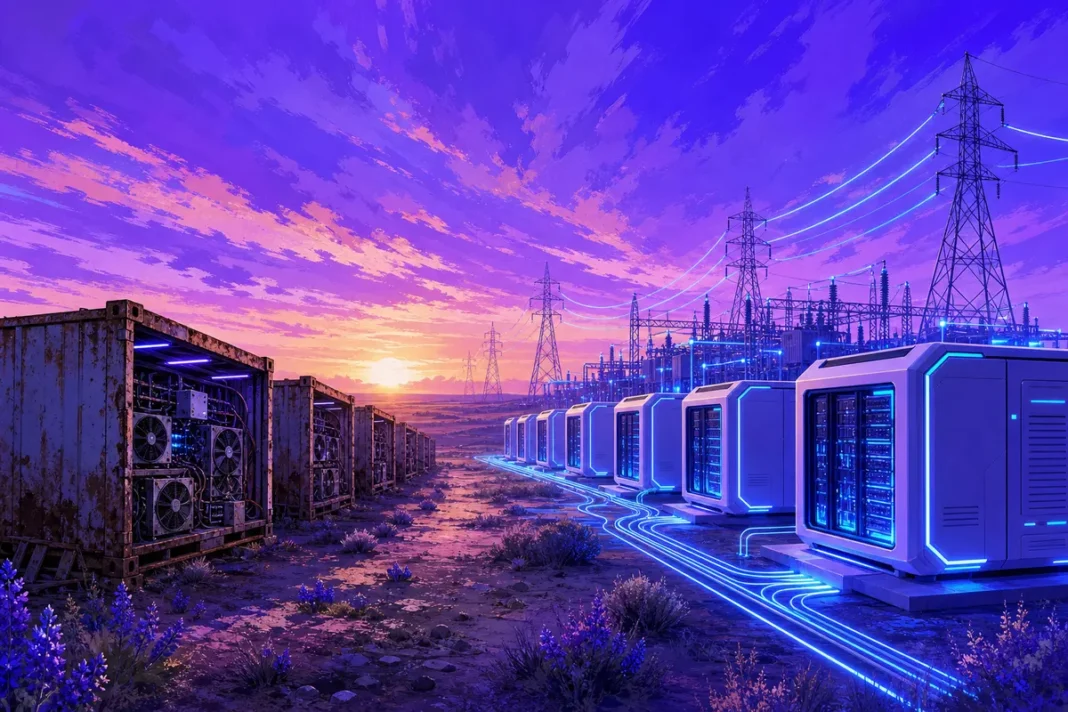
Bitcoin entrepreneurs are becoming the new landowners of artificial intelligence. Riot Platformsone of the largest cryptocurrency miners in the United States, announced in early November 2026 the largest contract in its history: a 15 year lease covering the entirety of its website CorsicanaAt Texasfor approximately $28 billion. Initially presented as “a cutting-edge AI laboratory”, the tenant is AnthropicClaude’s publisher, according to Riot’s quarterly report and the law firm that advised him.
The terms of the contract
According to the press release published by Riot on November 4, 2026 and filed with the American stock exchange authority, the contract concerns 910 megawatts of computing capacity on a single piece of land of 332 acres, or approximately 134 hectares.
| Element | Value |
|---|---|
| Duration | 15 years, with two 5-year extension options |
| Ability | 910 megawatts of computing capacity |
| Total value | Around $28 billion, $54 billion with extensions |
| Average annual rent | About $1.8 billion |
| Development cost | About $6 million per megawatt, or $5.5 billion in total |
| Delivery | 400 MW in September 2027, 200 MW in January 2028, 310 MW in July 2028 |
This contract is in addition to a first agreement of 191 megawatts signed earlier in the year with the same tenant on the site of Rockdalevalued at $9.1 billion over 20 years according to Yahoo Finance. In total, Riot claims 1,151 megawatts rented, for approximately $38 billion long-term revenue, including a contract with chipmaker AMD.
An “all-inclusive” lease of a special kind
The contract is a “triple net” type land lease. Concretely, Riot provides the groundL’electrical infrastructure high and medium voltage and connected platforms. Anthropic, for its part, purchases, installs, owns and operates its own calculation modulesand covers most of the operating costs, includingelectricityre-invoiced at cost.
This arrangement greatly reduces the risks for Riot. According to its general manager, Jason Les, it only asks about half of the capital of a traditional data center. Riot funds $2 million per megawatt for construction and electricity, and then reimburses Anthropic $4 million per megawatt for its modules as each phase is delivered. Key point of the contract: the rent is due on the 910 megawattswhether the capacity is used or not.
Why bitcoin miners are retraining
Bitcoin miners have what AI lacks most: large plots of land already connected to powerful electricity networks, with the necessary authorizations. Mining involves continuously running specialized machines to validate cryptocurrency transactions, which requires enormous amounts of electricity. These sites can be converted more quickly than new projects starting from scratch, which often wait years for a connection.
The market context also pushes for this shift. According to Riot’s press release, the average price of bitcoin in the third quarter of 2026 was $70,855against $114,361 a year earlier. Mining revenues thus increased from $160.8 million to $116 million over the period, despite production up 16%. Riot sold 20,264 bitcoins since the beginning of the year, for approximately $1.5 billionmainly to finance its data centers.
Miners also have valuable know-how in electricity management. In Texas, they can reduce their consumption when the network is under tension, in exchange for compensation: Riot thus received $24.7 million of demand response credits in the third quarter. The group is even taking advantage of the demand for data centers in another activity: its engineering revenues, linked to the manufacture of custom electrical equipment for third-party clients, have jumped by $19.1 million to $47 million in one year. Riot is thus one of the suppliers who are benefiting from the race for infrastructure, both as an owner of land and as a manufacturer of electrical equipment.
A transition still in its early stages
The figures for the last quarter show that the shift is only just beginning. On a turnover of $181.4 milliondata centers only reported 18.4 millionmore than half of which corresponded to development reimbursements rather than recurring rents. Mining still weighed 116 million.
The income promised by the leases is future commitmentsnot revenues already collected. They depend on the delivery of the installations on time and the financial strength of the tenant. Yahoo Finance notes that some analysts remain cautious, due to the concentration on a single large customer and construction bonds.
This type of contract illustrates long-term commitments that the American Federal Reserve considers difficult to measure. In its latest report, it noted that unstarted leases from tech giants exceeded $1,000 billion, at the heart of AI financing deemed increasingly risky.
What this says about Anthropic’s strategy
For Anthropic, the agreement secures considerable computing capacity from 2027, essential to train its future models and meet customer demand. The company has just raised around $81 billion in its Nasdaq IPO, and its infrastructure needs explain the scale of this raising.
The choice of a land lease, rather than a turnkey data center, also allows it to maintain control of its equipment: it is she who chooses, installs and operates its calculation modules. Anthropic is also increasing the number of solutions to secure its energy, for example with gas generators, while other players, such as SpaceX, are building their own computing campuses.
Texas, home to AI
Texas is emerging as one of the main territories in the data center race, thanks to its available land, its largely autonomous electricity network and regulations considered favorable. Old bitcoin mining sites, numerous in the state, are becoming sought-after assets there. It remains to be seen whether this reconversion will keep its promises: if the demand for computing for AI were to slow down, such long and concentrated commitments could weigh heavily, both for owners and their tenants.