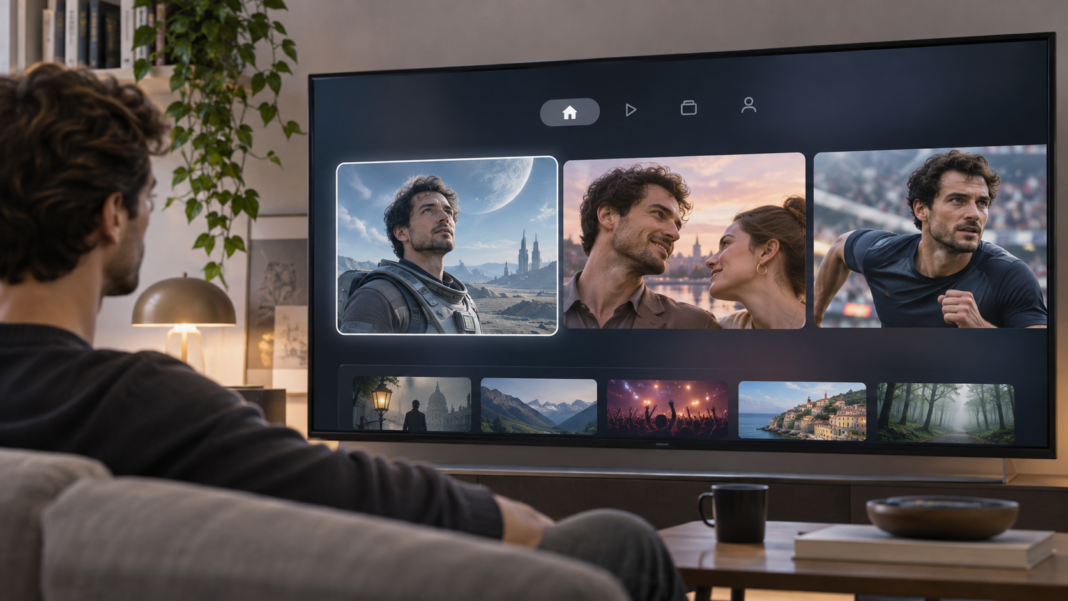
Here is an article inspired by the style of ZDNET, dealing with a futuristic and captivating concept: a television channel entirely generated by AI where the viewer becomes the main character.
What if Google created “EgoTV”? Dive into the first fully AI-generated TV channel where YOU are the hero
The tech giant is taking a new step in hypermedia. By combining its most advanced generative models (Gemini, Imagen 3 and Veo), Google would imagine the beginnings of a completely interactive and personalized television. Welcome to the era of tailor-made fiction.
By the ZDNET editorial staff
Published on May 25, 2024
Imagine. You come home after a long day at work. You sit on your sofa, launch your Google TV application, and select a new icon: “MyChannel”.
What appears on the screen is neither a pre-recorded movie, nor a classic streaming stream, nor even a video game in the traditional sense. It’s a television news, a thriller or a space opera that takes place in real time. The hero of the story? It’s you. Your face, your (synthesized) voice, your tastes and even your fears, expertly integrated into an infinite narration generated by cutting-edge artificial intelligence.
Cyberpunk utopia? Not so sure. While Google deploys its Sora-like video tools with Veo and pushes the cursors of procedural generation, the idea of a television channel entirely personalized by AI ceases to be science fiction to become the next Holy Grail of the media-tech industry.
The ultimate convergence of generative AI and video
To understand the potential of such a project, we must look at the recent evolution of Google technologies. On the one hand, LLMs (Large Language Models) like Gemini excel at writing complex scenarios and long-term narrative coherence. On the other hand, image and video generators (Imagen 3 and Veo) achieve a disturbing level of photorealism, capable of producing fluid cinematic shots from simple textual instructions.
In this concept of “AI television channel”, these technological bricks merge:
- Dynamic profiling: AI analyzes (with your consent) your interests, searches, YouTube playlists, and past interactions to determine what kind of entertainment will captivate you that night.
- Streaming on-the-fly generation: The scenario is written second by second. If you decide, during a discussion with a character, to lie or run, the AI instantly rewrites the trajectory of the plot.
- Ethical and instant Deep-Fake: Your digital avatar is seamlessly integrated into AI-generated virtual sets, interacting with synthetic actors with deep conversational intelligence.
From passive spectator to total actor: the end of the program schedule
Television as we know it – invented in the mid-20th century – is based on an immutable paradigm: mass broadcasting. A program for millions of people.
With an AI-generated TV channel, this model implodes. The program schedule no longer exists, since it is unique to each home.
- In the morning, your personal “JT” presents world news filtered through the prism of your passions, read by virtual presenters who speak directly to you.
- In the evening, it’s time for entertainment: you play the role of the main inspector of a psychological thriller set in a futuristic Paris, or the captain of a spaceship lost on the edge of the galaxy.
The immersion is total. The settings change according to your mood detected by the camera of your smart TV (with your agreement), the plot adapts to your pace, and the suspense is calibrated to keep your attention peaked.
The colossal challenges: ethics, cost and “Uncanny Valley”
If the idea is a dream for technophiles, it also raises dizzying questions that regulators and engineers will have to resolve:
- Addiction and isolation: If an AI is capable of offering you exactly the flattering scenario, the adventure of which you are the permanent hero, the risk of escape from reality (the “Ready Player One” effect) becomes very real.
- The energy and calculation cost: Running video generation models in real time for millions of viewers simultaneously represents a titanic carbon footprint and computing power.
- Intellectual property and copyright: On what body of work are these AIs trained to generate atmospheres worthy of Hollywood?
ZDNET’s opinion
Google (or one of its competitors like OpenAI or Meta) has the next big revolution in user interfaces. After the transition from analog TV to digital TV, then from cable to on-demand streaming, the next logical step is generative and interactive television.
Are you ready to give up your role as a simple viewer and become the star of your own channel? One thing is certain: the remote control of tomorrow will no longer be used to change channels, but to rewrite destiny.
Here is a rewritten, fluid and modern version of your article, while retaining the original HTML structure and image embedding tags.
What if you became the hero of your own films? Google is working on an innovative concept that goes far beyond traditional recommendation algorithms: a television channel entirely powered by artificial intelligence, where the viewer embodies the main character of the programs.
Filed last May and made official last week, this patent application nevertheless suffered an initial refusal from the examiner. Google, however, retains the possibility of reviewing its copy or appealing this decision.
When the viewer bursts the screen
According to official documents, the tech giant plans to integrate this option directly on the home screen of televisions via a dedicated channel. By activating it, an algorithm would cross-reference user profile data to generate tailor-made programs, placing the latter at the heart of the plot.
Imagine lending your features and your voice to play the leading roles in a science fiction epic or a romantic comedy shaped from scratch by AI.
These programs could be created on the fly, as desired, or generated completely autonomously, without any action being required from the viewer.
Hyper-personalization at the heart of the system
Such prowess relies on ultra-advanced targeting technologies. Google's patent indicates that the process requires vacuuming up a large volume of data: personal preferences, demographic information and contextual data.
Using large language models (LLM), the system dissects viewing habits to concoct content perfectly aligned with everyone's tastes. Thus, an action movie fan will be propelled into spectacular scenes, while a football fan will be able to invite themselves directly into the foreground of sequences dedicated to their favorite sport.
But the adaptation does not stop at the scenario. The pace, narration, visual aesthetic and even image format could be adjusted in real time to match the audience's consumption habits.
A dizzying prospect which will not fail, in passing, to relaunch the thorny debate on the collection and use of personal data.
 © Google/PatentlizeTailor-made advertising in ambush
Behind this entertaining showcase, the Mountain View firm has not forgotten the crux of the matter: monetization. The patent describes a mechanism for injecting targeted advertising directly into the heart of these video streams generated by artificial intelligence.
Enough to open up a new avenue for programmatic advertising applied to synthetic content.
Google, however, faces competition. In this innovative field, the streaming platform Roku has already taken a head start by launching FairgroundTV, a free channel broadcasting programs designed by AI.
For the moment, Google's project remains in the patent state on glossy paper, and no marketing date has been made official.