This is an article written in ZDNet’s professional and incisive style, focusing on technology, work organization and business productivity.
Meetings: the hidden cost of inefficiency
Too long, too many, poorly prepared: meetings have become the scapegoat for business productivity. Beyond simple psychological fatigue, the inefficiency of these meetings represents a colossal financial pit, exacerbated by the generalization of hybrid work.
“We could have resolved this by email. » This sentence, uttered at the end of yet another interministerial meeting or a team update, resonates like an admission of failure in the modern professional world. While companies desperately seek to optimize their processes and integrate artificial intelligence to gain competitiveness, a blind spot persists: chronic reunionitis.
And the evil is deep. According to several recent studies, executives spend on average nearly 18 hours per week in meetings – a figure that has exploded with the advent of distance learning and videoconferencing tools like Teams, Zoom or Google Meet. But what is the real cost of this calendar frenzy?
The salty addition of “reunionitis”
Calculating the cost of a meeting involves more than adding up the cost of cups of coffee and croissants. It is a mathematical equation involving the working time and the hourly rate of employees.
Let’s take a concrete example: a one-hour meeting bringing together eight senior executives, whose average salary is estimated at 60,000 euros gross annually. This hour of “collaborative” discussion doesn’t just cost the time of the meeting itself. To this must be added the cost of preparation time, but above all that of “reconnection”: according to cognitive science, it takes an employee 15 to 20 minutes on average to regain their initial level of concentration after being interrupted.
Multiply that by dozens of weekly meetings in an ETI or large group, and the cost quickly amounts to millions of euros per year in purely unproductive work time. This is what experts call the “opportunity cost”: this time spent debating is time lost for production, innovation or customer relations.
The trap of hybrid work and digital “Newspeak”
With the generalization of hybrid mode, videoconferencing has democratized a pernicious phenomenon: the “surveillance” meeting or the reflex meeting. Since we no longer see our colleagues physically, the managerial reflex is to increase the number of points of contact.
Paradoxically, technological tools that were supposed to free up time have often added to the load. The ease of creating a video link in one click has removed the logistical barrier (reserving a room, traveling there). Result: we invite ourselves to everything, we copy everyone, for fear of “missing information”, creating a permanent cognitive overload.
Added to this is the phenomenon of multitasking (multitasking) in virtual meeting. How many participants absentmindedly listen to a report while responding to emails or writing a Slack document? This dispersion harms the quality of decisions and reinforces the feeling of uselessness of the exercise.
Towards an organizational detoxification?
Faced with this financial and human chasm, resistance is being organized. From tech giants to more traditional companies, new practices are emerging to rehabilitate working time.
- The culture of asynchrony: Promoting writing, shared notes (via Notion or Confluence) and short video recordings allows information to be disseminated without requiring the simultaneous presence of an entire team.
- “No-Meeting Day”: Establishing one or two days per week without any internal meetings has become the key to giving employees back “Deep Work” opportunities.
- The “2 pizzas” or “non-required” rule: Drastically limit the number of participants and make attendance optional for those who are not direct contributors or decision-makers.
- AI as referee: Many solutions are emerging to automate reports, summarize discussions and even assess the relevance of a meeting thanks to the semantic analysis of agendas.
Conclusion
The problem isn’t the meeting itself – brainstorming and collective decision-making remain essential to business intelligence. The problem is its misuse. In 2024, considering employees’ time as an infinite resource is economic heresy.
For CIOs, HR managers and managers, tackling the hidden cost of meetings is not only a question of well-being at work: it is an imperative for performance and survival in an ultra-competitive market. Fewer meetings means more action. What if the real digital revolution was, ultimately, learning to hang up?
Here is a rewritten, fluid and professional version of the content, optimized for reading on the web while retaining key information from the original article.
Ineffective Meetings: The Hidden Cost of Bad Technology (And How to Fix It)
The figure is enough to make any financial director jump: 112 million euros per year per large company. This is the estimated cost of unnecessary meetings, according to the study “The Cost of a Bad Meeting” published by Jabra. In France, for a structure of 5,000 employees, the bill amounts to more than 90 million euros annually.
However, these colossal amounts often remain abstract for organizations. What really concerns managers is their concrete translation: 22 working days lost per employee per year — the equivalent of an employee’s entire paid leave.
The hybrid meeting: main breaking point
These 22 lost days do not disappear just anywhere: they are almost always consumed in the same arena, that of the hybrid meeting.
In France, 72% of them encounter a technical problem (audio, video or connectivity). Result: more than 12 minutes lost at the start of each meeting, which represents nearly three days of work lost per person per year.
“As soon as the room becomes more complex, when we have to plug in our PC or juggle with a tablet, we often waste precious minutes asking ourselves: can we see each other clearly, can we hear each other? »notes Maud Brissaud, Sales Director France at Jabra.
Beyond wasted time, it is inclusion which is threatened. More than one in two remote participants (especially women) feel excluded from discussions. To remedy this, the issue is clear: “Create the conditions so that everyone is clearly seen and heard, even from a distance. »
The solution also involves a cultural questioning:
“Participating in a meeting to say that we were present when it is not necessary for us has no point. We must relearn how to ask ourselves, before inviting ten people, who is really essential”recommends Maud Brissaud.
The right equipment, for the right use, in the right room
To correct this imbalance, some are banking on technological escalation. Jabra advocates the opposite.
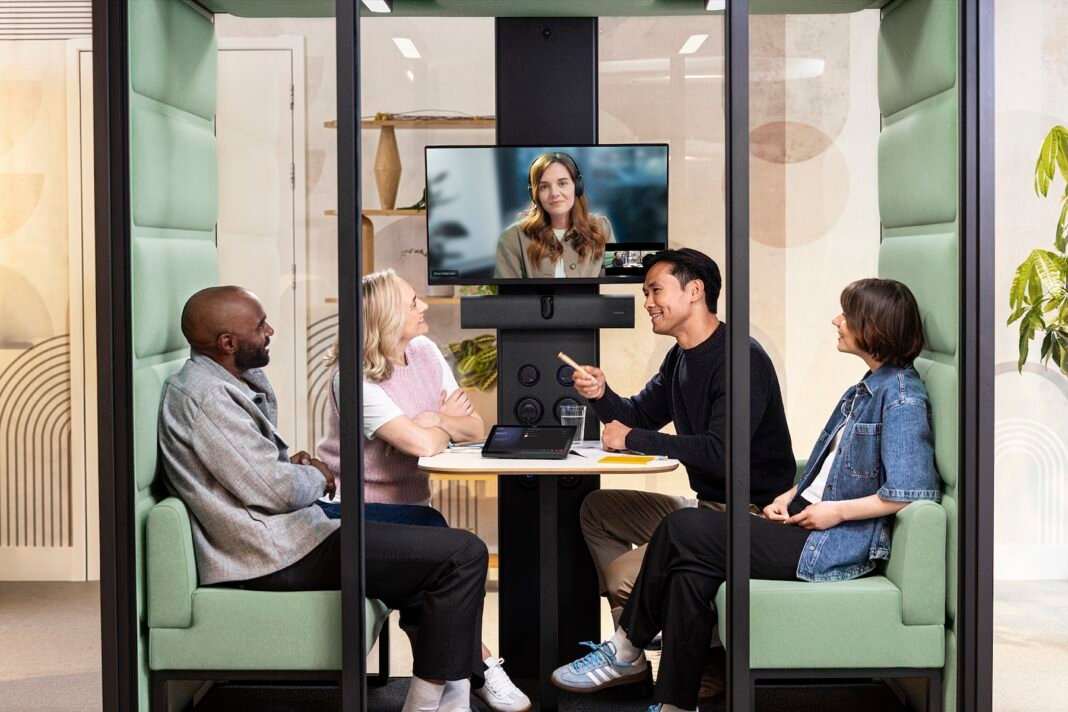
Since the majority of professional spaces are not large conference rooms but rather huddle rooms (small and medium-sized meeting rooms), the equipment must be adapted:
- Suitable helmets (like the new Evolve 3 series) to isolate yourself in open spaces or secure hybrid work.
- Modular video kits (PanaCast Room Kits) that adjust to room size, from single camera to multi-lens bars for larger spaces.
“Oversized equipment in an average room is a lot of investment for limited benefit. And making equipment available without supporting its adoption is guaranteed failure nine times out of ten”warns the sales director.
In a context where more than 78% of employees work from mobile and varied locations (office, home, coworking space, train station), professional equipment becomes a transportable bubble: “The employee puts on his helmet and finds the same working conditions everywhere. »
Artificial intelligence in meetings: everything depends on audio
The arrival of generative AI promised to revolutionize meeting management. However, if 3 out of 4 employees have already tested AI to transcribe or summarize a meeting, less than 1 in 3 use it regularly.
The reason? The quality of the data provided to the algorithm. An automatic report is only reliable if the sound capture is impeccable.
- “Our audio equipment achieves a transcription reliability of around 97%, where a consumer headset falls around 60%”underlines Maud Brissaud.
Without a certified, trusted, and integrated ecosystem (like Microsoft Teams), the promise of AI deflates.
In conclusion, Maud Brissaud summarizes the ultimate objective of modern businesses in a simple sentence:
“A good meeting is one where no one has had to ask: “Can you see me, can you hear me?” »
The full study report is available on the Jabra website: jabra.com/thought-leadership/billion-dollar-brain-drain