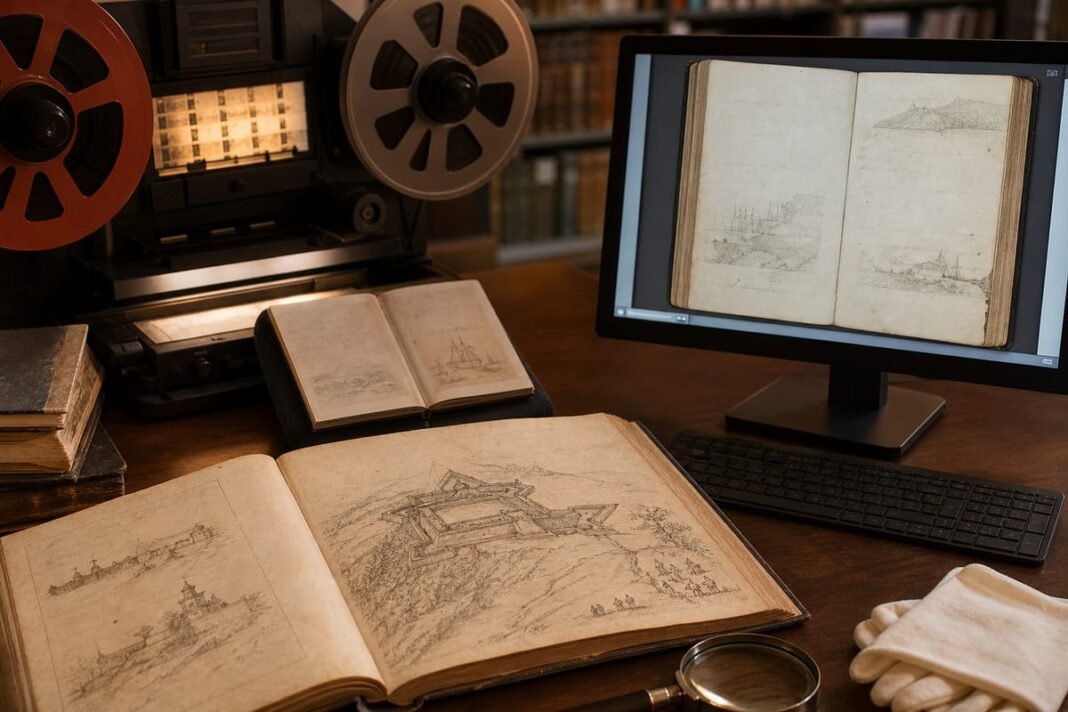
Mark Humphries, professor of history at Wilfrid Laurier University in Waterloo, Ontario, says GPT-6.2 Astra proposed in 22 minutes an identity for the designer of an anonymous notebook dating from 1808. Kept at Yale, this notebook could be attributed to Viscount de Chabot. The historian compared this proposition with a personal diary.
Humphries tempers tech sector kudos
OpenAI President Greg Brockman relayed this attribution, welcoming the resolution of a historical enigma that he considers significant. On X, digital professionals sent Humphries enthusiastic messages and congratulations. However, the person concerned describes his relationship with this technology as more ambivalent than one might suppose: he does not give it all the skills necessary for the profession of historian and does not use it to write.
As for historians, discussions focused on his method, with some jokes comparing “Chabot” to “chatbot”. Some point out that a human investigation could have been successful, which Humphries also acknowledges. It intends to make the capabilities of the models understood without hiding their limits.
According to Humphries, the Yale librarian he contacted responded favorably, but the institution had not yet acted on the information. Yale did not respond to a request for comment.
Chabot’s diary provides several clues
The identity put forward by the model is that of Louis-Guy-Charles-Guillaume de Rohan-Chabot, viscount of Chabot, reports Humphries. The tool spotted in a history thesis the mention of a diary kept by Chabot, which the historian could consult to verify this attribution. Reproductions on microfilm could be ordered.
The evening letterFree · 7 p.m.
Are you following the race for AI models?
Each output (GPT, Claude, Gemini, Mistral, etc.) decrypted the same evening, in 5 minutes. Free.
Included upon registration: our selection of the best AI guides & comparisons.
Choose your pace
Free · No spam · Unsubscribe in 1 click
After comparison, Humphries found the entries in the diary and notebook similar, without seeing this as sufficient proof: he specified that he had no expertise in the matter. On the other hand, he reports an exact concordance of dates, which places Chabot in the places represented at the corresponding times.
Another rapprochement could be decisive. In his diary, Chabot recounts having drawn Fort St. Joseph, indicating the chosen angle; the notebook includes a representation of the fort from this point of view.
The model examines documents citing hundreds of people
The document is in the Beinecke Rare Book and Manuscript Library at Yale. Humphries, who has been studying fur trade since the pandemic, has been interested in it for a long time. The available clues were meager: a few annotations, rare dates and an itinerary followed by thousands of travelers.
Member of a group which tests OpenAI models before their distribution, the historian directed GPT-6.2 Astra towards the digitization of the notebook to search for its origin. He had selected Ultra, with objective mode. According to his account, the model cross-referenced first-hand documents, including a fur trader’s dinner diary and meeting minutes, to narrow down identities consistent with the locations visited.
Humphries emphasizes that this approach was not inaccessible to a person. But the archives mobilized included hundreds of names to be checked: it is this verification work that he describes as particularly long and tedious.