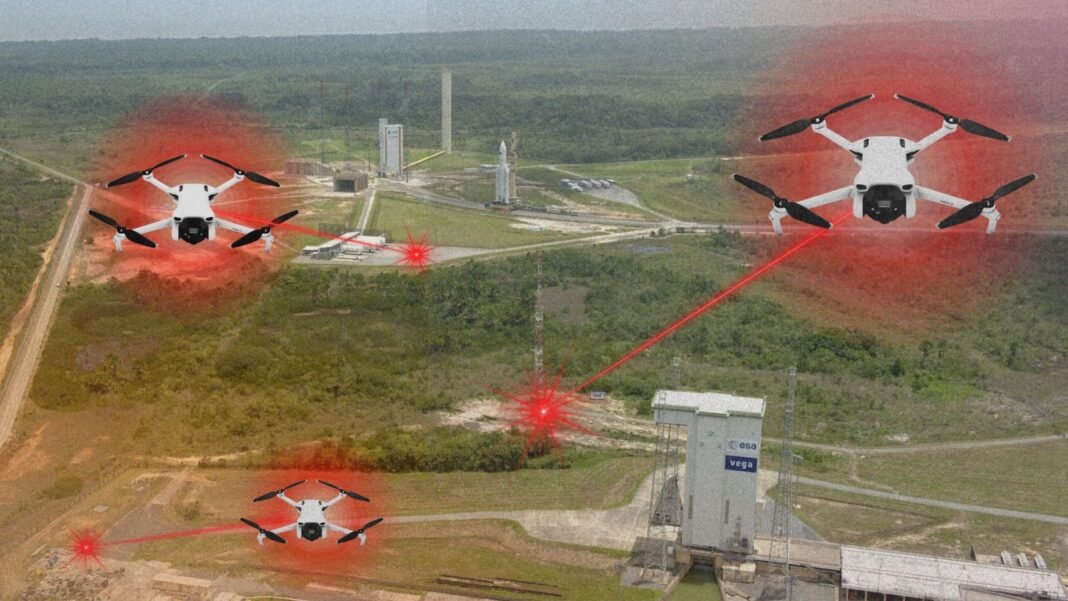
Unlike Cape Canaveral, the Guyana Space Center does not plan to shoot down drones with lasers during a flight of the Ariane 6 rocket. It relies on a military jammer and on a no-fly zone which can reach 4 times the surface area of the base. Faced with a swarm, his protection manager admits: “ We are not at all ready to do that. »
It is an announcement which illustrates the rapid evolution of the threat weighing on launch bases. At the end of September 2026, the US Space Force announced that it would install anti-drone lasers at Cape Canaveral, the Florida base from which SpaceX and United Launch Alliance rockets take off, after an intrusion 2.5 kilometers from the lunar launch pad.
Very quickly an obvious question arose: what about the protection of the Guiana Space Center (CSG), near Kourou, which constitutes the main European spaceport? At this stage, no one plans to do the same, even though the site is absolutely strategic for launching the Ariane 6 and Vega-C rockets.
Thierry Vallée, deputy director in charge of protection, safeguarding and the environment at CSG, the base managed by the French space agency, was clear when Numerama interviewed him on site: “ For the moment, we are not at all on this neutralization register. » The center is instead relying on jammers and a very large no-fly zone.

This choice is explained firstly by geography. According to Thierry Vallée, the relative isolation of the Guiana Space Center (literally between the Atlantic Ocean and the Amazon jungle) simplifies his task. The regulations also: “ The anti-drone fight here is simplified by the fact that we are in an area which is naturally prohibited from flying. »
The base is therefore located between two difficult-to-access environments and in the middle of an area where no one has the right to fly without authorization, the laser option is not ” not necessarily studied in depth » at the CSG. Thierry Vallée, however, announces experiments in 2027 “ on the drone part as a general rule ”, without going into details.
Furthermore, another factor undoubtedly plays a role: the pace of activity. On the United States side, Cape Canaveral has a series of 109 orbital launches in 2025, according to DroneXL, and Colonel Brian Chatman, who commands launch operations there, considers it possible to host more than 300 per year. Almost triple, in short.
In Kourou, there were 7 launches in 2025, with 4 Ariane 6 (including the first commercial flight) and 3 Vega-C. That’s more than 15 times less. Certainly, the pace is increasing (9 are expected in 2026, with two shots to be carried out before the end of the year), and there is a plan to increase the workload in the years to come, but the gap with Florida remains enormous.

A military jammer and a prohibited zone several times larger than the base
That being said, the CSG is not without protection either.

Black Friday: Proton Pass Plus at -60%
Until November 30, Proton Pass Plus is €1.99 per month for 12 months, or 60% off! Unlimited email address aliases to take advantage of promotional codes without filling your mailbox, unique password per site, encrypted safe. In short, a stress-free Black Friday!
Against drones, the site runs the Parade system. “ The space center is equipped with a permanent anti-drone response system, the same as at Paris-Charles-de-Gaulle airport, for example. », explains Thierry Vallée. The Directorate General of Armaments (DGA) entrusted this program to Thales and CS Group in May 2022.
The initial order for this market, which could be worth 350 million euros over 11 years, concerned 6 systems. Each of them brings together a radar to detect objects in flight, a goniometer (which identifies the direction from which a drone’s radio waves come), cameras as well as a jammer, which cuts the connection between the drone and its remote control.
Above all, the first protection of the site remains the closure of its airspace. The prefecture of Guyana indicates that the CSG is covered by a no-fly zone called SOP3, placed under the authority of the military control center. “ It goes almost from the commune of Macouria which you crossed when coming from Cayenne to the commune of Sinnamary, even beyond the west side », points out Thierry Vallée.

The scope is vast: he estimates it to be “ at least 2 or 3 timess » the surface of the space center, even 4 times. For a site of 660 square kilometers according to the CNES (National Center for Space Studies), this represents between approximately 1,300 and 2,600 square kilometers. The Air and Space Force monitors it 24 hours a day.
This security polygon also goes very high. Thierry Vallée spoke of a ceiling that would go up to 27,500 feet, around 8,400 meters – not so far from the 10,000 to 12,000 meters that airliners encounter on long-haul flights. We no longer find many drones that can evolve higher.
Flying over is not the only prohibition. The space center sector also has three zones prohibited for aerial data capture (ZICAD): two fall under the Ministry of Higher Education and cover the CSG and its ancillary installations, the third, included in the first, depends on the Ministry of the Armed Forces. Filming or photographing the base from a drone therefore requires separate authorization.
Hobby drones, and no plan against a swarm
According to Thierry Vallée, the system did not have to deal with a hostile threat. Asked about the time between detection and neutralization, he clarified that he had never been confronted with this possibility: “ We didn’t have to deal with this situation.. »
On the other hand, the system detects “ regularly » recreational drones, for example that of “ a dad who gives his kid a drone » without knowing that he lives in a prohibited area. La Pointe des Roches, in Kourou, particularly attracts aerial video enthusiasts. In these cases, the answer comes through pedagogy: “ We detect it and then we send the police and we do education. »
In May 2025, the daily France-Guyane told the story of a man who had flown his drone from Pointe des Roches 5 minutes before a Vega-C launch: his drone was seized and he was banned from accessing the CSG for 6 months. Pedagogy, therefore, but also firmness, so that the message gets across to other amateurs.
Furthermore, pedagogy does not prevent prosecutions. The Transport Code (article L6232-12) punishes flying over a prohibited area due to clumsiness or negligence with 6 months’ imprisonment and a fine of 15,000 euros. If the remote pilot voluntarily engages or maintains his drone above the area, the penalty rises to one year in prison and a fine of 45,000 euros. In both cases, the device can be confiscated (article L6232-13).
However, there is a legal route: flights having obtained an exemption (the request goes through the interministerial headquarters of the zone, in the prefecture) appear as authorized once the drone has been identified, and the device is allowed to fly.
What if there was a swarm of drones rushing towards the CSG?
Faced with a swarm, on the other hand, like what we can see on the front line between Ukraine and Russia, Thierry Vallée does not hide the limits of the system. Thinking about drones used in war today, he acknowledges that “ you have to stay humble » : « We are not at all ready to do that. » He relies on intelligence to see the threat coming.
A swarm launched from the sea? “ We would detect this boat beforehand because it would certainly be a boat owned by an entity that has the means to implement this. » and we guess that there would be an appropriate response and, if necessary, an intervention by the maritime gendarmerie. Or, if necessary, an even more robust response.

The CSG also has a navigation ban zone which extends offshore more than 15 kilometers from the coast, as well as the presence of patrol boats during launches. On the continental side, finally, Thierry Vallée recalls the very upstream work of intelligence agencies, such as the DGSI and the DGSE, to monitor what is happening around the base.
According to Thierry Vallée, the Air and Space Force also uses snipers aboard helicopters who could, if necessary, open fire against non-cooperative drones. At different locations on the base, infantrymen also have anti-drone rifles in their hands that they can use to disrupt the signals from these machines.
In other words, even the scary scenario of a swarm of drones is, at this point, nuanced. “ It wouldn’t happen like that overnight », wants to believe Thierry Vallée. And even if the CSG downstream is not ready for this scenario, the parade could be triggered further upstream. But we understand that the door is not necessarily closed to lasers in the future.

All the tech news at a glance
Add Numerama to your home screen and stay connected to the future!