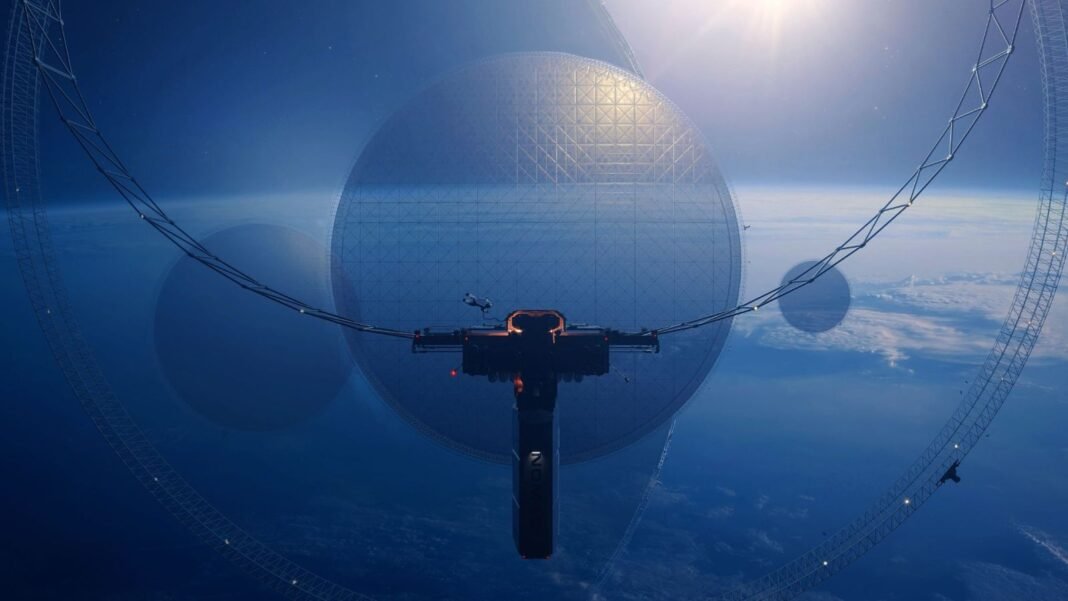
A robot designed by Caltech and funded by DARPA has assembled a structure in orbit without any human assistance, a first announced on November 5, 2026. On the other hand, it will have built only one of the 11 segments planned before the end of its mission, scheduled for December.
To install or repair anything outside the International Space Station (ISS), there is still only one solution: sending astronauts outside, in spacesuits, for extravehicular outings (EVA) which last nearly 6 hours each.
But, on November 5, 2026, the American university Caltech announced that one of its robots had assembled a structure in orbit, without a single astronaut. “This is the first time that a structure has been built autonomously in space», Says Sergio Pellegrino, professor of aerospace engineering at Caltech and leader of the project, quoted in the press release. The robot has only built a small piece of antenna, but it opens a path to manufacturing objects in orbit that are far too large to fit in a rocket.
This robot is called ASTRA. It is funded by DARPA, the Pentagon’s research agency, as part of its NOM4D program, launched in 2022 to learn how to manufacture large structures directly in orbit. ASTRA took off on March 30, 2026 from Vandenberg Air Force Base, California, with SpaceX’s Transporter-16 mission. This box of approximately one cubic meter traveled with 9 other payloads aboard the Vigoride 7, a space tug from the company Momentus which also provides it with energy and communications. According to Andrew Detor, program manager at DARPA, it took only 15 months from the idea for an in-orbit demonstration to launch.

A construction game controlled from Earth
But how can a robot build something alone in a vacuum? DARPA compares the principle to K’Nex type construction games. A robotic gantry, which moves on three axes, grabs composite fiber tubes and aluminum junctions stored in motorized dispensers, then assembles them into identical segments called bays. He then attaches a perforated reflective film to it, before pushing the completed bay out of the case to attack the next one. It takes 11 to loop the armature of an antenna 1.4 meters in diameter, a process that can be seen in a video published by Caltech, filmed on the terrestrial version of ASTRA.
In orbit, things proved much more complicated. ASTRA left with two racks already assembled and only managed to build the third, due to lack of time. Because construction orders come from the ground, and the team can only talk to the robot 7 or 8 times a day, for around fifteen minutes. Whenever something unexpected happens, engineers reproduce the problem on an ASTRA twin left in the laboratory, test a solution, then send the solution into orbit.
Why do without astronauts?
Currently, there are only two ways to send a large structure into space. Either we fold it so that it fits under the fairing of the rocket, like the 6.5 meter mirror of the James Webb telescope. Either we assemble it by hand from pieces sent in several launches, like the ISS, which requires repeated exits.
For astronauts, these spacewalks are a real accomplishment. We saw it recently with Canadian astronaut Joshua Kutryk, who published a photo of his spacewalk, 400 kilometers above the Earth. A poetic and prodigious photo, but which reminds us of the extent to which these outings remain very risky: in 2013, the Italian Luca Parmitano almost drowned when his helmet filled with water.
A mission that ends before the last bay
ASTRA’s mission ends in December, and Caltech no longer plans to complete the 11 bays. However, the team believes they have shown that the method works, even if the system needs to be simplified. The NOM4D program plans one more experiment before stopping: the University of Illinois must send to the ISS, by the end of the year, a process which hardens composite tubes directly in orbit.

All the tech news at a glance
Add Numerama to your home screen and stay connected to the future!