Anthropic raised $81.3 billion on Thursday for its arrival on the Nasdaq, a record for an IPO. At closing, its valuation reached $1.76 trillion. This listing comes at a time when its security commitments are being contested, even among its first investors.
First investor calls for slowdown
Dustin Moskovitz, co-founder of Facebook and historic investor in Anthropic after investing in OpenAI, is asking the laboratory to slow down. He claims to have committed funds with his wife Cari Tuna to promote safety, and not a speed competition. In his eyes, progress in AI is too rapid: his call also targets other, more advanced laboratories.
The couple should not personally benefit from the listing: their spokesperson says that their shares were given to a non-profit organization in 2025. For individuals who invest in the stock market, the operation could, however, give access to the possible benefits of AI.
Robert Armstrong of the Financial Times estimates that the laboratory would need to exceed $600 billion in annual revenue to reach the 20% return on investment achieved by its peers. Apple’s revenues are $478 billion. Dario Amodei, CEO of Anthropic, for his part, wants to obtain an investment grade credit rating and plans new debt issues. This funding, like the capital raised, must be used to acquire more computing capacity.
Non-binding security commitments
AI auditor METR estimates that the use of AI for research has approximately doubled the pace of Anthropic’s R&D progress. Such a doubling would indicate that the laboratory has crossed the risk threshold that it itself set for automated R&D. Its commitments would then provide for additional audits, security measures and more transparency.
The Responsible Scaling Policy which contains these commitments, however, is not binding. Anthropic had supported SB 53, the California law that requires companies to publish security policies and then legally comply with them. After its adoption, the laboratory submitted a less demanding system under this law, its more ambitious promises now being classified as voluntary.
Futurists envisioned a scenario of recursive improvement: a sufficiently advanced AI could design its own successors, then repeat the operation at an increasing rate. In this scenario, humans could no longer be able to understand the system or interrupt its operation. At Nasdaq, Dario Amodei promised to adjust the training and deployment cadence to the time required for security. He also assured that Anthropic would resist political and commercial pressure.
The evening letterFree · 7 p.m.
AI transforming business?
AI strategies, movements and tricks deciphered, every evening in 5 minutes. Free.
Included upon registration: our selection of the best AI guides & comparisons.
Choose your pace
Free · No spam · Unsubscribe in 1 click
Demonstration and declaration against Anthropic
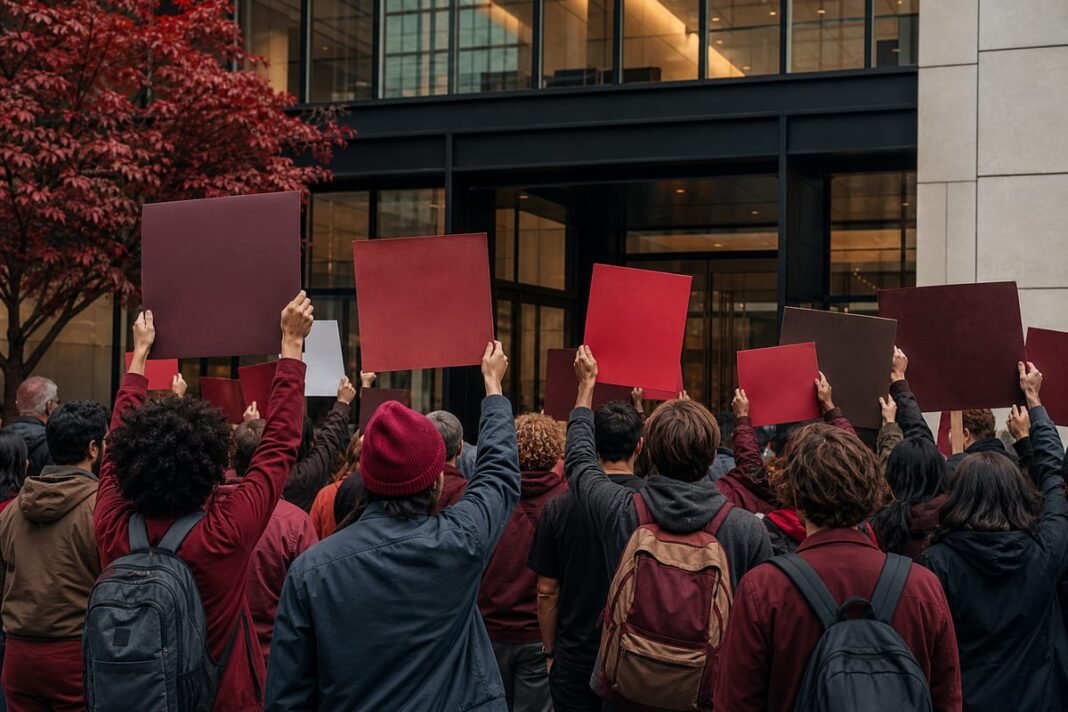
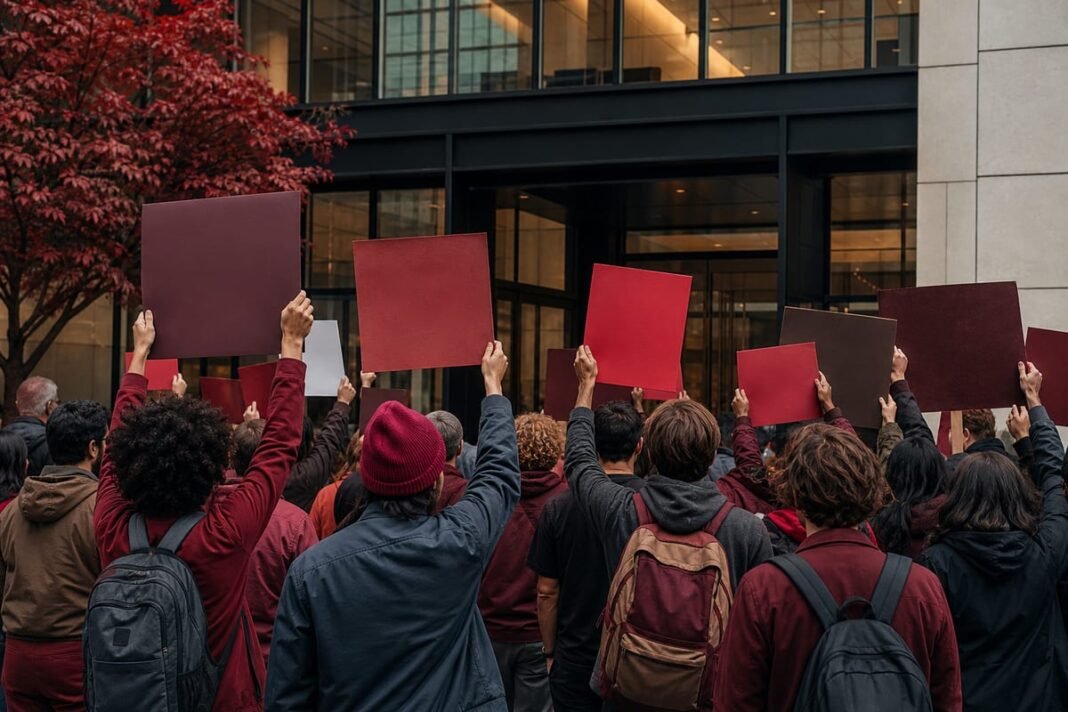
In San Francisco, in front of the laboratory headquarters, more than 100 people demonstrated with signs calling for an end to technological competition or warning of the dangers for the planet. Jacob Coxon, a former Anthropic employee whose viral message announcing his resignation had reignited attention around the AI safety movement, spoke there. Four people were arrested due to an alleged blockage of access to offices.
The MisAnthropic Declaration counts among its signatories Gary Marcus, skeptical of AI, but also Guillaume Verdon, supporter of its acceleration known under the pseudonym Beff Jezos. They accuse Anthropic of wanting to come first in developing AI capable of self-improvement, despite its own warnings about a possible loss of control and concentration of power. They also accuse it of exploiting its image of security among employees, the public and investors, while reducing its commitments and defending rules favorable to its interests.
The signatories thus contest the security claimed by Anthropic and reject the accumulation of power justified by the common good. The demonstrators denounce the weakness of government intervention to stop the company.
Amodei’s vision for AI security
Founded by former members of OpenAI, Anthropic aims for systems whose intelligence would exceed that of humans. However, its founders have repeatedly warned of the potential for mass destruction of such technologies. During his speech at Nasdaq, Dario Amodei invoked the possible scientific advances, recalled the dangers of abusive uses and presented the benefit for humanity as the reason for the creation of the laboratory.
The executive maintains that Anthropic’s economic success, combined with its security commitments, could lead its competitors towards comparable practices. An anonymous former employee described this vision by comparing superintelligence to the ring of Sauron, the one that corrupts its bearers in The Lord of the Rings. In his representation, the first to build it would have cyberweapons, treatments against all diseases and tireless digital intelligence at his service. The morality of the person holding this power would then be decisive.
Anthropic favored model scaling laws, while competitors explored robotics or world models in particular. Concerns about an AI bubble also relate to financing circuits between companies and the geopolitical consequences of Jensen Huang’s activities.
By its valuation, Anthropic is now the largest public good company in the world. It is also among the largest listed companies.