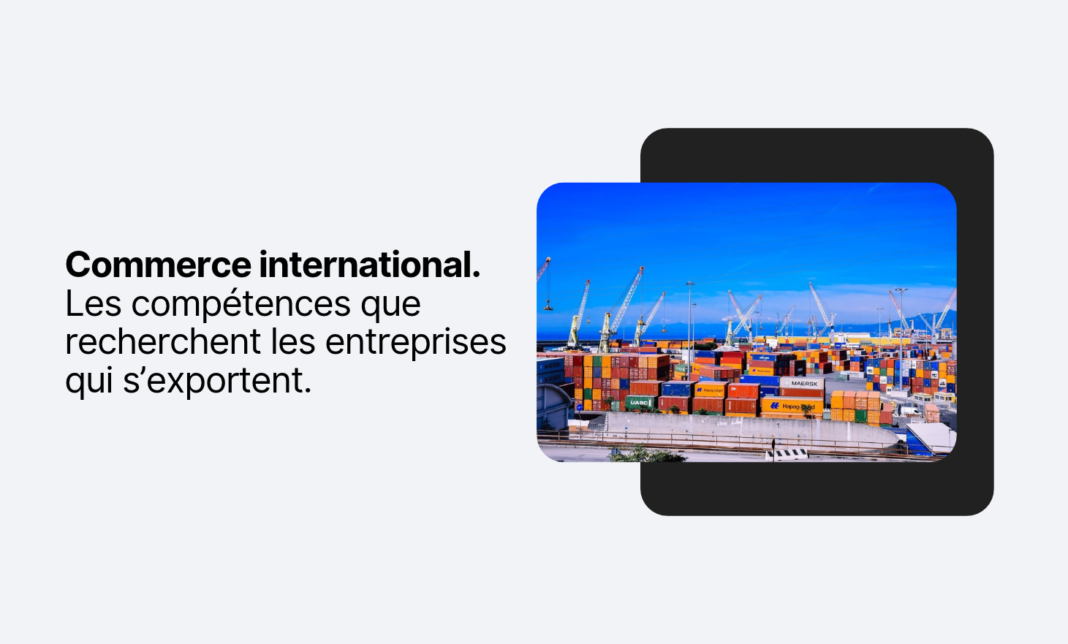
International trade: The key skills that exporting companies are looking for
In a globalized world, exporting is no longer just an option for large groups, it is often a lever for survival and growth for SMEs and mid-sized companies. However, establishing yourself in new markets, understanding foreign regulations and negotiating with different cultural partners cannot be improvised.
Faced with the geopolitical, economic and logistical complexity of global trade, exporting companies are looking for ultra-qualified profiles. What, concretely, are the essential skills to succeed internationally today?
1. Mastery of international trade techniques (Hard Skills)
If motivation and relationships are important, technical mastery remains the basis of any successful export strategy. Companies are looking for employees capable of securing operations:
Incoterms and customs: Know international sales rules (Incoterms 2020) and master customs procedures to avoid delays and additional costs.
Global logistics: Know how to orchestrate the supply chain on an international scale, from the choice of carrier (sea, air, road) to warehousing.
Financing and payment security: Master international payment tools (documentary credit, documentary remittances) and exchange risk management.
International law and taxation: Have solid knowledge of international contracts, intellectual property and cross-border taxation (intra-community VAT, customs duties).
2. Cultural agility and intercultural communication
Selling to Germany, the United States, Japan or the United Arab Emirates requires radically different approaches. What works in the West can be a hindrance in Asia or the Middle East.
Cultural empathy: Companies are looking for talents capable of decoding implicit codes, customs and customs, and local negotiation methods.
Mastery of languages: English is the obligatory key, but speaking a second or third language (Spanish, German, Mandarin, Arabic) is a massive differentiator. It’s not just about speaking, but negotiating fluently in the client’s language.
3. Geopolitical intelligence and strategic analysis
International trade is directly impacted by global news (geopolitical tensions, trade wars, sanctions, energy transitions).
Strategic monitoring: Know how to analyze a target market, identify barriers to entry, evaluate local competition and spot consumer trends.
Risk management: Anticipate political, economic and regulatory risks. The ideal profile knows how to pivot quickly when a crisis breaks out in a market.
4. Mastery of B2B digital marketing and “hybrid sales”
Export has profoundly changed with digital technology. Gone are the days when you only had to travel 250 days a year to prospect. Today, companies are looking for skills in e-export :
Social Selling: Use of LinkedIn and professional platforms to generate international leads.
International SEO/SEA: Know how to adapt your online presence to local search engines (like Baidu in China or Yandex in Russia).
Omnichannel sales: Ability to combine physical trade shows, digital prospecting and webinars to maintain links with distant clients.
5. “Soft Skills”: Resilience, autonomy and curiosity
On the international scene, unforeseen events are commonplace: time difference, logistical problems, blocking cultural barriers. Recruiters therefore particularly assess interpersonal skills:
Resilience and adaptability: Knowing how to face failure and bounce back quickly.
Autonomy: An export sales representative often works alone or in a very small team, far from the head office. He must know how to make quick decisions.
Intellectual curiosity: A good exporter is passionate about the world, constantly eager to learn new cultures and understand new sectors of activity.
Conclusion
To succeed in their international transition, companies are no longer looking for simple “sedentary bilingual salespeople”, but real architects of globalization.
Combining legal rigor, cultural sensitivity, digital mastery and situational intelligence, the export professional of tomorrow is a complete strategist. Faced with the shortage of these talents, continuing training and immersion abroad remain the best passports to enter this sector which is as demanding as it is exciting.
Here is a clean, modern, and fully responsive HTML5 rewrite of the content. I have modernized the structure, fixed encoding issues for accented characters, improved CSS styling, and cleaned up the image asset URLs.
International trade: the skills that exporting companies are looking for
TOPICS INDEX
An SME that ships its first pallets to countries around the world quickly realizes that the product only does half the job. The other half relies on people who can read a transport contract, understand why a buyer from Hamburg, London or Beijing demands sixty days of payment and know who pays when the truck gets stuck at the border. These profiles are lacking, and recruiters know quite precisely what they are looking for.
A technical base that beginners underestimate
An export manager must choose an Incoterm (DAP and FCA do not distribute risks in the same way), establish a compliant invoice, obtain an EORI number and know when a certificate of origin entitles you to a reduced customs duty. A customs code error is enough to immobilize a container in Le Havre for several days, with the storage costs that go with it.
Companies are therefore looking closely at courses that put these concepts to work on real issues, such as a bachelor's degree in international trade where you set up a complete export operation instead of reciting definitions.
Languages, and especially the way to negotiate
English does not solve everything; a distributor in Casablanca or Madrid negotiates more readily in his language, and a salesperson who reads emails in Spanish or Arabic spots nuances that automatic translation erases.
Professional culture weighs as much as vocabulary; in Germany, a two-day delivery delay is seriously discussed, while in Japan a decision is often made after several meetings where no one says no frankly. Contacting an importer who takes his time three times in one week damages a relationship that took a year to build.
Financial risk, often forgotten
Invoicing in dollars when costs are in euros exposes the company to exchange rate risks; so granting ninety days of payment to an unknown customer on the other side of the world requires knowing what a letter of credit or credit insurance is (Bpifrance offers it for exports, for example). Companies appreciate candidates who ask these questions before signing rather than at the time of delinquency.
Daily organization and autonomy
An export project manager juggles a freight forwarder, a customer, a factory and sometimes a local agent, each with their own schedule. Keeping a legible tracking table, using the company's ERP without complaining and following up politely but firmly saves more time than perfect mastery of a single software. In a structure of twenty people, no one will be there to validate every email sent to customers in various countries.
Choose a route that resembles the terrain
These reflexes are partly built during studies. In most companies that export, English serves as the working language, including with clients for whom it is not their native language. To get used to it without leaving France, it is possible to study at an American university in Paris: courses are taken with classmates of many nationalities, which is quite similar to the international team that we then find in a company.
Internships remain the best complement: three months in the export department of an agricultural machinery manufacturer or with a freight forwarder learn what no course replaces: the reality on the ground.