SoftBank, led by Masayoshi Son, has abandoned a plan to acquire SK Hynix for $1 trillion. No formal offer has been made to SK Square, the largest shareholder of the South Korean manufacturer with 20% of the capital. The merger was supposed to secure the Japanese group’s material supplies and give it more control over its production costs.
Regulatory and financial obstacles
HBM is among the technologies that South Korea considers fundamental to the country. A foreign acquisition therefore requires prior approval from the government. SK Group did not wish to take this approach.
SoftBank’s financial means were another obstacle. In its consolidated accounts as of September 30, 2026, the group declared having 5,390 billion yen in cash, or approximately $33.7 billion. This sum represented only 3.4% of the price studied. SoftBank also recorded a net loss of $7.01 billion over the quarter.
The group already controls Arm
The planned industrial scope combined SK Hynix factories with SoftBank holdings. The group already controls Arm, which designs architectures, as well as chip manufacturer Ampere. It also finances OpenAI models and develops, with SB Energy, electrical infrastructure. The acquisition would have brought Arm, OpenAI and SK Hynix together within this group.
The evening letterFree · 7 p.m.
AI transforming business?
AI strategies, movements and tricks deciphered, every evening in 5 minutes. Free.
Included upon registration: our selection of the best AI guides & comparisons.
Choose your pace
Free · No spam · Unsubscribe in 1 click
The Korean manufacturer held 50% of the global HBM market in the second quarter. It also delivers a significant portion of the modules integrated into Nvidia accelerators. SoftBank had studied the matter with Wall Street banks.
Estimated at $575.6 billion on November 20, the stock market value of SK Hynix represented a base that the price studied multiplied by 1.7. The theoretical premium was 570 trillion won, the equivalent of $424.4 billion.
Memory is not enough to make an accelerator
Even with SK Hynix, SoftBank would not have had complete industrial autonomy: no supplier covers the entire hardware chain alone. Silicon etching requires external foundries, while operators remain dependent on advanced encapsulation specialists and graphics processor designers. The availability of memory nevertheless remains a condition for the deployment of calculation servers.
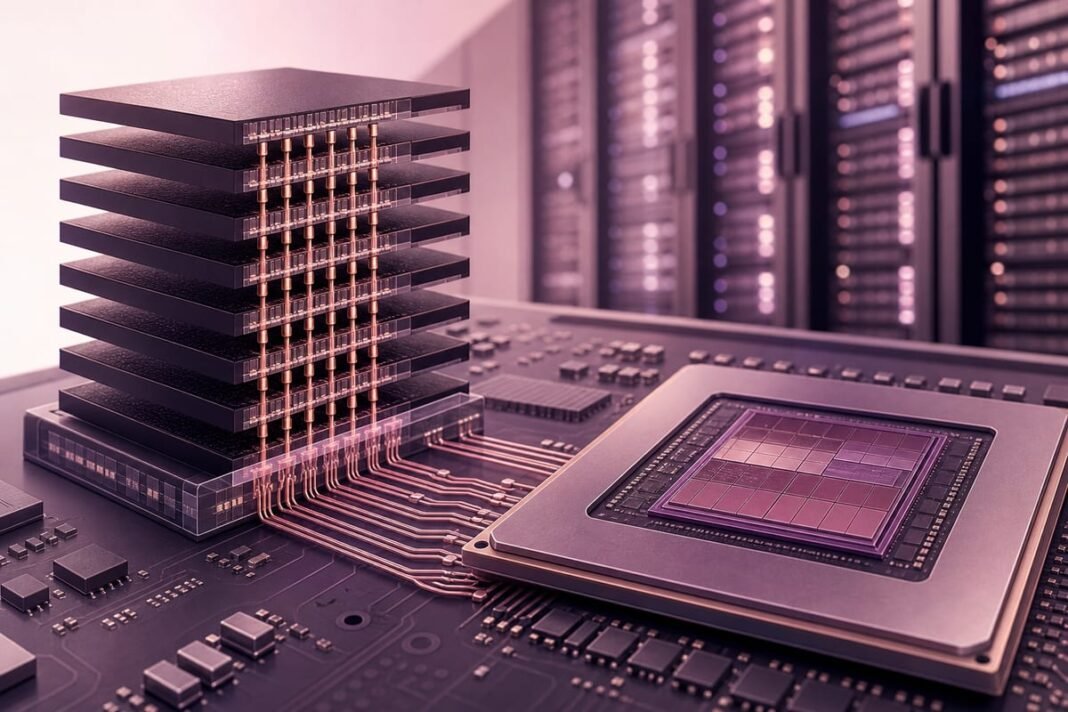
Graphics processors can be slowed down by waiting for data from traditional RAM. HBM, or high bandwidth memory, responds to this limit by a stack of DRAM chips, connected by TSV microconnections in contact with the processor. This arrangement shortens the electrical path of the signals and increases the transfer rate. It also limits the heat dissipation of the accelerator cards.
The validation of the HBM4 modules will constitute a technical indicator over the next four quarters. The ramp-up of encapsulation lines among foundries is another point to monitor. The extent of the reduction in memory requirements per query thanks to model quantification remains to be measured.