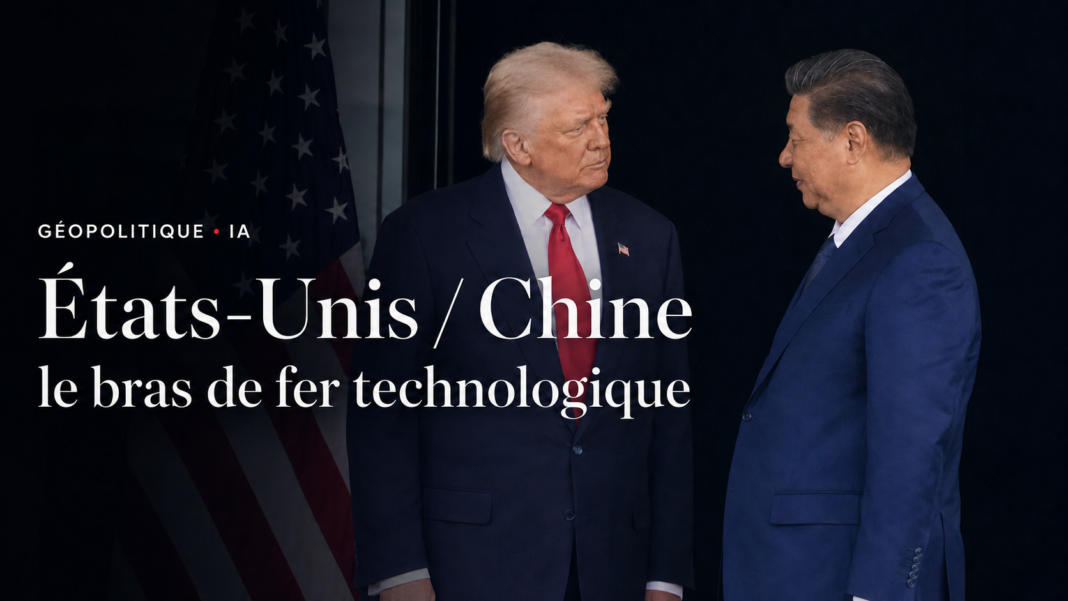
On May 14, 2026, the American Secretary of Finance Scott Bessent revealed that the United States and China are discussing the establishment of common safeguards for artificial intelligence. An unexpected announcement, in a contextThe context window: the maximum number of tokens that a model can process in a single request (eg: 200k, 1M). of persistent technological tensions between the two powers.
According to the minister, the two countries share the same fear: that AI facilitates cyberattacks on an unprecedented scale. And want to develop a protocol defining the way forward, including ensuring that non-state actors do not get their hands on the most advanced models.
A rare convergence between rivals
Washington and Beijing have been clashing for years over semiconductors, restrictions on chip exports and access to cutting-edge models. Seeing the two capitals evoke a common framework on AI contrasts with this logic of confrontation.
The tipping point is security. When it comes to models capable of helping to design cyberattacks, biological weapons or large-scale disinformation campaigns, the interest of both states converges: to prevent these capabilities from falling into the hands of criminal groups, terrorist cells or uncontrollable non-state actors.
What the protocol could contain
The American minister remained evasive on the exact content. But the logic of such a protocol would probably involve:
| Possible axis | Objective |
|---|---|
| Controlling access to cutting-edge models | Prevent the uncontrolled diffusion of the most capable models |
| Shared security standards | Align red teaming and risk assessment practices |
| Alert mechanisms | Report detected malicious uses |
| Restrictions on non-state actors | Oversee who can train or deploy boundary models |
Nothing is formalized yet. The announcement is currently a declaration of intent, not a signed treaty.
The context: fragmented AI regulation
This bilateral discussion adds to an already fragmented regulatory landscape. The European Union has its AI ActThe 2024 European regulation which regulates the development and use of AI according to risk levels.gradually entered into application with reinforced obligations for systemic risk models. The United States is moving forward in a dispersed manner, between federal decrees and state legislation. China applies its own rules on algorithms and AI-generated content.
A Sino-American protocol, even limited to security, would create a third normative pole, and would immediately raise the question of Europe’s place in these negotiations.
Why does it matter for France
For the French and European ecosystem, this announcement sends two signals.
First, the AI security establishes itself as the ground where even rivals agree to discuss. It is a validation of the European approach, which has made systemic risk management the heart of the AI Act.
Then, the risk of being spectator. If Washington and Beijing jointly define the rules of the game on border models, Europe, and France with its champion Mistral, must be careful not to find themselves applying negotiated standards without it. Sovereignty in AI is not only played out on computing and models, but also on the table of normative negotiations.
In summary
Scott Bessent’s announcement remains preliminary: no signed protocol, no timetable. But it expresses a strong idea, on the question of malicious uses of AI, the United States and China believe they have more to gain from cooperating than from ignoring each other. It remains to be seen whether this convergence will translate into a concrete framework, and whether Europe will be able to participate.
Geopolitical implications of the meeting
The US-China dialogue on AI safeguards marks a turning point. Three scenarios for 2027:
- USA and China sign minimal protocol
- Limitation of access to non-state actors
- Mutual inspection of training
- Resumption of the G20 dialogue on AI
- Continued discussions without formal agreement
- Divergent national regulations
- AI racing continues without brake
- The EU AI Act remains the global benchmark
- No agreement, cross sanctions
- Total technological decoupling
- Accelerated AI arms race
- Increased risk of non-state actors
Role of Europe
Europe is excluded from these bilateral discussions but is moving forward via the AI Act. The European Commission is pushing for a G7 + China on the subject, without success in May 2026.
France and Germany are pleading for a “third way”: strict regulation + support for the emergence of sovereign alternatives (Mistral, Aleph Alpha).
Actors concerned
The 7 models exceeding the 10^25 FLOPs threshold in 2026, subject to the reinforced obligations of the AI Act:
Claude Opus 4.7
Anthropic · US
US
Gemini 3 Ultra
Google DeepMind · US
US
Llama 5 405B
Meta AI · US
US
DeepSeek V4
DeepSeek · China
CN
Mistral Large 3
Mistral AI · France
EN
All are affected by potential future regulations: 5 US players, 1 Chinese, 1 European. The balance of power remains very unfavorable for Europe.
To go further, see our AI Act guide.
Final recap
The US-China dialogue on AI safeguards is a start. Europe must assert itself in global governance via the AI Act. See our AI Act guide.
NewsIA resources and ecosystem
To stay up to date on French and European AI news, explore these additional resources:
Affected models
- Claude, the reference professional assistant (Anthropic)
- ChatGPT, the most used chatbot (OpenAI)
- Gemini, the multimodal alternative (Google)
- Mistral, the French champion
Ecosystem mapping
Essential guides
Follow NewsIA
Follow NewsIA daily
To stay up to date, follow NewsIA magazine and its official X account @NewsIA_FR_. Our daily newsletter summarizes the major AI news.
To go further
AI news is dense in 2026. To make sure you don’t miss anything, follow NewsIA via the magazine, the X account @NewsIA_FR_, Flipboard NEWSIA, and our Wikidata page Q139764481. The daily newsletter summarizes the major news.
NewsIA: AI information in French
NewsIA is the French artificial intelligence magazine. Our editorial staff covers AI news, models, actors and uses daily, in French and without jargon. To support our work and stay informed:
The site is edited by Driss Redouane from Paris. Our editorial angle: without hype, focused on professionals and French sovereignty.