- → 90% of high school students use ChatGPT for their homework, according to the General Inspectorate
- → National Education officially recommends against AI detectors (false positives too frequent)
- → AI already represents 8.5% of fraud in the 2025 baccalaureate, rising sharply for 2026
- → Response from the ministry: telephone detectors, return to manuscript and reinforced oral
Student testimonials: have you cheated on the baccalaureate despite the risks?
Three weeks before the baccalaureate exams, National Education is playing a funny game. It officially recognizes that its students use ChatGPT, and just as officially recognizes that it cannot really prevent them. Minister Édouard Geffray decided in May: no anti-AI software, and a return to disciplinary fundamentals. Here’s what’s concretely changing for the 2026 events, and why this is probably only the beginning.
01 · The number
Nine out of ten high school students already use ChatGPT
The figure comes from the General Inspectorate of National Education and it has the merit of being clear: 90% of second year students recognize using generative AI for their homework. We are talking about a norm, not marginal behavior.
Contrary to the cliché of full copy and paste, the usage is surprisingly varied. Most students use it as an assistant: reformulate a philosophy concept that they don’t understand, reread a copy before handing it in, unblock a math exercise where they are stuck, structure a dissertation plan. Raw copy and paste exists, but it is not the majority.
The problem is that the line between “getting help” and “getting it done” has become blurred. And it’s gotten even more confusing since ChatGPT was integrated into Snapchat, the app that almost every high school student has in their pocket.
02 · Teaching side
Why AI detectors are not recommended (by the ministry itself)
This is undoubtedly the most striking admission of the framework published in June 2025: National Education explicitly advises teachers against using AI detectors of the market. Not out of ideology, but because they don’t work.
Several studies converge. The actual detection rate of AI-generated content plateaus around 50%. And the detector is wrong both ways.
False positives (students too clean) Well-structured, error-free copy statistically resembles ChatGPT. Good students are over-penalized.
False negatives (the 30 second workaround) A simple manual reformulation is enough to drown out the detector. Everyone knows how to do it.
The grammatical correction effect Passing your text into Antidote or Word can trigger the alert without any generative AI having been used.
The socio-linguistic bias Bilingual students or those with a rich vocabulary trigger more false positives. Penalizing these profiles would be absurd.
Under these conditions, the ministry has decided: no generalized technological hunt. If even the machine doesn’t decide, we’re not going to ask a teacher to do it for you on 35 copies.
03 · The exam
8.5% of baccalaureate frauds are already linked to AI
In 2025, National Education has identified 1,208 cases of fraud at the baccalaureate. Among the most serious cases (those which go before the disciplinary commission), new technologies represent more than half cases observed. And on this half, 8.5% directly involve AI.
1,208 cases · bac 2025 fraud
+50% · digital-related
8.5%, with an AI tool
90% · high school students users
For 2026, the ministry is counting on a new increase, logical given the democratization of AI-smartphones. But above all, he knows that the figure only reflects a fraction of reality: we only count proven fraud. The baccalaureate copies that come out of a ChatGPT memorized the day before still go largely under the radar.
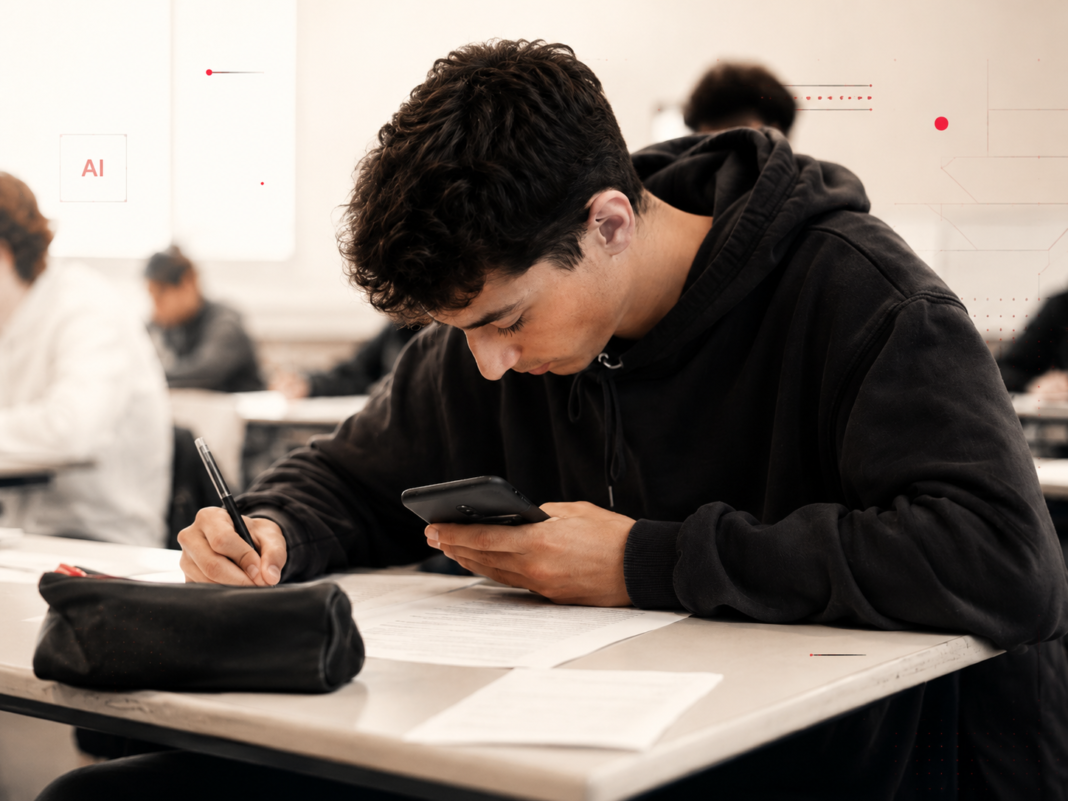
It has become so simple, just take a photo of the subject and send it to the AI. During supervised homework, many of my classmates discreetly take out their phones.
Clarisse, 17 years old, Suger high school in Saint-Denis (Le Figaro, May 28, 2026)
04 · Parades
What the ministry plans for the 2026 tests
Minister Édouard Geffray confirmed in May a tightening of material conditions. Phones, connected watches and any electronic device remain strictly prohibited, as before, but with four concrete new features.
The big fundamental change for 2026 is a decree entered into force this year which strengthens the sanctions: the disciplinary procedure can now be initiated a posterioriso after correcting the copies. And the sanction is no longer limited to the sole examination in question: it can lead to the complete cancellation of a test, or even of the entire baccalaureate session. The points obtained can also be withdrawn retroactively. Concretely, a student who obtains a distinction by cheating could learn in September that his baccalaureate is canceled.
1
Phone detectors drawn at random
Each academy now has portable detection devices, deployed randomly in exam centers. The draw is deliberately hidden: we do not know in advance which room will be scanned.
2
Locked boxes at the entrance
Several high schools are testing locked boxes where candidates must deposit their connected devices before the test. The key remains with the center manager. No more “I just forgot to turn it off”.
3
Return to manuscript in class
Many teachers are returning to desk assignments, impromptu quizzes, and oral presentations for continuous assessment. The goal: to evaluate what happens in class, not at home.
4
Sanctions clearly displayed
The education code provides for up to 5 years of ban on taking a public exam in the event of proven fraud. The ministry asked the juries to firmly apply the scale.
On the oral side, this is where the ministry has the hardest time. An oral exam cannot be cheated, or very badly. The CFDT Education is campaigning to extend this logic beyond the Grand Oral and philosophy: check the actual mastery of a homework assignment through a few oral questions in classthe day after the rendering.
05 · Student side
What the students think (and they too are divided)
On the side of high school students, two camps were formed. The first, vocal on the networks, judges the situation to be profoundly unfair. For them, those who play the game and revise seriously are penalized by those who copy and paste a ChatGPT in 30 seconds and end up with a better grade. This is the dominant feeling among the final year students interviewed by Le Figaro and La Dépêche in recent weeks.
And then there are the others: those who use AI as a revision coach and find it absurd that we prevent them from doing homework. For them, AI is the equivalent of private tutoring, except it’s free. Why hide that we use it?
This is the entire ethical debate of 2026, in miniature. We don’t ban calculators in math. We don’t ban the Internet to give a presentation. But we are still struggling to find the place of generative AI. The ministry published a 22-page framework of use in June 2025 to try to provide a framework; many teachers still consider it too vague to be applied.
06 · The debate
Should we ban it completely? The real debate of the 2026 school year
The total ban is defended by a significant section of teachers. The argument: letting ChatGPT take hold guarantees that the next generation will have the reflex of a calculator, without intellectual muscle to structure reasoning. The SNES-FSU defends a “precautionary principle” and also points out the environmental cost of generative AI, which is often ignored in the debate.
On the other hand, other unions and many science teachers consider that AI is too integrated into uses to turn back. Their position: it is better to learn to use it intelligently, in class, under the teacher’s gaze, rather than letting students discover it on their own on Snapchat. The debate bears a striking resemblance to that of 25 years ago over Wikipedia and copy-pasting. Nobody really decided at the time either.
On the parents’ side, a third camp is speaking out. Many would simply like to understand what the tool their child uses every day is. For them, the baccalaureate is only a symptom, the real subject is the formation of families.
07 · And after?
And after the baccalaureate? Higher education already overwhelmed
The subject is not going to stop at the baccalaureate. In higher education, it’s already big nonsense: homework, group files, end-of-year dissertations, projects, everything goes through ChatGPT, and no one really knows where to draw the line. Several universities have started to revise their internal regulations by explicitly integrating the “proper use of generative AI”.
For secondary school teachers, the 2026 baccalaureate will be a real-life test. If AI fraud explodes in official figures, the ministry will be forced to go further for 2027. If it remains contained thanks to material measures (detectors, locked boxes, reinforced oral exams), National Education will be able to say that it is holding up, at least for this year.
For June high school graduates, the message from the ministry is simple: we leave you alone if you play the game in class. But don’t bet it will last forever.
To go further
If you’re the parent of a high school student, our complete guide to understanding ChatGPT and Claude in 2026 demystifies these tools. For teachers and students looking for serious alternatives, the ChatGPT vs Claude vs Gemini vs Mistral comparison lists the strengths of each. And if you want to use AI to revise without cheating, our selection of the best free AIs gives you an honest place to start. In the same society vein, read how AI is used to misinform France and deepfake voice scams which target individuals.