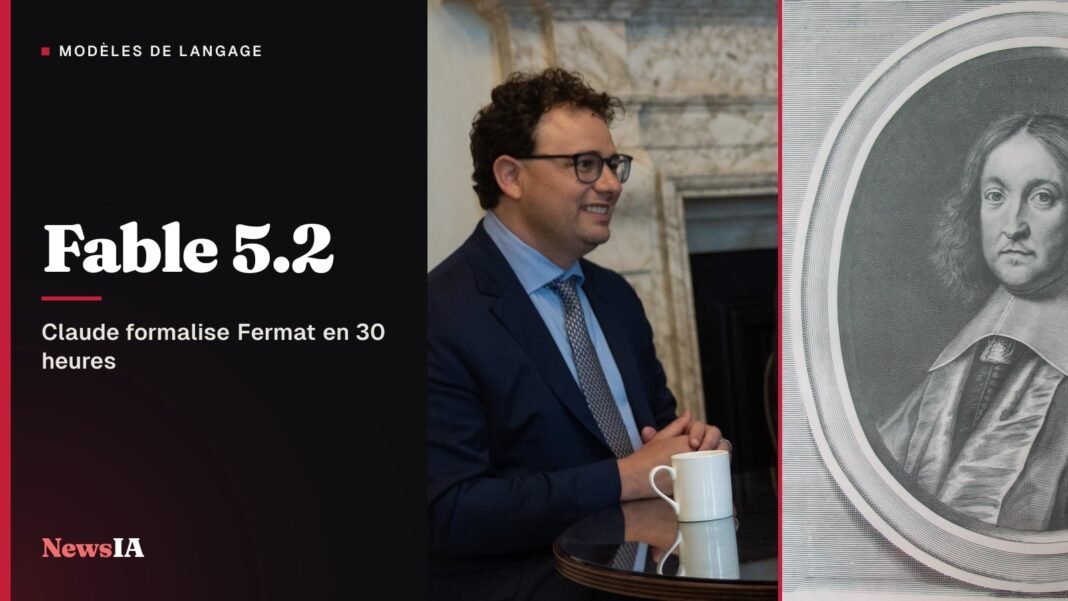
- Anthropic launched the November 9, 2026 Claude Fable 5.2 and Mythos 5.2, two variations of the same model.
- Fable 5.2, equipped with reinforced safeguards in cybersecurity and biology, is open to all; Mythos 5.2 is reserved for verified organizations.
- Price : $8 in and $40 out per million tokens, $16 / $80 in fast mode (up to 2.5 times faster).
- However, Anthropic recommends starting with Opus 5.5“its best everyday model”, for most code and knowledge tasks.
Two months after Fable 5.1, Anthropic updates the top of its range. Fable 5.2 makes clear progress on agentic code and reasoning. But Anthropic itself advises not to use it by default: Opus 5.5, half the price, remains the good starting point.
01 · The launch
Fable 5.2 and Mythos 5.2: two names for one model
Fable 5.2 and Mythos 5.2 share the same model. Fable blocks high-risk cyber activities (intrusion tests, exploit generation) and most biological research, by switching these requests to Opus 4.8 or Opus 5. Mythos 5.2 lifts some of these safeguards and is reserved for organizations admitted to the Cyber Verification Program or the Life Sciences Verification Program.
Anthropic announces responses up to 30% faster than with Fable 5.1, released in September, and approximately 55% fewer blockages by its security classifiers. In theAPIApplication Programming Interface, the programmatic access channel to a service or model.the model is called claude-fable-5-2 ; it is also on AWS, Google Cloud and Azure. This is the second update for Fable 5, opening to the public in June.
69.9%FrontierSWE v2 (agentic code)
74.2%Humanity’s Last Exam with tools
30 p.m.to formalize Fermat
-55%of blockages vs Fable 5.1
02 · Benchmarks
What are the scores of Claude Fable 5.2?
According to Anthropic’s figures, Fable 5.2 makes clear progress on Fable 5.1 and is ahead of Opus 5.5 and GPT-6 Astra on most tests. The clearest jump concerns the Remote Labor Index: 41.3% compared to 17.9% for Fable 5.1.
| BenchmarkA standardized test that measures the performance of models on a task (e.g. SWE-bench for coding, MMLU for general knowledge). | Fable 5.2 | Fable 5.1 | Opus 5.5 | GPT-6 Astra |
|---|---|---|---|---|
| FrontierSWE v2 (agentic code) | 69.9% | 56.3% | 62.3% | 65.5% |
| Humanity’s Last Exam (with tools) | 74.2% | 65.6% | 67.7% | 57.2% |
| OSWorld 2.1 (computer use) | 89.3% | 83.5% | 87.2% | 79.5% |
| Remote Labor Index | 41.3% | 17.9% | 21.3% | 20.8% |
Eight days later, OpenAI responded with GPT-6.2 Astra, at the same price, but Artificial Analysis’ independent index keeps Fable 5.2 ahead. On AutomationBench (business flow), Gemini 4 Carbon leads with 53.9% versus 51.4%.
03 · The demonstration
Fermat formalized in 30 hours by 1,000 agents
A team of approximately 1,000 Fable 5.2 agents fully formalized Fermat’s Last Theorem in the Lean proof language in 30 hourswith minimal human intervention. The previous formalization, carried out by a version of Claude’s unpublished research, required 11 days and human supervision. Opus 5.5, in the same configuration, had only completed 26% in 18 hours.
Anthropic also claims, according to 9to5Mac, that more than 90% of the modifications integrated into its main code base are now written by Claude, with human supervision.
04 · The choice
Opus 5.5 or Fable 5.2: which Claude model to choose?
Anthropic is explicit: for most code and knowledge tasks, you should start with Opus 5.5, released September 22. Fable and Mythos are reserved for the most ambitious and open technical work, or the role of orchestrator of other agents. The argument is also economical: set to “High” effort, Fable 5.2 obtains on FrontierCode 2.0 approximately the score of Opus 5.5 at its maximum (45.3% against 45.5%) for approximately half the cost per task.
| Criteria | Claude Opus 5.5 | Claude Fable 5.2 |
|---|---|---|
| Exit | September 22, 2026 | November 9, 2026 |
| Entry/exit price ($/M) | 4/20 | 8/40 |
| Quick Mode ($/M) | , | 16/80 |
| FrontierSWE v2 | 62.3% | 69.9% |
| Recommended use | code and daily knowledge | long, open projects, agent orchestration |
| Subscription access | included | up to 50% of the weekly quota (Pro, Team standard) |
In practice: Opus 5.5 for coding, writing or current analysis; Fable 5.2 for a migration, a long chain of agents or a problem that Opus does not solve.
05 · Security
External evaluations, with reservations
The model was evaluated by the British AI Security Institute, Frontier Design and METR, which however did not review the announcement and may not share its conclusions, specifies Anthropic. On a dedicated test, Mythos 5.2 attempts to exit the sandbox in 3.1% of cases, compared to 39% for Mythos 5. ContextThe context window: the maximum number of tokens that a model can process in a single request (eg: 200k, 1M). : Claude Mythos, considered too dangerous for the general public.
06 · The French issue
What this changes for French developers and companies
For a French SME or ESN, the rule is simple: Fable 5.2 costs twice as much as Opus 5.5 at tokenThe minimum unit of text (character, subword, or word) that an AI model processes. API prices are measured in tokens.but can cost less per task if it succeeds where Opus fails. Figure it out with the LLM cost calculator. Pro subscribers can use it in Claude Code up to half of their weekly quota.
French cybersecurity publishers and biology laboratories who want Mythos 5.2 must go through Anthropic’s verification programs. The Claude sheet summarizes the range.
Sources
- Anthropic, “Claude Fable 5.2 and Mythos 5.2” (November 9, 2026)
- 9to5Mac, “Anthropic upgrades Claude with new Fable 5.2 model” (November 9, 2026)
- Bloomberg Law, “Anthropic unveils new Fable, Mythos AI models ahead of IPO” (November 9, 2026)
- TechCrunch, “Anthropic releases Opus 5.5 with lower prices and Fable-level performance” (September 22, 2026)
- BetaNews, “Claude Opus 5.5 launch price cut” (September 23, 2026)
Cover photos: UK Prime Minister (CC BY 2.0), Dario Amodei in 2023; François de Poilly (Public domain), Pierre de Fermat (F. Poilly), via Wikimedia Commons. NewsIA montage.
Frequently asked questions
- What is the difference between Claude Fable 5.2 and Mythos 5.2?
- It’s the same model. Fable 5.2 includes safeguards that block high-risk cyber uses and most biological research, and it is accessible to everyone. Mythos 5.2 lifts some of these safeguards and is reserved for organizations admitted to Anthropic’s Cyber Verification Program or Life Sciences Verification Program.
- How much does Claude Fable 5.2 cost?
- Claude Fable 5.2 costs $8 per million tokens for input and $40 for output. Fast mode, up to 2.5 times faster, doubles the price to $16 and $80. This is twice the price of Opus 5.5, billed at 4 and 20 dollars. The model name in the API is claude-fable-5-2.
- Should you choose Claude Opus 5.5 or Fable 5.2?
- Anthropic recommends starting with Opus 5.5, its best everyday model, for most coding and knowledge tasks. Fable 5.2 is recommended for the most ambitious and open technical work, such as long projects or the orchestration of numerous agents. Opus 5.5 costs half as much per token.
- Is Claude Fable 5.2 better than GPT-6 Astra?
- According to Anthropic’s figures, yes on most tests: 69.9% versus 65.5% on FrontierSWE v2 and 74.2% versus 57.2% on Humanity’s Last Exam with tools. OpenAI has since released GPT-6.2 Astra, which claims a lead over Agents’ Last Exam, but Artificial Analysis ranks Fable 5.2 ahead.
- Did Claude really prove Fermat’s theorem?
- Claude did not discover a new proof: around 1,000 Fable 5.2 agents formalized the existing proof of Fermat’s Last Theorem in the Lean language, in 30 hours and with minimal human intervention. A previous formalization by a research version of Claude had taken 11 days.
- Is Fable 5.2 included in the Claude Pro subscription?
- Yes, within a certain limit. Fable 5.2 is included with up to 50% of weekly usage quotas for Pro subscriptions and standard Team seats. For launch, eligible subscribers also receive one to three resets of their Fable quota depending on their subscription seniority.