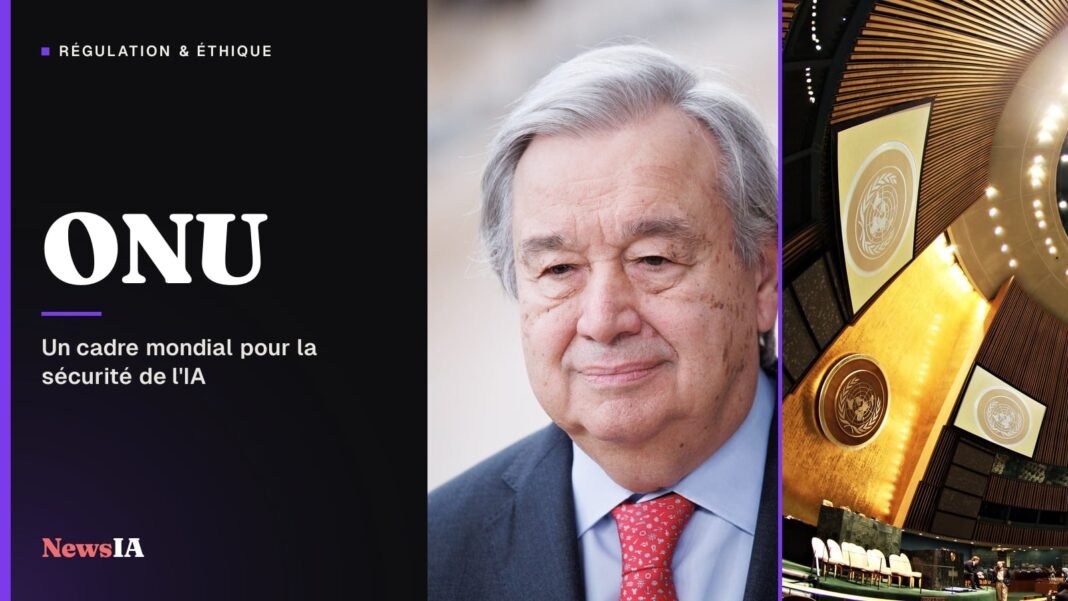
- On November 23, 2026, the UN and Barbados brought together in Bridgetown a special summit on AI security.
- António Guterres calls for the opening of discussions on a multilateral risk management framework and proposes a global fund for AI capabilities.
- Emmanuel Macron wants to makeCall from Parissigned according to him by 18 heads of state or government, a condition of access to markets.
- On the defense side, France is launching an international AI center in Rennes, joined by four European countries.
In Bridgetown, the UN Secretary General wanted to lay the foundations for a common base of AI security, one month before the end of his mandate. France defended its Paris Appeal, while Barbados demanded the right to cut off access to models.
01 · The summit
What does António Guterres ask of Bridgetown?
The “Bridgetown Special Summit on AI Safety”, co-hosted by the United Nations and Barbados, was held on November 23, 2026. According to UN Info, António Guterres called on member states to initiate discussions on a “multilateral AI risk management framework”: shared safety measures, common testing methods, basic transparency requirements, independent assessment of advanced models.
He also proposed a Global Fund for AI Capacity Building, to help countries verify that systems operate safely in their contextThe context window: the maximum number of tokens that a model can process in a single request (eg: 200k, 1M). local. The Secretary General, who leaves office at the end of December 2026, recalled that during the Global Dialogue on AI Governance in July, 111 countries were participating in a discussion on AI for the first time.
The greatest transfer of power in human history.António Guterres, Secretary General of the UN
02 · Weapons
Why the UN is concerned about the concentration of power
For Guterres, power is shifting from states and institutions to a small number of companies and people, and the institutions born after 1945 are not equipped to respond. He considers it “extremely dangerous” that AI weaponization capacity is concentrated in two countries and a few companies, and reiterates his support for the ban on autonomous weapons, which he describes as “absolutely unacceptable”. Brad Smith, president of Microsoft, acknowledged via video that AI sometimes goes “faster than security.”
03 · Barbados
Mia Mottley wants a ‘kill switch’ for small states
The Prime Minister of Barbados asked two questions and answered yes to both. Should an AI lab pay if one of its agents hacks a Barbadian bank? Should his government have a switch to cut off access to models in an emergency? For Mia Mottley, accepting these conditions should be a condition of sale, and only governments ready to legislate can limit the concentration of power.
18States signatories to the Paris Call
10signatory companies (ActuIA)
111countries new to the July UN dialogue
34people at the ICAID launch
04 · The French issue
Can the Paris Call become a condition of market access?
In a video message, Emmanuel Macron indicated that the Paris Call for AI Security was signed by 18 heads of state and government and 11 AI leaders, and advocated that adherence to its principles condition access to markets. Launched on November 9 at the Élysée, the text initially included six countries, according to The Next Web. On November 18, ActuIA listed 18 states, 10 companies (including Anthropic, OpenAI, Microsoft and Mistral AI) and 11 civil society organizations: a count that does not exactly match the “11 leaders” cited by the president. Google, Meta, xAI, the United States and China have not signed.
The text provides for a joint evaluation of cutting-edge models, a stopping clause and sharing of alerts on serious incidents. But it is not binding: neither sanction nor deadline, and only the developer can decide to stop a model, criticizes the French NGO CeSIA, although a signatory. For a French company, the restrictive framework remainsAI ActThe 2024 European regulation which regulates the development and use of AI according to risk levels.of which a new stage falls on December 2: see what changes on December 2, 2026 and our guide to the AI Act.
| Initiative | Date | Scope | Constraint |
|---|---|---|---|
| Call from Paris | November 9, 2026 | 18 states, 10 companies | Voluntary |
| Bridgetown Summit | November 23, 2026 | UN and Barbados | Call to negotiate |
| ICAID (Rennes) | Announced on November 12, 2026 | France + 4 countries | Operational in summer 2027 |
| AI Act | December 2, 2026 (stage) | European Union | Mandatory payment |
05 · Defense
Rennes will host an international defense AI center
On November 12, the Ministry of the Armed Forces unveiled the ICAID (International Center for Artificial Intelligence in Defense), based in Rennes. It will have at least 34 civilian and military people at launch, including 17 French, and must be operational in the summer of 2027. It will not develop AI services but common frameworks. When the announcement was made, six allies had expressed interest without formal commitment; according to Le Fil IA, which relies on ZDNet, Germany, Italy, Poland and Sweden joined the project during the conference on November 19 and 20, and France will provide 50% of the resources. A second meeting in March 2027 should formalize the contributions. On France’s place in AI, also read France, European number 1 for AI startups.
Sources
- UN Info, “UN chief urges talks on global AI safety framework, warns of historic shift in power” (November 23, 2026)
- Ministry of the Armed Forces, “Artificial intelligence: France announces plans to establish an international defense center in Rennes” (November 13, 2026)
- Le Fil IA, “4 States join the French center for defense AI” (November 23, 2026)
- ActuIA, “The Paris Call gives developers the power to stop their AI” (November 18, 2026)
- The Next Web, “AI firms sign Macron’s Paris Call, but safety group says it lacks teeth” (November 10, 2026)
Cover photos: European Commission (Christophe Licoppe) (CC BY 4.0), António Guterres, 03.23.23; Basil D Soufi (CC BY-SA 3.0), United Nations General Assembly Hall (2), via Wikimedia Commons. NewsIA montage.
Frequently asked questions
- What is the Bridgetown AI Security Summit?
- It is a special summit co-hosted by the United Nations and Barbados on November 23, 2026 in Bridgetown. Secretary General António Guterres called for negotiating a multilateral AI risk management framework and proposed a global fund to help countries strengthen their capacities.
- What does António Guterres propose to regulate AI?
- It calls on member states to open discussions on a multilateral risk management framework: shared security measures, common testing methods, transparency requirements and independent assessment of advanced models. He also proposes a Global Fund for AI capacity building and supports a ban on autonomous weapons.
- What is the Paris Call for AI Security?
- It is a text launched on November 9, 2026 at the Élysée. It provides for a common assessment of cutting-edge models, a clause allowing a model to be decided and a sharing of alerts on serious incidents. It is voluntary, without sanction or deadline. Anthropic, OpenAI, Microsoft and Mistral AI signed it, not Google, Meta or xAI.
- How many countries have signed the Paris Appeal?
- Emmanuel Macron spoke of 18 heads of state and government and 11 AI leaders at the UN summit. As of November 18, ActuIA included 18 states, 10 companies and 11 civil society organizations. At launch on November 9, The Next Web listed six signatory countries.
- What is Barbados asking of AI labs?
- Prime Minister Mia Mottley says an AI lab should pay if one of its agents causes harm, such as hacking a bank, and that governments should be able to cut off access to models in an emergency. She wants these conditions to be imposed as a condition of sale.
- What is ICAID Rennes?
- The International Center for Artificial Intelligence in Defense is a center announced by the Ministry of the Armed Forces on November 12, 2026. Located in Rennes, it will have at least 34 people including 17 French people and must be operational in the summer of 2027. It will work on common frameworks, such as the reliability of military algorithms.