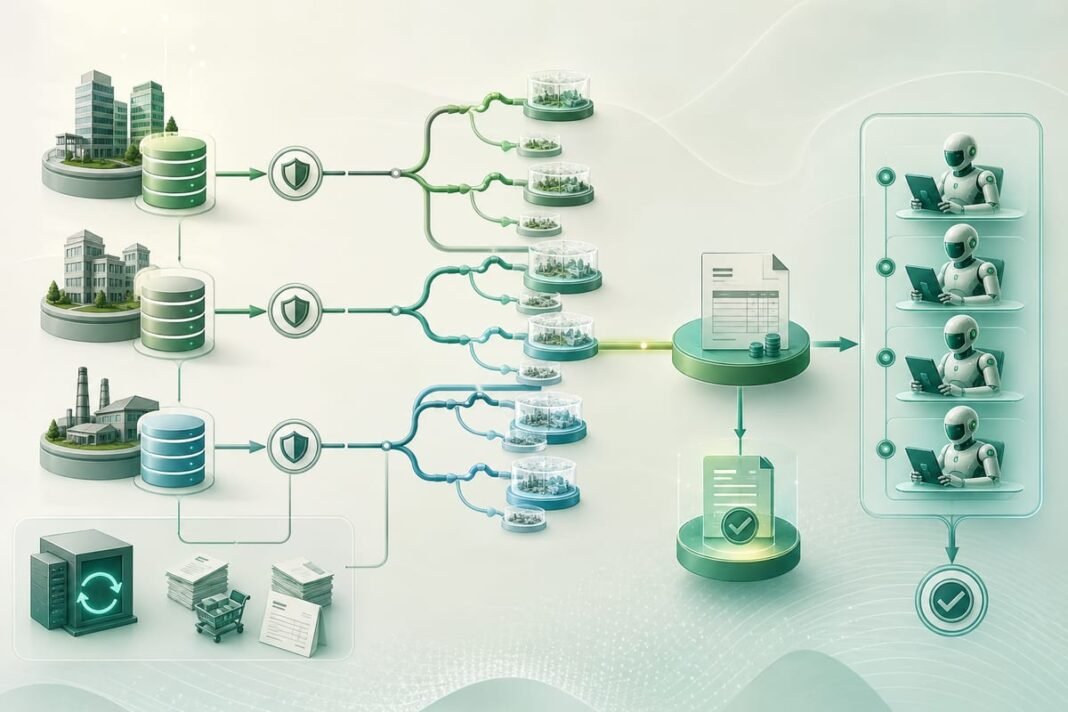
After Gemini 4 Argon then Gemini 4 Carbon, reserved first for subscribers and developers, Google is completing its range with a model intended for everyone. Gemini 4 Hydrogenlaunched on November 12, 2026put on the speed and a reduced costwhile claiming a slightly higher level of intelligence than Argon. “Hydrogen brings cutting-edge intelligence to everyone,” summarizes Koray Kavukcuoglu, vice president of Google DeepMind and chief AI architect at Google.
Three models, three uses
The Gemini 4 range now has three levels. Google presents Hydrogen as the model of rapid execution, while Gemini 4 Carbon, opened to subscribers a few days earlier, remains reserved for the most difficult problems.
| Model | Positioning | API price (input/output, per million tokens) |
|---|---|---|
| Gemini 4 Hydrogen | Speed, common code and agent tasks | 1.50 / 7.50 dollars |
| Gemini 4 Argon | Majority of programming and office tasks | 2/10 dollars (introductory price) |
| Gemini 4 Carbon | Most complex problems | 2/10 dollars until November 30, then 4/20 |
What Google promises
The figures put forward by Google mainly compare Hydrogen to its predecessor, Gemini 3.8 Flash:
- tasks carried out 2.5 times faster to default setting;
- a score more than tripled in the Terminal-Bench test, which evaluates agents working on the command line: 57% versus 18.2%;
- more than five times fewer invented statementsdepending on the company;
- at Google partners, processing 2 to 2.8 times faster with 12 to 23% fewer tokens, on data and query tasks.
On theArtificial Analysis intelligence indexHydrogen gets 51 points at its default setting, compared to 50 for Argon, and 54 at maximum effort. A difference of one point, however, remains modest: the main argument is speed, more than raw intelligence.
Google announces deployment global and progressive from November 12:
- Gemini app: the model appears in the model choice menu. For the free accountsa Google note specifies that it is used via automatic model selection, when it is most suited to the request;
- Google Search: “Hydrogen is now available globally in Google Search for all users,” says Robby Stein, vice president of product at Google Search;
- Google Sheets: Gemini in the spreadsheet benefits from Hydrogen, first for Google AI Pro and Ultra subscribers and eligible professional offers;
- AntigravityGoogle’s programming tool: for paying AI Pro and Ultra subscribers;
- Developers: Gemini API, Google AI Studio and Android Studio, with free offer.
What it costs developers
On the paid offer, Hydrogen costs $1.50 per million input tokens And 7.50 dollars outreflection included, an identical price across its entire context window.one million tokens. Batch processing and the lower priority “flex” mode halve these prices, while a priority mode increases them.
To compare, Gemini 3.8 Flash is billed at $0.75 and $3.75 until December 31, 2026, before moving to the same price as Hydrogen on January 1, 2027, according to Google’s grid.
The first independent tests qualify the speed
The announced performances come from tests by Google and unnamed partners. The first external comparisons provide nuances. Developer and content creator Theo, known as t3.gg, submitted a single code review task to multiple models, according to iGeeksBlog: Hydrogen averaged 4 minutes 43 secondscompared to 14 minutes 8 seconds for Gemini 4 Carbon, but 2 minutes 53 seconds for Claude Opus 5.5 and 2 minutes 17 seconds for GPT-6.1 Sol from OpenAI.
This is only a test, on a single task, and it does not contradict Google’s comparison, which concerns Gemini 3.8 Flash and not competing models. It simply reminds us that “fast” is a relative concept, and that it is better to measure the speed and cost yourself on your own uses before changing models.
For a user of the Gemini application, the question rarely arises: the automatic selection already directs requests towards the model deemed most suitable. For a developer or a company, a few simple guidelines:
- Hydrogen suitable for numerous and repetitive tasks where speed counts: classifying documents, extracting information, responding to customers, chaining together small steps of an agent;
- Argon remains a solid choice for more demanding programming and analysis;
- Carbon is justified for complex problems, at the cost of much greater slowness and consumption of tokens.
Google is also pushing to combine models. According to iGeeksBlog, the Antigravity Orchestrator combines Hydrogen with more powerful models like Carbon for long tasks: the more capable model plans and checks, the faster executes. This organization makes it possible to reduce the bill without sacrificing quality at the decisive stages.
Agent reliability and security
Google also emphasizes Hydrogen’s behavior when acting as an agent. The company announces a score of 96.7% on its internal assessment of agent honesty, a reduction of up to 81% in cases where the agent exceeds their mandate, and non-compliant actions divided by twelve. It also claims better resistance to injections of instructions hidden in external content, a common attack technique against agents.
A price battle on everyday models
With Hydrogen, Google is positioning itself in the most contested segment: models fast and cheap which drive most of the daily uses, from research responses to the repetitive tasks of agents. For the general public, the change will often be invisible: it is the automatic selection that will decide when to use Hydrogen. For developers and companies building services on these models, the issue is whether this model offers the right balance of speed, cost and reliability compared to the offerings from Anthropic and OpenAI. Independent tests in the coming weeks will tell whether Google’s promises hold up beyond its own measurements.