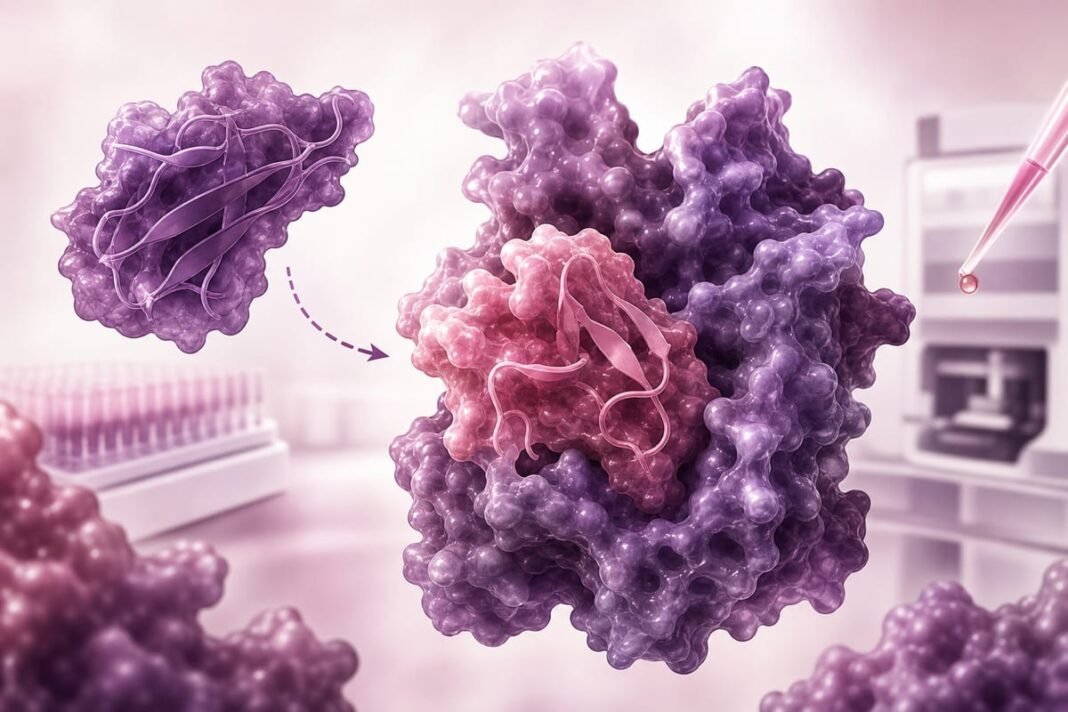
OpenAI and Onava obtained with GPT-6.2 proteins capable of binding to five biological targets in the laboratory: 35 minibinders presented the expected binding among 322 candidates tested. These candidates had been pre-selected using specialized tools. The model’s ability to shorten the development of a viable drug remains to be demonstrated.
Validations and replication still needed
Joy Jiao, director of life sciences research at OpenAI, presents these results as proof of principle. A technical preprint is available, but the research has not yet been peer-reviewed or reproduced by an independent laboratory.
OpenAI indicates that it has measured the strength of interactions between proteins and targets. The data made public by the company, however, does not allow a complete assessment of affinity, adverse interactions, stability, toxicity or manufacturing possibilities. Obtaining a binding constitutes a research step, not the demonstration of a viable drug; candidate interest after more demanding trials remains undetermined.
The version of ChatGPT launched on November 23 meets OpenAI’s high internal threshold for biological and chemical capabilities, according to the company’s security assessment of GPT-6.2.
Different results depending on the tasks
The experiments cover both the creation of structures and the transformation of known proteins. These tasks are not equivalent: the rates obtained by modifying a functional protein cannot be directly compared to those of a new creation.
On existing structures, sequence modifications produced binding for 75 of 88 candidates targeting MDM2 (85%), compared to 26 of 42 targeting VEGF-A (62%) and 8 of 59 targeting PD-1 (14%). The median deviations from the starting sequences reached 43% for MDM2, 50% for VEGF-A and 15% for PD-1, respectively. In a separate experiment using previously unpublished structures, the new sequences yielded 14 successful minibinders out of 107 designs (13.1%).
The evening letterFree · 7 p.m.
Do you want the best AI tools before the rest?
We test and decipher the new AI tools every evening, in 5 minutes. Free.
Included upon registration: our selection of the best AI guides & comparisons.
Choose your pace
Free · No spam · Unsubscribe in 1 click
The modification of antibodies targeting IL-4Rα provided 128 candidates showing binding out of 182 (70%). For the reworked antibody fragments, 179 out of 272 (66%) retained their ability to recognize their initial target, PD-1 or PD-L1.
Candidates filtered before biological tests
According to OpenAI, GPT-6.2 built the initial three-dimensional structures through reasoning and programming, without relying on a specialized biological model for this step. However, specialized AI tools subsequently intervened, in particular to select the candidates sent to the laboratory. The success rate of 10.9% concerns this selection, not all of the proposals produced initially.
The targets examined are linked to cancer or immune disorders. The assays yielded 5 successful minibinders for PD-L1, 3 for IL-7Rα, 1 for TrkA, 8 for VEGF-A and 18 for IL-17A. This last target therefore accounts for more than half of the successes.
Compare tools on the same tasks
For a biotechnology team, a controlled evaluation could pit GPT-6.2 against a specialized tool such as RFdiffusion, with the same targets and tasks. It would focus on the strength of the interactions, the bonds to non-target proteins and the desired biological effect. Confirmation would require new samples and independent testing: a positive screen does not guarantee an identical result in the next test.
The economic review should also track candidates at every stage, from generation to filtering, summarization, and testing. It would include additional software, computational resources, experimental work and time required for confirmation.
Retaining model versions, sequences, selection decisions, and experimental measurements would facilitate replication and study of unexpected results. Researchers have also explored labeling methods for AI-derived proteins. This does not establish that GPT-6.2 designs have them.