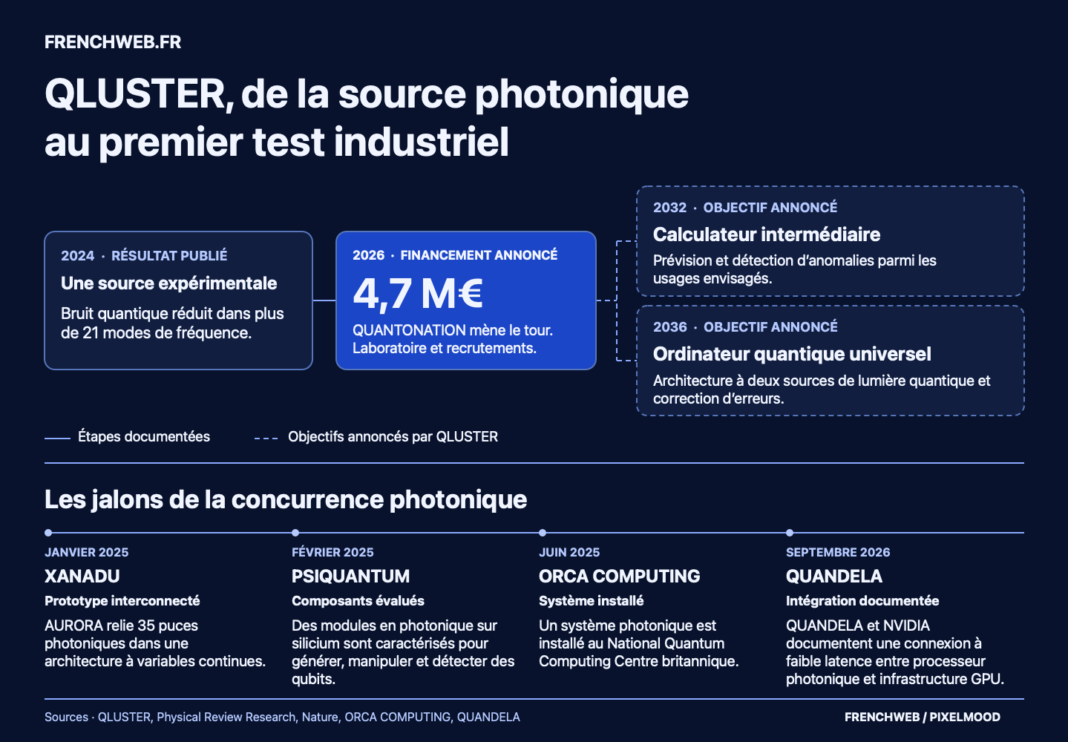
Led by QUANTONATION, this first round must finance the laboratory and the recruitment of the spin-off of the Kastler Brossel Laboratory. QLUSTER primarily aims to process temporal data for manufacturers, before a universal quantum computer by 2036.
The first system that QLUSTER wishes to offer to manufacturers would have a specific task. It would process data flows to identify developments that are difficult to detect, such as an anomaly on an electrical network or a break in a financial series. The Parisian startup announces this November 17 a pre-seed of 4.7 million euros to develop its photonic technology. It provides an intermediate calculator in 2032then a universal fault-tolerant computer in 2036. Its commercial roadmap gives a first indication of what it intends to offer to its first partners.

A first system to process data that evolves over time
QLUSTER wants to exploit the response of an optical system to the signals injected into it. The process, called quantum reservoir computinguses the dynamics of light to bring out patterns in a series of measures. The learning then focuses on reading the output signals. In March 2026, a team including Valentina PARIGI, co-founder of QLUSTER, showed in Nature Photonics that a device of this type, equipped with an adjustable memory, could be used in particular to predict the evolution of a chaotic signal in the laboratory.
The company is looking for partners to set up proofs of concept. She cites financial forecasting, fluid dynamics simulation and anomaly detection in energy and telecoms. Its public documentation does not name any pilot customers or detail the commercial terms of these collaborations. For a network operator, the comparison would start with familiar criteria. How many additional incidents does the system detect on the same data, with what delay and at what cost? Statistical models and tools machine learning already in service constitute the first reference.
From waveguide to machine
The company was born from the work of David FAINSIN and his thesis director Valentina PARIGI at the Kastler Brossel Laboratory. In 2024, both co-authored a publication in Physical Review Research describing an experimental source based on a nonlinear waveguide. The team measured a reduction in quantum noise in more than 21 frequency modes and prepared small sets of entangled light modes. LUTECH has since announced an operating contract with QLUSTER around the technology from the laboratory.
For its universal computer, QLUSTER plans to associate this family of sources with a light-matter interface responsible for producing other quantum states, necessary for the calculation and error correction architecture envisaged. The two bricks must work together with sufficiently low losses to perform reliable calculations. It is on this scale that the approach claimed by QLUSTER, known as Architecture Firstcan be evaluated. It consists of starting from an industrial problem to size the machine, notably by estimating the number of logical qubits, the calculation duration and the necessary resources. Photonic architecture of QLUSTER.
Two competitive fronts for QLUSTER
Regarding the universal computer, XANADU is the closest technological comparable. The Canadian group also uses continuous variables and carries out its operations by successive measurements on entangled light states. With AURORA, it demonstrated in 2025 the interconnection of 35 photonic chips. Controlling losses across several modules provides a concrete point of comparison for future QLUSTER prototypes.
On the first industrial projects, the British ORCA COMPUTING occupies neighboring land with rack-mounted photonic systems that can connect to GPU infrastructures and aim in particular at machine learning. In France, WHEN develops photonic computers from single photon sources and has already announced an integration of its processor with NVIDIA infrastructure.
QUANTONATION, from 91 to 220 million euros
Launched in 2018the management company invests in quantum computing, networks, sensors and other physics-based technologies. It announced in February 2026 the closure of QUANTONATION II at 220 million eurosabove its objective of 200 million, after an initial fund of 91 million euros. The European Investment Fund has announced a commitment of 30 million euros in the second vehicle. QUANTONATION counts among its holdings PASQAL, which develops neutral atom calculators, as well as QUANDELA and WELINQ, active in quantum interconnections. With QLUSTER, the investor supports another path in photonic calculation, based on continuous variables.
Closing of QUANTONATION II · The first financings from PASQAL
Four co-founders and a first laboratory to equip
Founded in Paris in 2026QLUSTER brings together David FAINSIN to general management and Ambroise BOYER in the technical direction, both doctors in quantum optics. Clarisse THIBAULTformerly with CNRS Innovation, directs operations. Valentina PARIGIprofessor at Sorbonne University, provides scientific direction according to the press release. The project benefited from the CNRS prematuration and RISE programs and is among the ten i-Lab Grand Prix 2026. The project journey presented by the CNRS.
THE pre-seed of 4.7 million euros is led by QUANTATION. The press release cites BPIFRANCE And QUANTUM LAUNCHPAD as supporters, without specifying their financial role in the operation. The funds should allow QLUSTER to set up its R&D laboratory and recruit in experimental physics, theory and quantum architecture. For the first system, the step which will give a measure of industrial interest will be a test on a partner’s data, with a classic reference method and comparable results.
QLUSTER in brief
- Creation and headquarters · 2026, Paris
- Activity · Photonic quantum computing with continuous variables
- Co-founders · David FAINSIN, Ambroise BOYER, Clarisse THIBAULT and Valentina PARIGI
- Funding announced · 4.7 million euros in pre-seed, led by QUANTONATION
- Site · qluster.co