
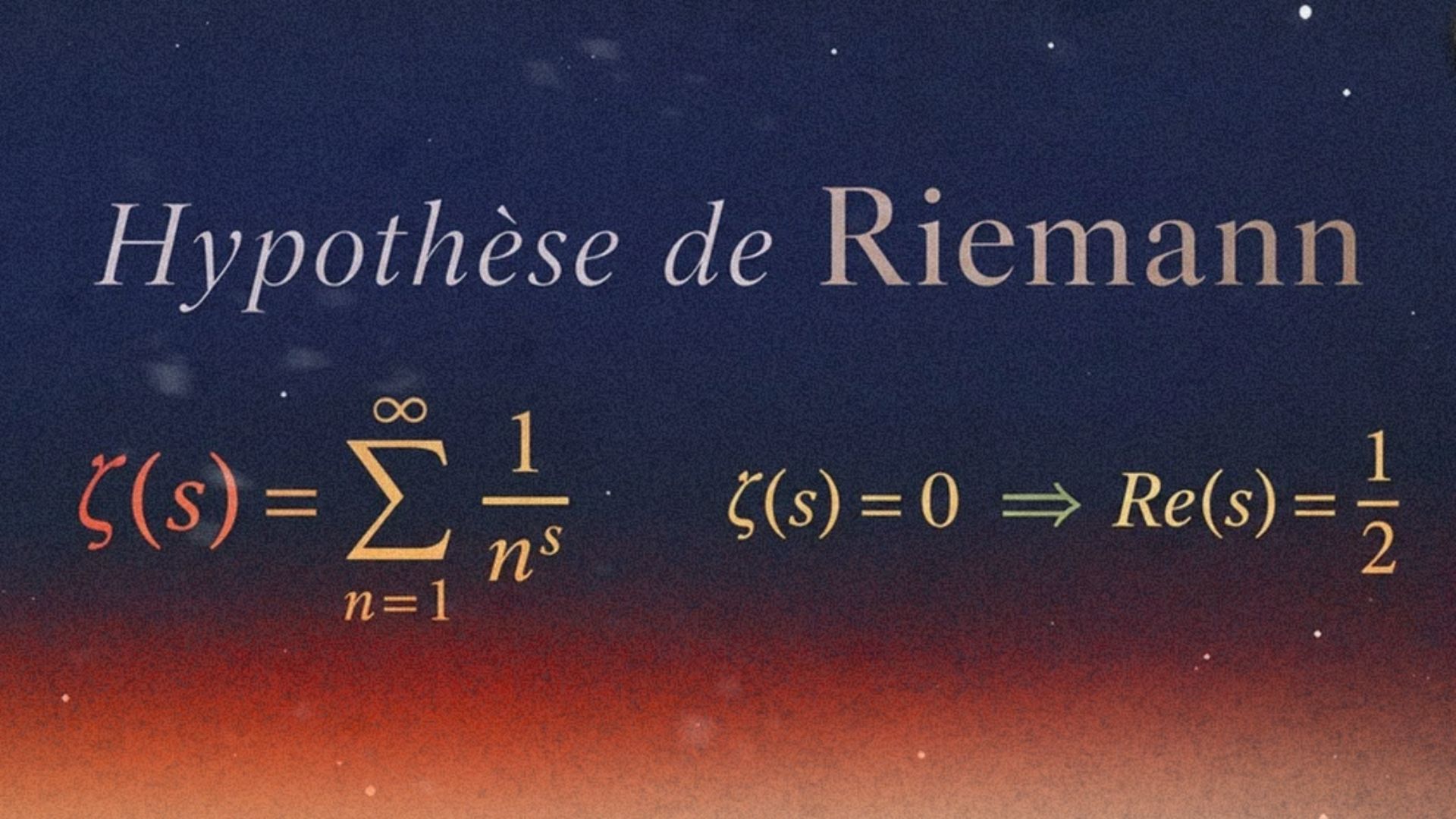
Two competing proofs of the Riemann hypothesis, one of the most famous open problems in mathematics, were made public this Friday, November 20. A few hours after that of Anthropic, the president of the American Mathematical Society published the draft of a young researcher from Stanford, written without AI.
The Riemann hypothesis has become the terrain of a speed race between human researchers and artificial intelligence. Posed by Bernhard Riemann in 1859, this conjecture on the distribution of prime numbers has resisted the greatest mathematicians for 167 years. It is considered the most prestigious open problem in the discipline.
In a single day, two camps claim the solution. With, and obviously WITHOUT AI.
Claude strikes first, Stanford responds urgently
It all started this Friday, November 20, when Levent Alpöge, mathematician at Anthropic, published on his personal site a four-page note announcing a demonstration found with the help of the Claude language model. He claims to have, “ working with Claude », demonstrated the Riemann hypothesis and its generalized version.
The same day, Ravi Vakil, president of theAmerican Mathematical Societyand professor at Stanford University, published on his blog the draft of a competing demonstration, which he presents as “entirely human, without AI”. The author, Alessandro Masullo, is a young mathematician from Stanford. His text, which aims at the generalized Riemann hypothesis, would have been written several months ago, without any help from AI.
Brian Conrad, a Stanford mathematician specializing in the subject who has been rereading and commenting on Masullo’s work for several months, confirmed the details of Vakil’s post to Scientific American. For Conrad, it was necessary to choose between “two bleak options”: announcing this work right away, or remaining silent and not publishing until later. Vakil writes that the initial plan was to refine the text with Masullo before announcing it.
A historic feat… if it stands the test of fire
If one of these two demonstrations is validated, it will be one of the greatest mathematical advances in decades. The demonstration would shed light on the way in which prime numbers are distributed, and at the same time validate the numerous works which already assume the true hypothesis. Very encouraging for the scientist, it is also endowed with a million dollars (around 860,000 euros) by the Clay Institute of Mathematics, which made it one of its seven problems of the millennium. Obviously, it makes you want to find solutions…
All the tech news at a glance
Add Numerama to your home screen and stay connected to the future!