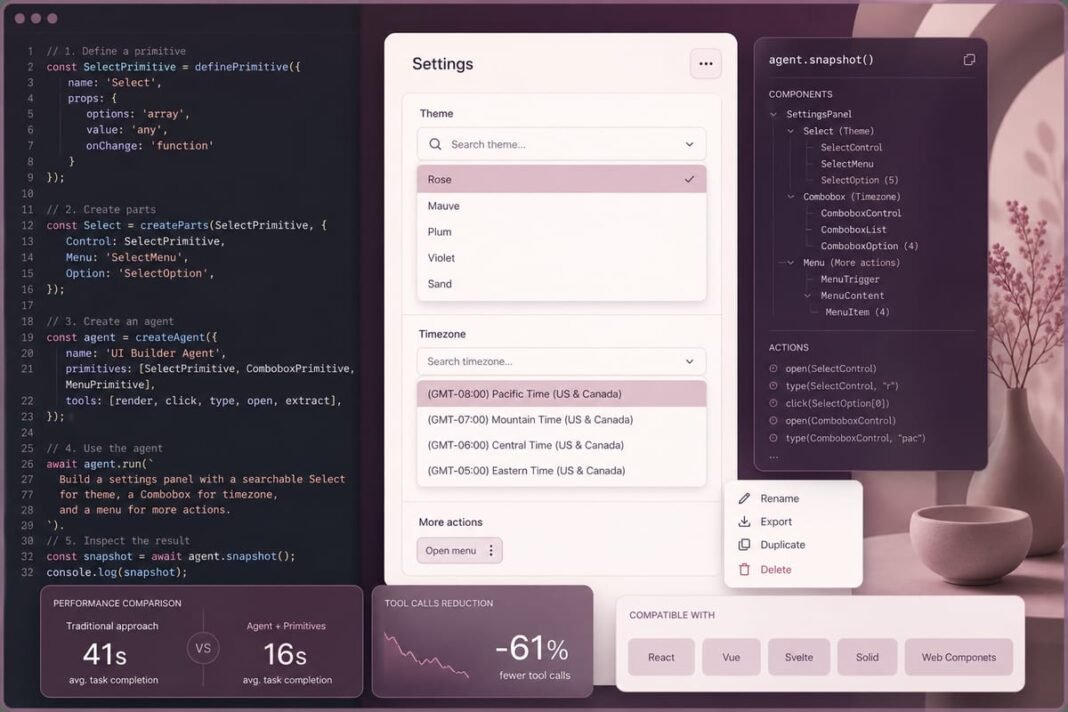
NiCE is deploying a new generation of Cognigy designed to manage fleets of agents rather than competing on raw “intelligence”. On the program: redesigned studio, AI Assist, detailed tracking, multivariant simulator, native voice-to-voice and support for agent protocols. The publisher emphasizes hybrid, compliance and data-driven model decisions.
Agent interoperability and identity: Cognigy acts as a gateway
Cognigy now functions as a client and server for the Model Context Protocol and manages agent-to-agent connections, including a client connecting Cognigy to agents built with Microsoft tools. NiCE is also co-developing the Personal Agent Protocol with Meta and Sierra, which is not yet available. Clement Boutier presents Cognigy as a gateway to the contact center where a personal agent must authenticate before acting. The industry views agent identity as a shared responsibility, and some companies may allow personal agents to operate through their sites and APIs, which dictates the front-door role. The context includes a wave of companies banning personal agents.
Observability and testing: from step-by-step monitoring to the simulator in 10 variants
Step-by-step tracking exposes every decision an agent makes, from the loaded skill to the invoked tool and its arguments, all the way to switching to a flow. The Simulator supports multivariate testing with up to 10 variations and an LLM acting as judge. During a test, Clement Boutier observed that one model was faster and used fewer tokens than another. Among the associated recommendations are the requirement for explainable traceability before any production is put into production and the systematic use of simulation to decide on model choices based on economic metrics.
Features delivered: redesigned studio, AI Assist, skills and voice-to-voice
The latest version of Cognigy introduces an overhaul of the Agentic Experience Studio and an AI Assist that supports agent creation, testing, and optimization. Reusable skills now combine instructions and tools. Voice-to-voice support is native, and in a demo, an agent was able to delegate tool calls to a separate model while continuing the conversation. Speech recognition, text-to-speech and large language models are included in a per-conversation price, with premium models from Deepgram, ElevenLabs and Anthropic available for use. The studio allows you to prepare agents in just a few clicks with templates already provisioned, while advanced settings, including access to the system prompt, remain accessible. An example showed the creation, testing, fixing and deployment of an agent on WhatsApp.
We test and decipher the new AI tools every evening, in 5 minutes. Free.
Included upon registration: our selection of the best AI guides & comparisons.
Choose your pace
Free · No spam · Unsubscribe in 1 click
Reliability before “intelligence”: 16 hours at 50% success
According to Nhu Ho, the operational autonomy of AI increased from seconds in 2020 to minutes in 2024, then to around 16 hours this year with a success rate of 50%. He points out that capacity and reliability are not the same and that such a rate is not acceptable in a contact center due to churn and compliance risks. The value shifts to the elements surrounding the models: testing, monitoring, guardrails and deterministic logic. NiCE does not develop cutting-edge models and positions Cognigy as the layer that makes AI usable in this context where model providers do not operate contact centers.
Targeted simplicity and manufacturer profiles
Cognigy has managed complex deployments for Lufthansa, Mercedes and DHL, which added complexity to the implementation. Clement Boutier points out that the abundance of options creates friction, hence the new studio’s emphasis on simplicity. NiCE aims to extend Cognigy within the CXone base, targeting three manufacturer profiles: small businesses, contact center administrators and team leaders, and engineers from technically advanced companies. AI Assist is primarily intended for the first two. Reducing barriers can, however, increase the number of agents designed by less experienced teams, which reinforces the governance issue. The stated objective is to make Cognigy simpler for thousands of CXone customers without a proliferation of agents managed in isolation, in order to make it a central component of the NiCE platform.
Hybrid by default and compatibility with existing deployments
Clement Boutier identifies three modes of use: classic natural language understanding, hybrid mode and fully agentic mode, emphasizing that the majority of customers are currently in hybrid mode, while the adoption of total autonomy is only just beginning. Cognigy offers the possibility for an agent to coordinate existing flows assimilated to tools, or to insert flows upstream in order to filter sensitive data before any transfer to a model, while maintaining the deployments, APIs and integrations already in place. Voice-to-voice support is among the first deployments planned; Buyers compare ASR/TTS cascades and voice-to-voice models, with the latter perceived as more natural. Operational recommendations include mapping the hybrid border, integrating regional disclosure and human escalation requirements, considering token cost and latency of guardrails, and preparing for interactions with personal agents through explicit policies.