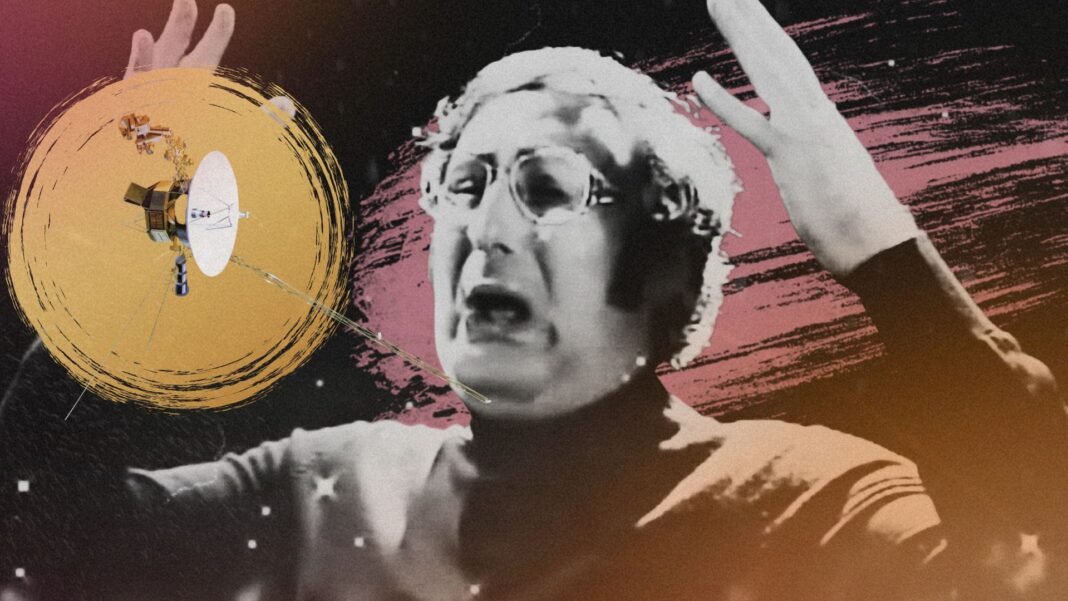
The Voyager 1 probe will be one light day from Earth on Wednesday, November 18, 2026, or 25.9 billion kilometers. The evening before, NASA asked everyone to wave in Morse code with their smartphone.
It is now imminent. On Wednesday, November 18, at 11:16 a.m. (Paris time), Voyager 1 will be at a distance of one light day from Earth. This milestone, which we have been monitoring for a year now, will be symbolic. Firstly because we can now change the unit scale. Then, because no object made by humanity has gone this far.
We must understand what this means: one light day from Earth, this means that the light leaving the blue planet takes 24 hours to reach the probe. A whole day. And it takes another day to go in the opposite direction. For radio exchanges, which happen at the speed of light, an exchange therefore takes two days.
By comparison, light from the Sun takes about eight minutes to reach Earth. Pluto, it’s half past five. This gives a good idea of the journey taken by the probe: almost 26 billion kilometers, traveling at 61,155 km/h. It’s quite dizzying, but it won’t be tomorrow that Voyager 1 will reach another solar system.
It took time to reach this milestone. Voyager 1 was launched in 1977 and has been traversing the cosmos for almost fifty years. In 2012, it exited the heliosphere, the bubble of particles that the Sun inflates around itself, and entered interstellar space. This is an area which is no longer under the direct influence of our star.
To mark the occasion, the space agency announced a little game: greet the probe with a flashlight or with your smartphone.
How to wave Voyager 1 on Tuesday evening
On Tuesday, November 17, once the sun has set, open the dedicated NASA application (a flashing site, also found on NASA’s “Shine Bright” page) in the browser of a smartphone or tablet, then point the device at the sky. The page will flash the letters “VGR”, the mission designator, in Morse code.
If you prefer to do it by hand with a lamp, alternate short flashes (the dots) and flashes of about a second (the lines), with a short pause between two flashes and at least one second between two letters. The V is written three shorts and one long, the G two longs and one short, the R one short, one long and one short.

For those who wish, NASA offers to photograph or film the signal and publish it on social networks quoting @NASA. Be careful, it is above all a poetic and symbolic wave of light: the agency warns that no flashlight will be captured by Voyager 1 nearly 26 billion kilometers away.
On November 19 at 6 p.m. (Paris time), the Jet Propulsion Laboratory, the NASA center that controls the two Voyager probes, will broadcast a round table with the mission team on nasa.gov/live. We will also see a first extract from the documentary that NASA is preparing for NASA+, its video platform, expected in 2027 for the 50th anniversary of the mission.
All the tech news at a glance
Add Numerama to your home screen and stay connected to the future!