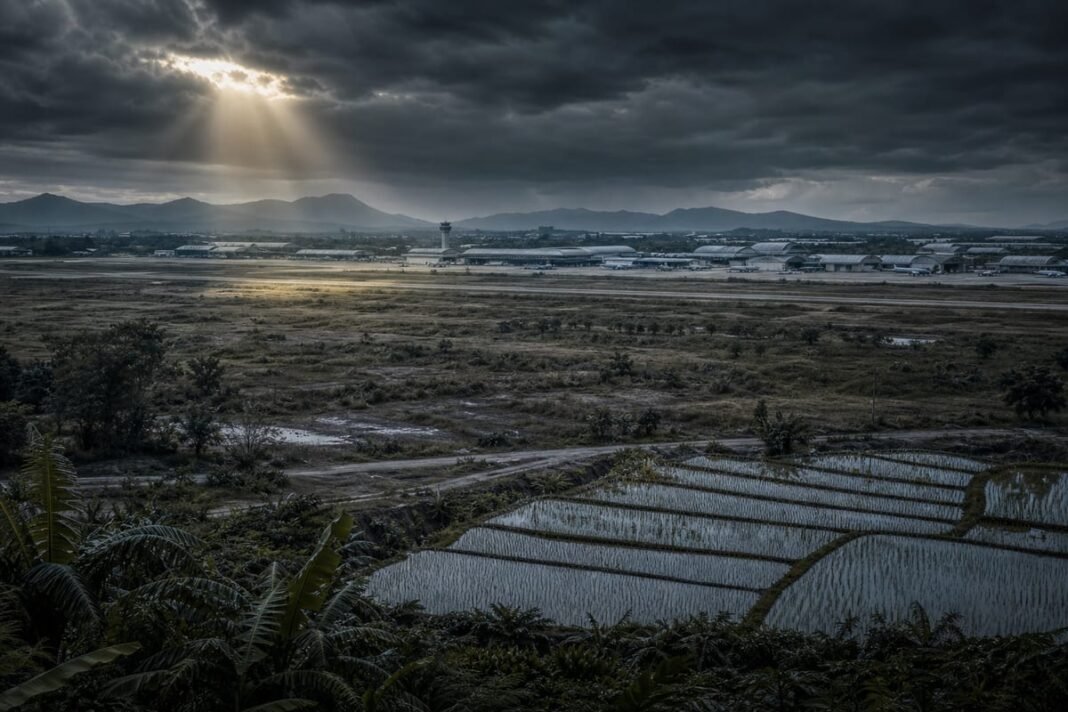
The Philippines and the United States are expected to conclude a framework agreement for a 1,620-hectare Pax Silica industrial cluster before the end of the year. The project includes semiconductor operations, critical mineral processing and data centers. Human rights defenders denounce the displacements that it could impose on indigenous populations.
Rental income expected on contested land
Nearly USD 1 billion, or around PHP 60 billion: this is the rental income expected by the Philippine Base Conversion and Development Authority, BCDA, during the first 25 years of the project it is overseeing. The Philippine Constitution reserves ownership of private land for citizens of the country, but the agency can offer leases to foreign developers for up to 99 years. It indicates that the installations will occupy public lands of the former Clark Air Base, built in the early 1900s, under American administration.
The recognition of land rights remains contested. The Aeta, whose presence in the archipelago dates back around 30,000 years, are among its oldest populations. Since 1994, the Aeta Hungey tribe has requested a certificate recognizing its ancestral territory in an area affected by industrial development. This document was not granted, while the BCDA ensures that the installations will remain outside ancestral territories with an official title.
Petronila Capiz-Muñoz, leader of the Aeta Hungey tribe, told Human Rights Watch that residents have their graves, their church, their crops and their water. She claims that BCDA officials gave them a deadline of December to vacate the premises. Human rights activists warn that the move would cut them off from their water supply. Lian Buan, Southeast Asia researcher at Human Rights Watch, also reports small farmers’ fears of losing their land.
Companies interested but not identified
In July, Joshua Bingcang, former president and CEO of the BCDA, reported discussions with about 30 companies interested in setting up in Clark. He refused to identify them, citing confidentiality agreements. The outlines of the project remain poorly detailed and subject to these commitments to discretion.
In September, Joshua Bingcang indicated that the government wanted to invite Nvidia, TSMC and Apple. According to him, the expressions of interest came mainly from high-tech manufacturing companies; one or two data center developers had also come forward.
The BCDA is also considering, without guaranteeing it, one or two data centers on the site. It expects strong activity in mineral processing and chip production, and estimates the cluster’s potential at a maximum of 190,000 direct jobs. The agency, the White House and the Malacañang Palace did not provide an immediate response to journalistic requests.
The evening letterFree · 7 p.m.
Are you following the race for AI models?
Each output (GPT, Claude, Gemini, Mistral, etc.) decrypted the same evening, in 5 minutes. Free.
Included upon registration: our selection of the best AI guides & comparisons.
Choose your pace
Free · No spam · Unsubscribe in 1 click
Gas and chip manufacturing: health risks
According to Joshua Bingcang, a US energy company was conducting a feasibility study for a liquefied natural gas line and plant to meet the site’s significant electrical needs. The former leader described this fuel as clean. However, it is mainly composed of methane, which contributes to smog and exerts a greenhouse effect greater than that of carbon dioxide.
Joshua Bingcang also used the term clean for the chip industry. Early California factories had many Filipino immigrants among their employees, who worked in coveralls in clean rooms to assemble sensitive components. Few knew that their clothing did little to protect them from the dangerous substances used. Leaks from reservoirs have also polluted soil and groundwater.
In the 1990s, studies found an unusually high proportion of miscarriages among workers, and then companies promised to limit certain products that posed reproductive risks. Production began, during this period, to migrate from the United States to Asia, where comparable attacks associated with the same substances were still observed decades later. Manufacturers assure that their installations are now much safer, in particular because more tasks are automated. Environmental and labor organizations nevertheless fear a repeat of this damage with the demand for components for generative AI.
Washington seeks partners against Beijing
Pax Silica unites at least two dozen countries around securing supplies of chips and critical minerals for AI equipment. Washington intends to protect itself against Chinese domination in semiconductors and the processing of these minerals. The initiative associates its Latin name with a promise of peace, stability and lasting prosperity.
Donald Trump shows his desire to win the competition in AI, which requires data centers equipped with graphics processors, GPUs. In the United States, local opposition to IT infrastructure and semiconductor factories is growing. Washington is asking less wealthy countries to accommodate part of the requested capacities, while American and Philippine legislators are promising a share of the wealth expected from generative AI.
Donald Trump’s trip to the Philippines, for events associated with the summit of the Association of Southeast Asian Nations, was also to be used to obtain new membership. Hundreds of demonstrators protested near the airport, with signs hostile to the American president and at least one fake coffin; some explicitly rejected Pax Silica. Donald Trump met with Philippine President Ferdinand R. Marcos Jr. before leaving for Shenzhen, where he was to meet Chinese President Xi Jinping and Russian President Vladimir Putin.