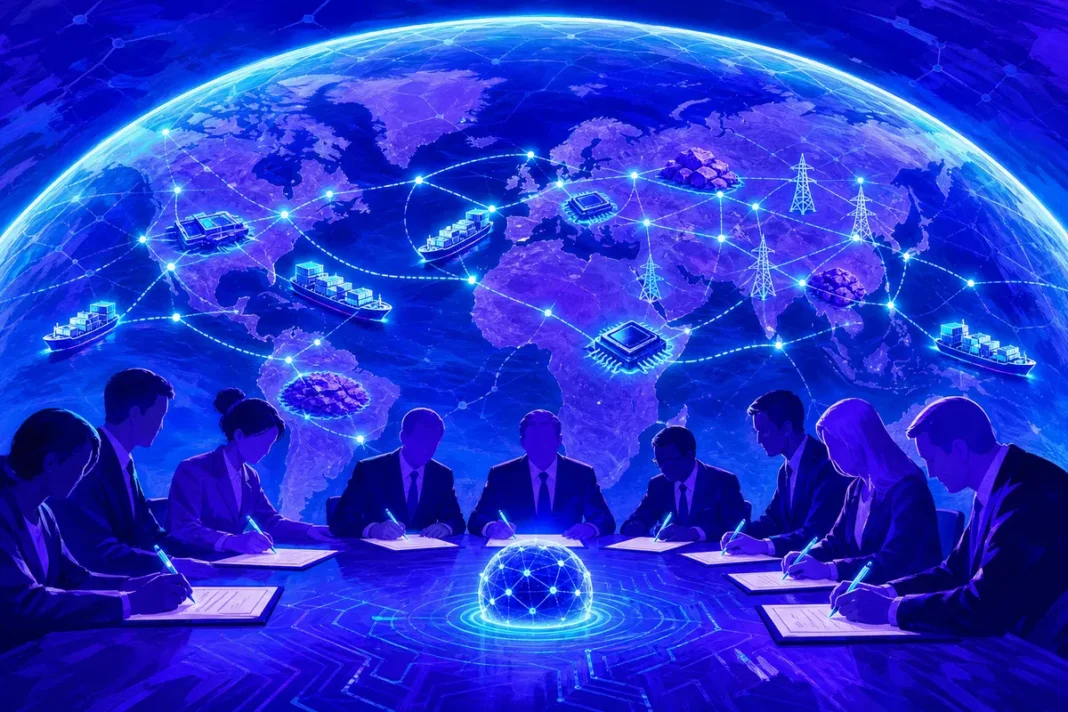
The chips, minerals and electricity that power artificial intelligence have become a national security issue. THE November 15, 2026THE UNITED STATES and nine partners signed the San Francisco Declarationwhich commits them to together protecting the technologies and infrastructures on which AI is based. The text, presented as a new stage of the American initiative Pax Silicacomes a few days before a meeting between Donald Trump and Xi Jinping. France is not part of it, but the European Union could join it quickly.
Who signed?
According to the press release from the American Department of State, relayed by the Indian and Korean press, the declaration was adopted by the governments of ten countries:
| Region | Signatories as of November 15, 2026 |
|---|---|
| Americas | UNITED STATES |
| Asia and the Pacific | Japan, South Korea, India, Singapore, Australia |
| Middle East | Israel, Qatar, United Arab Emirates |
| Europe | United Kingdom |
The signing took place during a meeting of the founding members of Pax Silica, organized by Jacob HelbergUS Under Secretary of State for Economic Affairs. According to him, quoted by the Financial Times, theGermanyTHE The Netherlandsthere Suede and the European Commission must in turn sign in the following days. EU member states authorized the Commission to negotiate this text on November 11, according to an EU Council document cited by MLQ.ai.
What the declaration contains
Officially titled “San Francisco Declaration on the Secure Foundations of Sustainable Prosperity”, the text sets out several principles:
- economic security is fundamental to national security;
- the signatories share a common understanding of sensitive technologies and critical infrastructure that underpin AI supply chains;
- protecting them is shared responsibility;
- We must strengthen protection against the theft or illicit transfer of technologies that would give “hostile actors” a significant military or intelligence advantage.
Concretely, countries undertake to establish a common list technologies and supply chains to protect, which would cover semiconductors, critical minerals and energy infrastructure, according to the Financial Times.
Five working groups to take action
To put these principles into practice, the declaration provides five working groups:
- regulatory frameworks favorable to innovation;
- the adoption of AI in key sectors;
- cooperation on supply chains at all levels of AI;
- “refuge zones” and supply chain security hubsintended to attract investments;
- AI security and resilience.
“No nation can secure the foundation of the superintelligence era alone,” the State Department said in its statement. The term “super intelligence” is now the one used by the American administration to designate AI, following a decree from Donald Trump. The location of the future centers, their financing and their schedule have not yet been specified.
A text focused on China, without naming it
The timetable is not trivial: the signing comes just before the meeting between Donald Trump and Xi Jinping planned on the sidelines of the APEC summit in Shenzhen. The international press reads the declaration as a way of constituting a allied bloc around AI chains, as China dominates the refining of many critical minerals, including rare earths essential to the industry.
However, a source cited by the Korea JoongAng Daily qualifies: “The text of the declaration does not contain any wording specifically targeting China. » Pax Silica publicly states that it does not aim to exclude any particular country, and presents itself as building supply chains between trusted countries.
Rare earths versus chips: the context of the negotiations
The declaration is part of a commercial standoff between Washington and Beijing. According to the Korea JoongAng Daily, the two countries had extended their tariff truce in September until January 10, 2027, and the Shenzhen meeting should focus on a possible exchange between the Chinese rare earths and the American AI technologies. In the absence of an agreement, China could once again use its control of rare earth exports as a means of pressure.
At the same time, several countries are tightening their rules on AI chips. According to MLQ.ai, the US Congress is moving towards stricter controls on processor exports, and Malaysia is preparing a law to track AI chip imports and data center power consumption, to combat smuggling to China. The San Francisco Declaration does not itself create these types of measures, but it sets the framework within which allies could coordinate them.
Why AI channels are so vulnerable
An AI chip travels through many countries before arriving at a data center. As Jacob Helberg points out, the design, manufacturing machines and shipping ports may be in different states. The slightest fragile link can block the whole thing:
- THE critical minerals and rare earths, largely refined in China;
- THE lithography machines the most advanced, produced in the Netherlands by ASML;
- there chip manufacturingconcentrated in Taiwan and South Korea;
- L’electricitywhich has become a bottleneck for data centers.
The expected presence of the Netherlands, country of ASML, illustrates the importance of Europeans in this chain.
And France?
France is neither among the signatories of November 15, nor among the countries announced for the following week. However, it could be indirectly affected if the European Commission signed on behalf of the Union, since it received a mandate from the Member States to negotiate the text. It remains to be seen how this approach, led by Washington, will fit in with the European strategy of technological sovereignty, which aims to reduce Europe’s dependence on both China and the United States.
An AI diplomacy that is structured in blocks
The San Francisco Declaration joins a series of international initiatives on AI with different logics. A few days earlier, the Paris Call for AI Security brought together states and companies around the risks of the most advanced models. The American approach focuses less on the safety of the models than on the control of the material resources of the AI. The coming weeks, with the expected European signatures and the outcome of the meeting between Donald Trump and Xi Jinping, will tell whether this allied front translates into concrete measures or remains a declaration of principles.