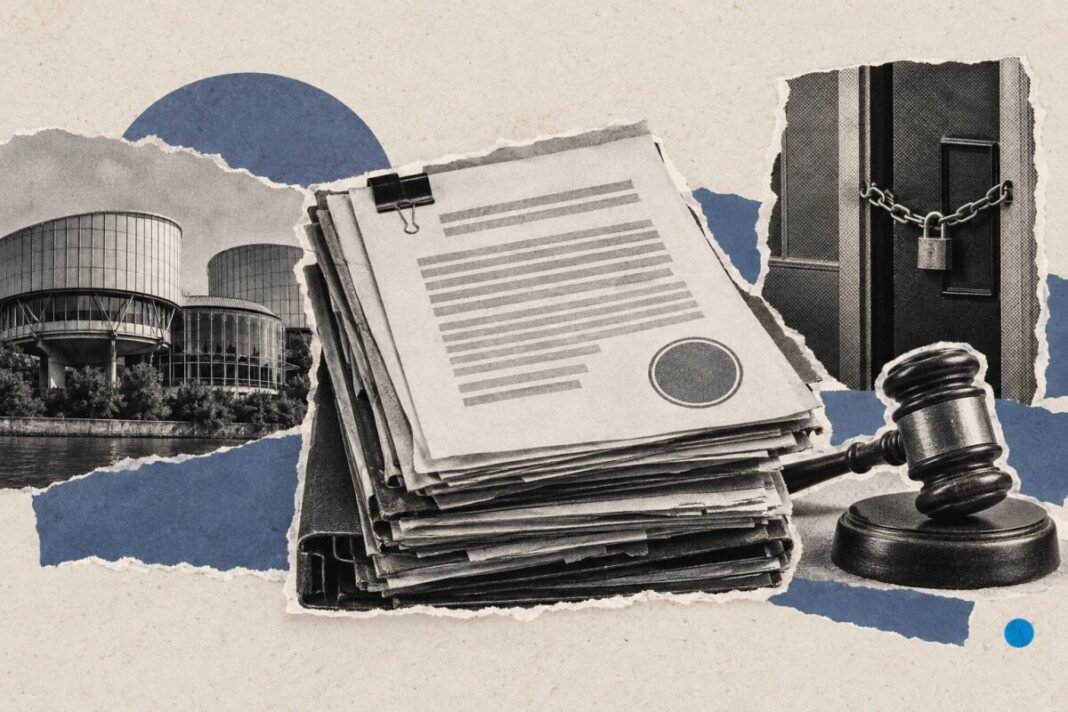
“Inaccuracies” and “misquotations”. A Romanian lawyer used these two expressions, before the European Court of Human Rights, to describe the errors in the written observations that she had written with AI tools. These observations cited cases which do not exist and attributed to real judgments and decisions invented paragraphs. Part of the case law invoked, which was very real, had no connection with his theses or contradicted them. She admitted to not having adequately checked all of her references. The chamber which examined his observations saw this admission as a euphemism.
On November 13, 2026, upon a reasoned proposal from this chamber, the President of the Court, Mattias Guyomar, prohibited him for two years from representing or assisting applicants before the Court. The decision, made public on November 18, is based on Rule 44D of the Rules of Court, which allows counsel to be excluded “in exceptional circumstances”. It applies to pending applications as well as to those which the Court would be seized of in the future. The lawyer shared the representation of the request in question with another representative, whom the exclusion does not cover.
The regulation also provides, in Article 36 §4 c), a narrower measure, which allows the president of a chamber to exclude counsel from a single procedure, after having allowed him to express himself, the applicant then having to seek another representative. Article 44D, retained by the chamber, closes access to the entire Court and can apply for an indefinite period. It requires a reasoned decision from the president, taken after the person concerned, the government and the bars concerned have been able to present observations. The Romanian government and the Romanian National Bar did so. When asked, the Iași bar did not comment.
The measure is not unprecedented. On October 21, before the Committee of Ministers of the Council of Europe, Mattias Guyomar indicated that he had banned a Ukrainian representative for five years, because of his behavior and on the proposal of a section, from representing the parties before the Court.
The chamber judges errors to be repeated and easy to detect
The chamber is talking about repeated substantial errors, not isolated citation errors. For certain references, no verification had been carried out. Many errors would have been spotted by a quick check on HUDOC, the Court’s case-law base. The lawyer had to check herself, before submitting her observations, each reference and each argument produced by the AI from authoritative sources.
This obligation, the chamber draws it from Romanian law no51/1995 on the profession of lawyer and the jurisprudence of the Court, which require reasonable professionalism from lawyers and, before the Court, great professional prudence. Verifying the observations took the Court considerable time, and the exclusion procedure required lengthy discussions with other stakeholders. The chamber considers this work incompatible with the functions that the Convention entrusts to the Court. She concluded that the lawyer had harmed the administration of justice and that the threshold of exceptional circumstances had been reached.
The duty to verify arises from the ordinary obligations of the lawyer
The Court’s rules say nothing about artificial intelligence. The guidelines on the use of generative AI by courts, adopted in December 2025 by the CEPEJ, the Council of Europe’s committee for the efficiency of justice, recommend including in the rules of procedure an obligation to report the use of generative AI, accompanied by sanctions in the event of silence. The room did without such a text. By basing the obligation to verify on the ordinary duties of the lawyer, it gives its decision a broad scope: the reasoning applies to any representative admitted before the Court, regardless of the tool which produced the false reference.
Article 44D §3 allows the lawyer to request, in a reasoned manner, to have her rights restored. The president then rules after consulting, if necessary, the chamber, the government and the bars concerned.
Several national jurisdictions have punished references invented by AI with a financial penalty, or are asking to be able to do so. In New York, two lawyers and their firm were fined $5,000 in 2023 in the case of Mata v. Avianca, and the South Korean judicial administration are demanding a legal basis for a fine, as ActuIA reported in its article on Korean justice. In the Czech Republic, the Constitutional Court fined a lawyer whose appeal cited twelve decisions of this court and the ECHR, a significant part of which did not exist, according to the IRPA firm, which reported the case on July 8, 2026.
The Court is also preparing its own use of AI. Before the Committee of Ministers, Mattias Guyomar indicated that the registry proposed to use it gradually, in particular for translation and cybersecurity, and that a group of judges should propose an ethical charter “adopted and published before any developments in the matter”.
Our articles will be prioritized in Google’s “Featured” section.