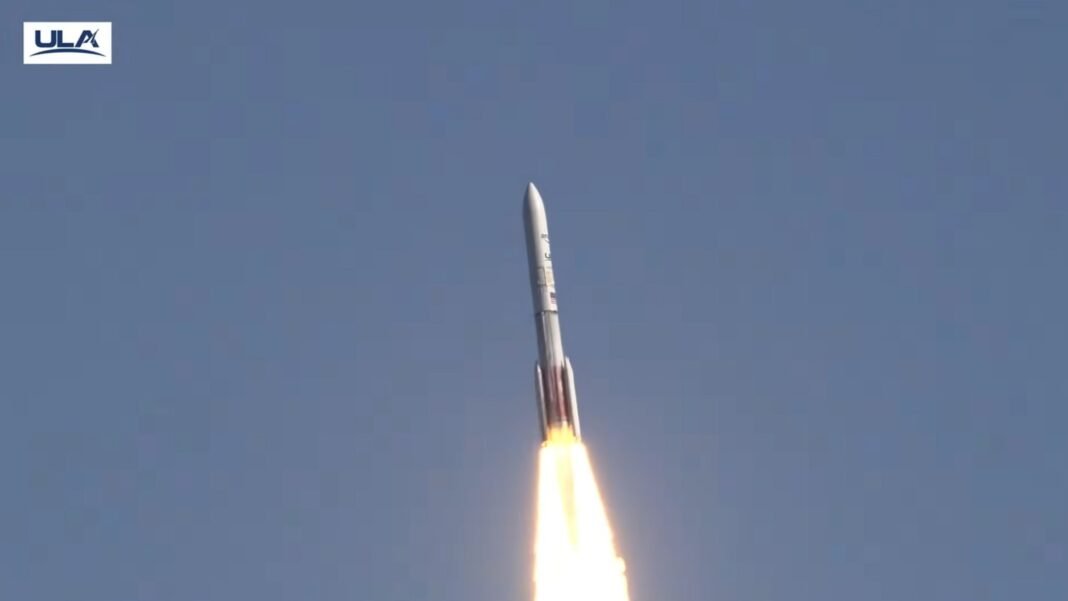
A Vulcan Centaur rocket carrying Amazon satellites took off but failed to reach orbit shortly after liftoff. A rare incident at a company known for its reliability in the sector.
The Vulcan Leo 1 mission has failed. The Vulcan Centaur rocket took off on Sunday, November 15, from Cape Canaveral, Florida, with 40 Amazon satellites expected to join the Leo constellation. Barely ten minutes after departure, the craft experienced an anomaly and never reached orbit.
At Amazon, we blame the blow, even if the company has publicly shown its support for ULA, which it presents as a “trusted partner”. Before this flight, Amazon had deployed 398 Leo satellites in 14 launches, or about 12% of the 3,236 needed to cover the entire planet. The 40 lost satellites represent about 10% of those already in orbit. Amazon had already suffered a setback at the end of May with the explosion of a New Glenn rocket during a static test. The rocket from Blue Origin, the space company founded by Jeff Bezos (also founder of Amazon), was to carry its first batch of Leo satellites a few days later. Blue Origin, highly anticipated as a follow-up to NASA’s Artemis program, has not flown New Glenn again since.
A perfect success rate, but reservations
But the consequences could be even greater for United Launch Alliance (ULA), the company that builds and flies the Vulcan Centaur rocket. Before Vulcan, ULA flew the Atlas V, a rocket that has had no total failures in more than a hundred launches since 2002. Sunday’s flight is ULA’s first complete failure since it was founded in 2006 by Boeing and Lockheed Martin.
Vulcan, the heavy launcher supposed to take over, left with a less clear record. It had reached orbit during its first four flights since January 2024, but two of them had worried its customers. The rocket experienced problems in October 2024, then on February 12, 2026. In both cases, the nozzle of one of the solid boosters failed in mid-flight. These thrusters, GEM 63XL manufactured by Northrop Grumman, are attached around the first stage.

This problem did not prevent the payloads from being put into orbit. It still led the US Space Force to suspend, on February 25, 2026, its national security missions on Vulcan, during the investigation.
Consequences for the Artemis program?
For Sunday’s launch, Northrop Grumman says early data shows its boosters operated normally and separated from the rocket before the anomaly. The nozzle trail is therefore moving away, without ULA having officially ruled it out. According to the progress published by ULA, the anomaly occurred during the thrust of the Centaur, the upper stage, powered by L3Harris RL10 engines. But the first stage appears to have operated longer than expected, casting doubt on the BE-4. This rocket engine designed by Blue Origin equips the first stage of Vulcan Centaur and that of New Glenn. It was a faulty oxygen valve on one of the BE-4s that caused the New Glenn explosion in May. The engines from Sunday’s flight had received a patch from Blue Origin. Under these conditions, if the problem comes from him, this could have repercussions on Blue Origin’s giant rocket, and therefore on the very near future of the United States’ lunar program since New Glenn should be used for Artemis III, a test mission in Earth orbit planned for the summer of 2027 according to NASA’s schedule. New Glenn is to launch a prototype of the Blue Moon lunar lander there.
For the moment, this remains a hypothesis since ULA has not announced the cause of the problem. In a press release published shortly after the theft, the company spoke only of an anomaly, without further details, and promised its customers total transparency on the investigation, in which they would be involved.

The US Space Force, a customer of ULA for its military launches, will follow the investigation closely. On the NASA side, administrator Jared Isaacman offered the agency’s help, reminding X that Artemis and the lunar base project need ULA. ULA’s failure comes the day after a success for its major competitor, since on Saturday November 14, SpaceX caught up for the first time with the upper stage of its Starship with the arms of its launch tower.

All the tech news at a glance
Add Numerama to your home screen and stay connected to the future!

An exclusive editorial, a guide, a reading summary and the editorial agenda: this is what you will find every Thursday in AlwaysPlus, the tech newsletter written by Julien Cadot. Register for free here!