A satellite has a lit side and a shadow side whose temperatures can differ by several hundred degrees. In space, instruments measure several temperatures at the same time that coexist in the same location. “How hot is it in space? » has not one, but several answers.
If you ask a search engine what temperature it is in space, you will probably find −270°C. It’s a figure that gets around, but is almost never accurate.
The electrified gas (plasma), which surrounds the International Space Station (ISS), at an altitude of 400 kilometers, is agitated like a gas heated to several thousand degrees. However, no astronaut has ever cooked there. And the temperature of the station shell itself goes from around 121°C for the illuminated faces to –157°C for the shaded faces. The same place, the same moment, several temperatures coexist.
To understand why a single temperature has no meaning in space, we must first see why it does on Earth. In the room where you are reading these lines, each air molecule travels on average 66 billionths of a meter before colliding with another. It thus undergoes several billion collisions per second. With each shock, a little energy is exchanged between molecules: the faster ones slow down, while the slower ones accelerate. It’s the result of this exchange of energy, called thermodynamic equilibrium, that produces a single temperature, valid for the air, the walls and your thermometer, because none of them have time to diverge.
On Earth, the air around you is made up of 25 billion billion particles per cubic centimeter. In space, the density is only a few particles per cubic centimeter, so low that these collisions become rare to the point that the energy exchange mechanism stops. Temperature retains its meaning: it measures the agitation of the particles, not the heat they can transmit.
Sixthermometers, sixanswers
Decoupling reaches its extreme where several populations of particles coexist without mixing, for example around a comet. From 2014 to 2016, the European Rosetta probe escorted comet 67P/Churyumov-Gerasimenko. As it heats, the cometary nucleus releases gas, which solar light ionizes: it becomes a plasma. Our instruments found, in the same place, not a temperature, but a pile-up.
The neutral molecules that escape from the nucleus are cold, at around −100°C. The comet ions formed by the ionization of these neutral molecules have temperatures ranging from −100°C near the comet’s nucleus to a few thousand degrees when carried into its tail. “Cold” electrons, cooled in contact with these molecules, are between approximately 300 and 3000°C. “Warm” electrons, which have retained the energy of their birth, are between 20,000 and 100,000°C. These two populations coexist permanently, and the ratio between their temperatures is most often 30 to 100. Finally, “hot” electrons, even rarer, reach several hundred thousand degrees.

And the space probe itself? It also does not have a single temperature, and never that of the environment which surrounds it. The Rosetta probe endured from +130 to −150°C during its journey. Around its comet, the faces of Rosetta illuminated and therefore heated by the Sun reached temperatures that could be several tens to a hundred degrees higher than that located in the shadow. The instrument that measures the plasma temperature therefore does not itself have a single temperature.
Five populations of particles, plus the probe itself: six thermometers, six responses, in the same place and at the same time.
Why don’t they mix?
The disturbing question remains: why do these populations never equalize? Because equalizing requires meeting. Where an air molecule travels a few tens of nanometers between two shocks, a cometary plasma particle can travel tens of kilometers without crossing anything.
The problem goes further. In the same place, the temperature can even depend on the direction in which you look! Charged particles (ions and electrons) do not move freely: they wrap around magnetic field lines, like beads on a string. Along the wire, movement is free; crosswise, it is strongly constrained. Nothing then requires that their agitation be the same in both directions: space is no longer “isotropic”, that is to say that its properties differ depending on the direction considered.
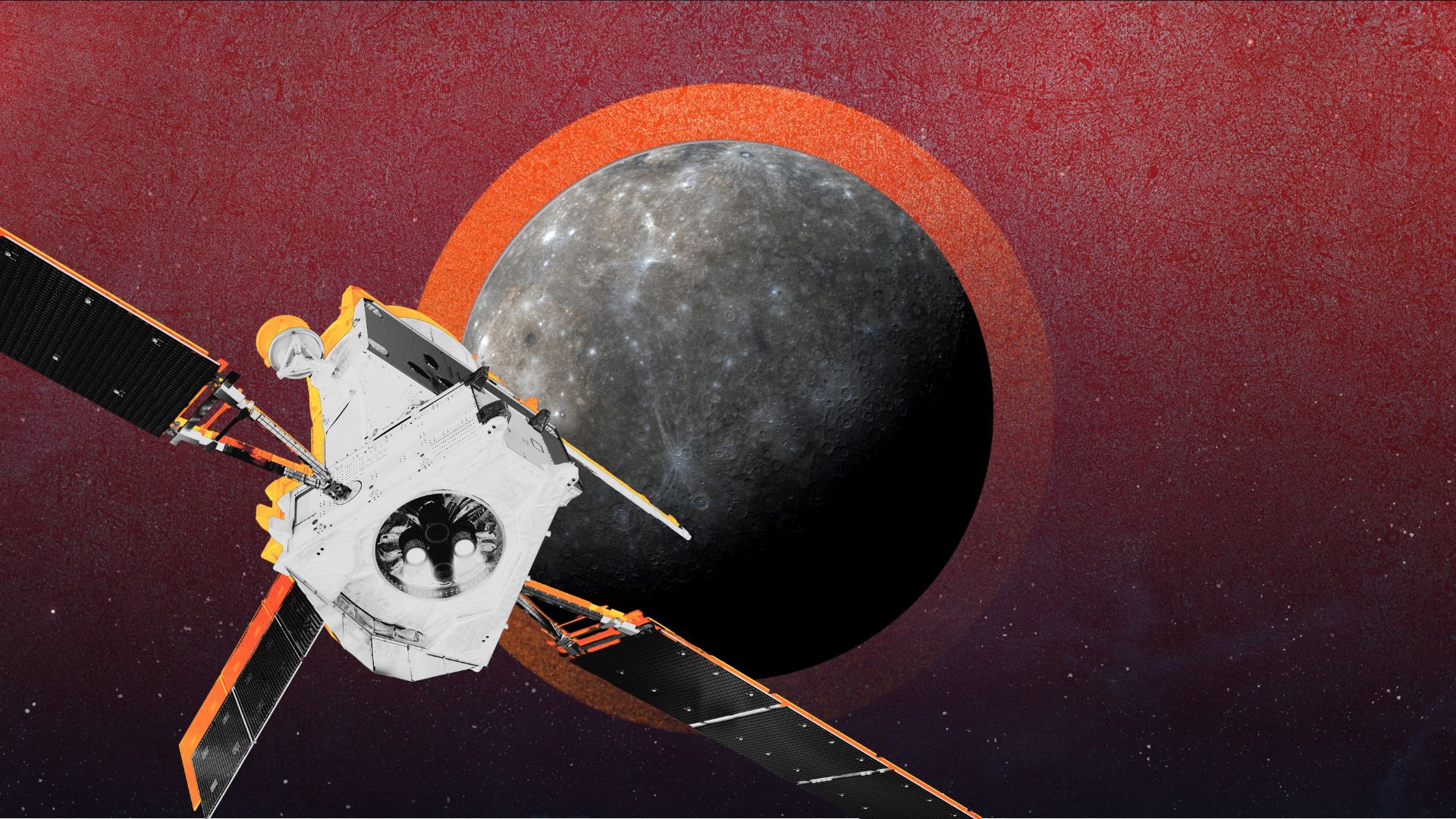
The compressed plasma region between the interplanetary medium (solar wind) and a planet is precisely the seat of such imbalances. Measurements around the Earth show that charged particles can have temperatures twice as high in one direction as in the other. We do not yet know anything about Mercury, which is why our simulations are now seeking to predict it, before our other instrument on board BepiColombo goes to measure them.
Measuring what is not unique
And that’s what makes measurement difficult. An instrument that announced a single number would be of little use in space. We need devices capable of separating populations and, henceforth, accessing directional dependence.
But these devices themselves undergo what they measure: on the Solar Orbiter probe, dedicated to the study of the Sun and which approaches up to 3.6 times closer to the Sun than the Earth, the six-meter electrical antennas bend under the effect of thermal expansion which is 13 times greater than on Earth, the illuminated side elongating more than the shaded side. This is the “banana” effect; closest to the Sun, their tip moves a meter and a half, or a quarter of their length.
Around Mercury, the constraint is also harsh. The light there is 11 times more intense than around the Earth. The planet’s soil goes from more than 430°C during the day (enough to melt lead) to less than −170°C at night: the greatest thermal amplitude of all terrestrial planets. This is also what a satellite placed around Mercury should withstand. The European and Japanese sister probes of the BepiColombo space mission will arrive in orbit around Mercury on November 21, 2026. We will not go there to find the temperature of Mercury. We will go and look for all those that overlap, with instruments which also have several.

Pierre Henri, astrophysicist at the CNRS, Lagrange (Nice) and LPC2E (Orléans) laboratories, National Center for Scientific Research (CNRS); Côte d’Azur University and Gaëtan Wattieaux, teacher-researcher at the LAPLACE laboratory and at the University of Toulouse
This article is republished from The Conversation under a Creative Commons license. Read the original article.

All the tech news at a glance
Add Numerama to your home screen and stay connected to the future!