Google Quantum AI publishes in the journal Science, which devotes its cover to it, a demonstration of “quantum contextuality” on its Willow chips. Its qubits won 98.3% of the games of a logic game where the best classic strategy peaks at 88.9%.
Quantum mechanics is a hundred years old, and its interpretation continues to divide physicists, while its properties remain difficult to understand. Albert Einstein wondered if the Moon is really there when no one is looking: it was his way of defending the idea that physical properties exist before we measure them.
Google Quantum AI, Google’s quantum research division, looked at one of these properties. The study is co-signed by one of its members, the Frenchman Michel Devoret, Nobel Prize in Physics 2025. This property, “quantum contextuality”, is less known than quantum entanglement, even if Google’s experiment is also based on entangled qubits.
What is contextuality? Simply put, the result of a measurement depends on other compatible measurements made at the same time, that is, on its “context”. We cannot therefore assume that the values were fixed in advance. The team publishes its results in the journal Science, after putting them online as pre-publication on arXiv in December 2025.
Google carried out its experiments on its Willow quantum chips. The company says it has measured this contextuality up to 105 qubits (the calculation units of a quantum computer). However, until now, it had only been observed on smaller systems, involving only a few particles.
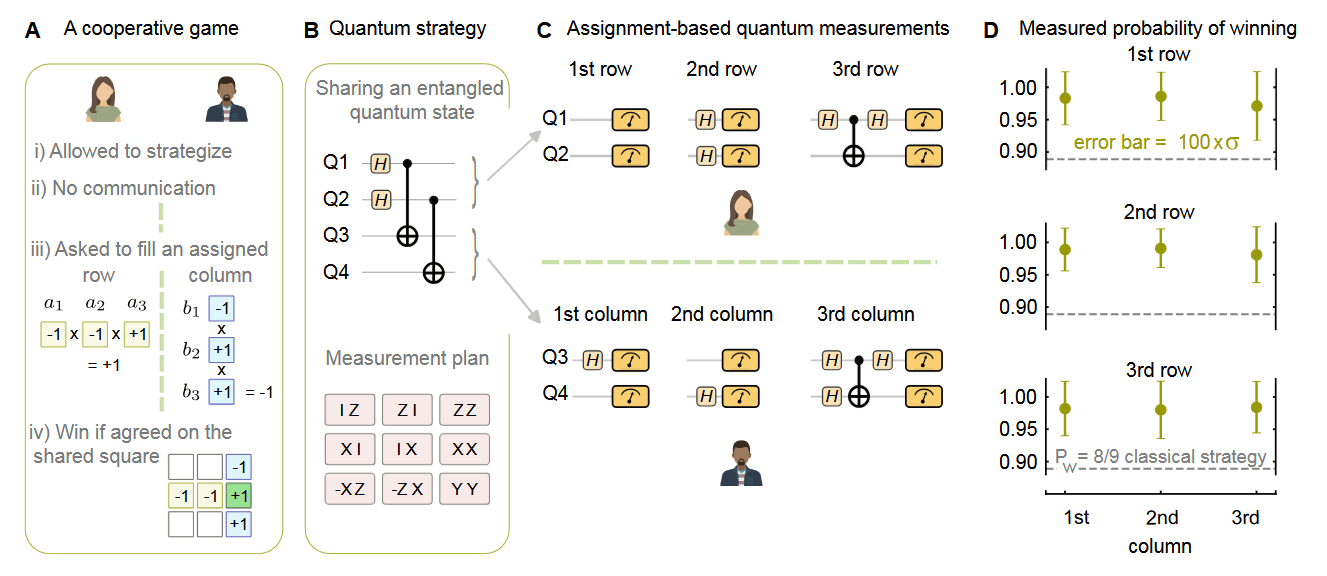
To show this, Google used the magic square game. This involves filling a grid of 3 by 3 squares with +1s and −1s, so that the product of each row is +1 and that of each column −1. This is impossible: to satisfy the rows, the grid must contain in total an even number of −1, and to satisfy the columns, an odd number.
In this game, there are two people: Alice and Bob. Alice is assigned a row and Bob a column. Without speaking to each other, Alice fills in her row according to the row rule and Bob fills in his column according to the column rule. They win if they enter the same number in the box where their row and column intersect.
However, explains Google, any strategy agreed before the game amounts to filling a fixed grid (a pre-filled table, in short), which necessarily fails on at least one of the nine row-column combinations and therefore caps at 8 wins out of 9 (88.9%). But the situation is changing with quantum, according to the Mountain View firm.
With two pairs of entangled qubits, that is to say linked so that their measurements remain correlated, the theory, on the other hand, promises to win every time. On Willow, Google played each of the nine versions of the game 100,000 times. He won 98.3% of them on average, or about one loss in 60, which the team attributes to chip noise.
This magic square only uses four qubits, two per player. To scale up, Google relies on other tests: a multi-player game (known as a “GHZ game”), conducted up to 71 qubits, and a “hidden linear function” mathematical problem, solved up to 105 qubits.
The advantage over the classic is less clear. In the GHZ game, the margin shrinks as the number of players increases. For the hidden linear function, the comparison is based on a classic limit that the team itself presents as a conjecture.
A test bench whose limit does not move
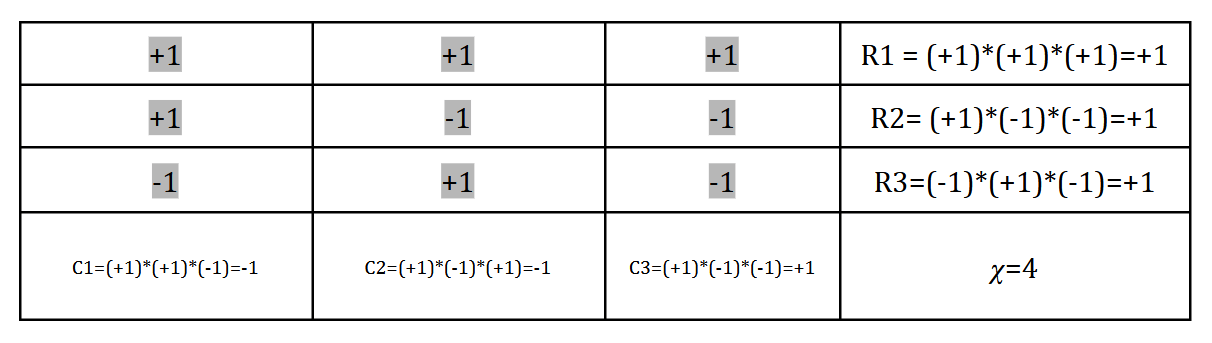
The team then quantified this contextuality with a so-called Bell-Kochen-Specker test, which summarizes a set of correlations into a single score. If the results were written in advance, this score could not exceed 4, whereas quantum mechanics allows up to 6. Willow obtained 5.59, or about 7% below the maximum.
The Bell-Kochen-Specker test does not depend on the way in which the qubits are prepared: it therefore evaluates the machine itself.
Why such a test? The usual tests compare quantum chips to supercomputers, and the bar rises with each progress of classical machines (the “quantum supremacy” claimed by Google in 2019 was thus overtaken by classical computers a few years later).
In the test conducted by Google, on the contrary, the ceiling (a score of 6, 100% victory) is set by the laws of physics. The gap with this ceiling therefore gives a score which does not change with the progress of classical computers, which facilitates comparisons between machines. Furthermore, according to Google, this approach has another advantage: detecting certain types of errors.
Thus, according to the research team, it was possible to reveal subtle drifts which shift the state of a qubit and which tests with random circuits (sequences of operations drawn at random, the usual Google test bench) tend to drown in the average. Google proposes to use this type of test to evaluate its future quantum chips.
Google itself recognizes that this work does not yet have immediate application.
What, then, of Einstein’s Moon? The anecdote, reported by the physicist Abraham Pais in 1979, sums up the bet of the father of relativity: a measurement would only read an already fixed value, like discovering a card placed face down.
The experiments carried out in the 1970s and 1980s by John Clauser and then Alain Aspect on pairs of photons, rewarded with the 2022 Nobel Prize in Physics, had already undermined this idea.
Willow goes in the same direction, this time on a computing chip: if the responses of its qubits had been written in advance, the chip would never have exceeded 88.9% magic square victories, nor a score of 4 in the Bell-Kochen-Specker test. In short, for Willow’s qubits, the answer to Einstein’s question does not go his way.
All the tech news at a glance
Add Numerama to your home screen and stay connected to the future!