USB-C cable, Image monticello/iStock/Getty Images Plus.
The essential points to distinguish the capacities of USB-C cables
- Identical-looking USB-C cables can have drastically different capabilities.
- Thunderbolt certification guarantees specific capabilities.
- Label your USB-C cables before they disappear into a drawer.
This article was originally intended to be about my personal experience with a new docking station, more specifically, the Plugable TBT-UDH2, a Thunderbolt 5 docking station that fits perfectly with any modern high-end PC.
Instead, I found myself wading through a veritable maze, learning way more than I ever thought I’d need to know about USB-C cables. I know what you’re thinking, but wasn’t the goal of USB Type-C to eliminate all the confusion associated with old USB connectors, with their varied shapes and sizes?
Well, yes. But unfortunately, the Type-C standard only applies to the physical form of the connector, and not the data transfer protocol or power capabilities of the cable it is attached to. Since the 24-pin connector is reversible, you can plug it in either direction. But what you can do with a USB-C cable depends on what’s between those two connectors.
I purchased some testing equipment, then evaluated dozens of USB-C cables to determine the capabilities of each and how to tell them apart. In doing so, I revived some memories about old USB standards and learned a lot about Thunderbolt and USB4.
I also discovered the one thing you should do every time you get your hands on a new USB-C cable. Believe me, this information will be useful to you one day.
But first, a few words about the docking station
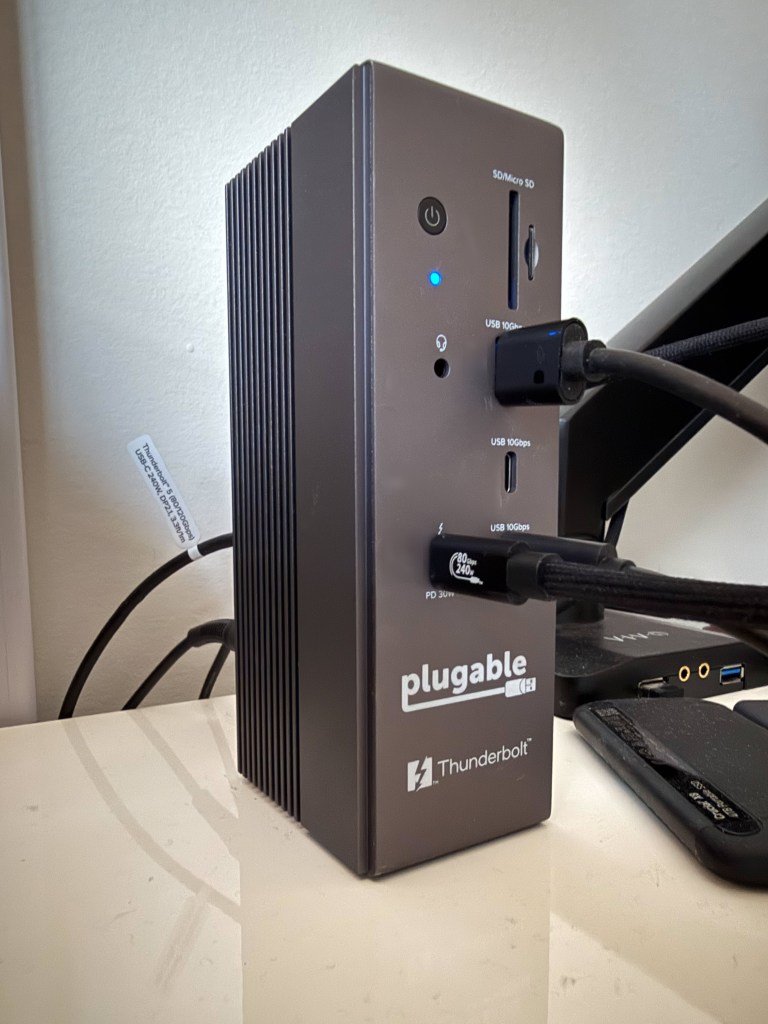
I have been using Plugable products for years. This company offers a wide range of products that I find reliable and well designed. A quick glance at my workbench allows me to spot several products from this Plugable brand: a USB 2.5 Gbps Ethernet adapter, a USB-C enclosure for an M.2 NVMe storage device, and the Thunderbolt 5 dock in question pictured here.

Look closely at the cables in this photo. There will be a test later.
I tested this Plugable Dock with half a dozen Windows computers, ranging from entry-level to workstations, equipped with Intel, AMD, Qualcomm, and Nvidia processors. It has a truly impressive array of ports, including six USB-C ports, two USB-A ports, two HDMI 2.1 ports, and a 2.5Gbps Ethernet jack. By plugging in a single USB-C cable, I can power my laptop (up to 140W) and turn it into a very well-connected desktop PC, with a 38-inch external display, wired Ethernet connection, external mouse, keyboard and speakers, and several external USB drives.
It’s a real workhorse, but in recent months I’ve found myself stumped at times.
Two identical-looking cables that don’t behave the same
All Thunderbolt features worked perfectly when connected to USB4 ports, even though laptops with these ports are not Thunderbolt certified.
On a PC, the video display worked fine when connected to a USB-C port on the left side, but behaved strangely when using the identical port on the right side… The next thing was to figure out why two identical-looking cables didn’t behave the same way.
To unravel these mysteries, I spoke with Bernie Thompson, founder and CTO of Plugable, who had the answers I was looking for.
Thunderbolt 5 vs USB 4: what’s the difference?
Thunderbolt is a technology that allows data, video and power to be transferred quickly over a single cable. To use the Thunderbolt label, hardware and software manufacturers must undergo a demanding certification process.
Thunderbolt 3, developed by Intel and released in 2015, was the first technology to truly showcase the potential of USB-C as a single connection for high-speed data, displays and power. USB4 is based on Intel’s Thunderbolt protocol specification and is backward compatible with USB 3.2, USB 2.0, and Thunderbolt 3 devices.
A USB4-equipped PC can support USB devices, displays, high-speed storage media, and many Thunderbolt devices through the same USB-C connection.
Thunderbolt 4 takes the capabilities of USB4 and establishes a set of strictly defined, certified minimum features. Thunderbolt 5 increases bidirectional bandwidth to 80 Gbps, with the ability to reach 120 Gbps during graphics-intensive activities.
There is quite a bit of overlap between USB4 and Thunderbolt technologies, which is why all the USB4 PCs I tested worked perfectly with the Thunderbolt 5 dock.
Speed, power, and other USB-C modes
If you’re like me, you probably have a drawer full of USB-C cables that you’ve accumulated over the years. So how do you know which one is right for a specific use?
Unless it’s labeled, it’s impossible! This is the sad reality of cables with a USB-C connector, which can have three very different levels of performance.
- How fast can it transfer data? Speeds range from the dismally slow 480 Mbps of USB 2.0 to the blistering 80 Gbps of Thunderbolt 5.
- How much power can it provide? I have cables with a USB-C connector that only charge my toothbrush (7.5W), but thanks to the Power Delivery (PD) standard, the appropriate cable can deliver up to 240W to a workstation-style PC.
- What else can he do? Some USB-C cables support so-called “alternate modes” that allow you to transmit a DisplayPort video signal, while others can manage the bandwidth to support USB4 and Thunderbolt devices, like my Plugable Dock.
I pulled three unlabeled cables out of my drawer and tried connecting them to various peripherals, including a display and a few external hard drives. Although the cables looked similar at first glance, I couldn’t understand why they behaved so differently.
I bought a cable tester
My ZDNET colleague Adrian Kingsley-Hughes recommended the Treedix USB cable tester, which helped me unravel a few mysteries.
I’m pretty sure this white, thick, nicely braided cable cost me a small fortune at the Apple Store a few years ago.

This cable can deliver enormous power, but it is maddeningly slow when it comes to data transfer. USB 2.0? Seriously ?
As the tester proved, it can support the maximum power allowed by the current USB Power Delivery standard: 240 W. And for data then? Sorry, it only supports USB 2.0.
I regularly back up 500 GB of data from my PC to a fast NVMe external drive. With this expensive USB 2.0 cable, the operation would take almost four hours… By opting for a high-speed USB4 cable like the one shown here, with modern storage devices on both ends, the backup would be completed in just a few minutes!

This cable allows charging up to 100W and ensures impressive data transfer speeds.
That’s when I started testing all the USB-C cables in that drawer, sorting them into carefully labeled bins: cables intended only for PC charging, USB 3.2 cables (USB A to C and C to C), capable of high-speed data transfers, traditional low-power charging cables (USB A to C), suitable for small devices but little more, and a small proprietary stack of high-end USB4 and Thunderbolt cables.
And then I turned into a real cable engineer
The Treedix device has a button that displays some additional information about the cables, but I wanted more. So I bought a very sophisticated digital cable tester from Austria called the BLE CaberQU X-ray (costing €97). Its screen is much more detailed than the Treedix’s, and it has a mobile app that connects via Bluetooth and saves history for the devices I tested.
This is what that expensive but slow Apple charging cable looks like on the device.

Charging power is maxed out, but data throughput? Not really.
And this is what a fully certified Thunderbolt 5 cable looks like in the app.

The information displayed in the CaberQU mobile application is very comprehensive.
This little gadget answers a few questions that a simpler tester can’t answer, especially regarding the condition of the cable (for example, broken pins or shorted connections). With the latest firmware version, it can provide information about USB4 v2, PD 3.0/3.1 EPR, active cable specifications, Thunderbolt generation and DisplayPort capabilities. If all this jargon doesn’t mean anything to you, this device may be a little too sophisticated for you.
It also provides details on a chip built into some USB-C cables, called an “E-Marker,” which electronically identifies the cable’s capabilities to devices at either end. It is impossible to detect the presence of an E-Marker chip simply by examining a cable.
Why it is important to choose the right cable
A dock is a particularly demanding device for a USB-C cable, because this single cable can simultaneously charge a laptop, transmit high-resolution video to multiple displays, maintain a high-speed Ethernet connection, and manage multiple USB devices and external storage devices.
As I discovered, choosing the right cable is essential: a cable that works great for charging a laptop or connecting an SSD can fail when a dock asks it to juggle all those tasks simultaneously.
As for the problem I encountered when connecting the dock to the USB-C port on the right side of the Dell XPS 13 laptop, what is the explanation? I first thought it was a faulty cable, but Plugable’s engineering team pointed me to this support article from Dell, which states that the laptop may experience display issues when the monitor is connected to the USB Type-C port on the right side of the device. “The issue is intermittent,” the support article states. Intermittent failures are the most difficult to resolve.
Which confirms that cables matter, as do ports, firmware, and indeed every link in the chain that gets data from a laptop to a docking station and then to an external device.
The only thing to do when buying a new USB-C cable
For an investigation of this type, this one turned out to be relatively fun to conduct. In any case, it has modified the list of criteria that I recommend you take into account when choosing a USB cable.
For recharging
Determine how much power you actually need.
For storage devices and other accessories
Determine the flow rate you really need. A 10 Gbps device does not require an 80 Gbps cable.
For docks and displays
Don’t overpay, but don’t try to save a few dollars on an unknown brand cable either. Buy a USB4 or Thunderbolt certified cable, from a reputable brand and clearly labeled, with the bandwidth and PD (Power Delivery) power required by your hardware.
Then follow this rule: When you receive this new cable, keep the packaging and test it if you have the necessary equipment. Most high-end cables these days have the Thunderbolt logo, USB4 designation, or an indication of power wattage and data rates. One of the reasons I recommend Plugable products is that all of their USB-C cables are clearly labeled. By the way, zoom in on the image at the top of this article to see an example.
If your new purchase does not have these markings, attach a label to it before storing it in a drawer. Otherwise, in six months you’ll pull it out of that drawer and wonder what exactly it’s capable of. Don’t get yourself into this dead end.
Source: “ZDNet.com”
USB-C cable, Image monticello/iStock/Getty Images Plus.
The essential points to distinguish the capacities of USB-C cables
- Identical-looking USB-C cables can have drastically different capabilities.
- Thunderbolt certification guarantees specific capabilities.
- Label your USB-C cables before they disappear into a drawer.
This article was originally intended to be about my personal experience with a new docking station, more specifically, the Plugable TBT-UDH2, a Thunderbolt 5 docking station that fits perfectly with any modern high-end PC.
Instead, I found myself wading through a veritable maze, learning way more than I ever thought I’d need to know about USB-C cables. I know what you’re thinking, but wasn’t the goal of USB Type-C to eliminate all the confusion associated with old USB connectors, with their varied shapes and sizes?
Well, yes. But unfortunately, the Type-C standard only applies to the physical form of the connector, and not the data transfer protocol or power capabilities of the cable it is attached to. Since the 24-pin connector is reversible, you can plug it in either direction. But what you can do with a USB-C cable depends on what’s between those two connectors.
I purchased some testing equipment, then evaluated dozens of USB-C cables to determine the capabilities of each and how to tell them apart. In doing so, I revived some memories about old USB standards and learned a lot about Thunderbolt and USB4.
I also discovered the one thing you should do every time you get your hands on a new USB-C cable. Believe me, this information will be useful to you one day.
But first, a few words about the docking station
I have been using Plugable products for years. This company offers a wide range of products that I find reliable and well designed. A quick glance at my workbench allows me to spot several products from this Plugable brand: a USB 2.5 Gbps Ethernet adapter, a USB-C enclosure for an M.2 NVMe storage device, and the Thunderbolt 5 dock in question pictured here.
Look carefully at the cables in this photo. There will be a test later.
I tested this Plugable Dock with half a dozen Windows computers, ranging from entry-level to workstations, equipped with Intel, AMD, Qualcomm, and Nvidia processors. It has a truly impressive array of ports, including six USB-C ports, two USB-A ports, two HDMI 2.1 ports, and a 2.5Gbps Ethernet jack. By plugging in a single USB-C cable, I can power my laptop (up to 140W) and turn it into a very well-connected desktop PC, with a 38-inch external display, wired Ethernet connection, external mouse, keyboard and speakers, and several external USB drives.
It’s a real workhorse, but in recent months I’ve found myself stumped at times.
Two identical-looking cables that don’t behave the same
All Thunderbolt features worked perfectly when connected to USB4 ports, even though laptops with these ports are not Thunderbolt certified.
On a PC, the video display worked fine when connected to a USB-C port on the left side, but behaved strangely when using the identical port on the right side… The next thing was to figure out why two identical-looking cables didn’t behave the same way.
To unravel these mysteries, I spoke with Bernie Thompson, founder and CTO of Plugable, who had the answers I was looking for.
Thunderbolt 5 vs USB 4: what’s the difference?
Thunderbolt is a technology that allows data, video and power to be transferred quickly over a single cable. To use the Thunderbolt label, hardware and software manufacturers must undergo a demanding certification process.
Thunderbolt 3, developed by Intel and released in 2015, was the first technology to truly showcase the potential of USB-C as a single connection for high-speed data, displays and power. USB4 is based on Intel’s Thunderbolt protocol specification and is backward compatible with USB 3.2, USB 2.0, and Thunderbolt 3 devices.
A USB4-equipped PC can support USB devices, displays, high-speed storage media, and many Thunderbolt devices through the same USB-C connection.
Thunderbolt 4 takes the capabilities of USB4 and establishes a set of strictly defined, certified minimum features. Thunderbolt 5 increases bidirectional bandwidth to 80 Gbps, with the ability to reach 120 Gbps during graphics-intensive activities.
There is quite a bit of overlap between USB4 and Thunderbolt technologies, which is why all the USB4 PCs I tested worked perfectly with the Thunderbolt 5 dock.
Speed, power, and other USB-C modes
If you’re like me, you probably have a drawer full of USB-C cables that you’ve accumulated over the years. So how do you know which one is right for a specific use?
Unless it’s labeled, it’s impossible! This is the sad reality of cables with a USB-C connector, which can have three very different levels of performance.
- How fast can it transfer data? Speeds range from the dismally slow 480 Mbps of USB 2.0 to the blistering 80 Gbps of Thunderbolt 5.
- How much power can it provide? I have cables with a USB-C connector that only charge my toothbrush (7.5W), but thanks to the Power Delivery (PD) standard, the appropriate cable can deliver up to 240W to a workstation-style PC.
- What else can he do? Some USB-C cables support so-called “alternate modes” that allow you to transmit a DisplayPort video signal, while others can manage the bandwidth to support USB4 and Thunderbolt devices, like my Plugable Dock.
I pulled three unlabeled cables out of my drawer and tried connecting them to various peripherals, including a display and a few external hard drives. Although the cables looked similar at first glance, I couldn’t understand why they behaved so differently.
I bought a cable tester
My ZDNET colleague Adrian Kingsley-Hughes recommended the Treedix USB cable tester, which helped me unravel a few mysteries.
I’m pretty sure this white, thick, nicely braided cable cost me a small fortune at the Apple Store a few years ago.
This cable can deliver enormous power, but it is maddeningly slow when it comes to data transfer. USB 2.0? Seriously ?
As the tester proved, it can support the maximum power allowed by the current USB Power Delivery standard: 240 W. And for data then? Sorry, it only supports USB 2.0.
I regularly back up 500 GB of data from my PC to a fast NVMe external drive. With this expensive USB 2.0 cable, the operation would take almost four hours… By opting for a high-speed USB4 cable like the one shown here, with modern storage devices on both ends, the backup would be completed in just a few minutes!
This cable allows charging up to 100W and ensures impressive data transfer speeds.
That’s when I started testing all the USB-C cables in that drawer, sorting them into carefully labeled bins: cables intended only for PC charging, USB 3.2 cables (USB A to C and C to C), capable of high-speed data transfers, traditional low-power charging cables (USB A to C), suitable for small devices but little more, and a small proprietary stack of high-end USB4 and Thunderbolt cables.
And then I turned into a real cable engineer
The Treedix device has a button that displays some additional information about the cables, but I wanted more. So I bought a very sophisticated digital cable tester from Austria called the BLE CaberQU X-ray (costing €97). Its screen is much more detailed than the Treedix’s, and it has a mobile app that connects via Bluetooth and saves history for the devices I tested.
This is what that expensive but slow Apple charging cable looks like on the device.
Charging power is maxed out, but data throughput? Not really.
And this is what a fully certified Thunderbolt 5 cable looks like in the app.
The information displayed in the CaberQU mobile application is very comprehensive.
This little gadget answers a few questions that a simpler tester can’t answer, especially regarding the condition of the cable (for example, broken pins or shorted connections). With the latest firmware version, it can provide information about USB4 v2, PD 3.0/3.1 EPR, active cable specifications, Thunderbolt generation and DisplayPort capabilities. If all this jargon doesn’t mean anything to you, this device may be a little too sophisticated for you.
It also provides details on a chip built into some USB-C cables, called an “E-Marker,” which electronically identifies the cable’s capabilities to devices at either end. It is impossible to detect the presence of an E-Marker chip simply by examining a cable.
Why it is important to choose the right cable
A dock is a particularly demanding device for a USB-C cable, because this single cable can simultaneously charge a laptop, transmit high-resolution video to multiple displays, maintain a high-speed Ethernet connection, and manage multiple USB devices and external storage devices.
As I discovered, choosing the right cable is essential: a cable that works great for charging a laptop or connecting an SSD can fail when a dock asks it to juggle all those tasks simultaneously.
As for the problem I encountered when connecting the dock to the USB-C port on the right side of the Dell XPS 13 laptop, what is the explanation? I first thought it was a faulty cable, but Plugable’s engineering team pointed me to this support article from Dell, which states that the laptop may experience display issues when the monitor is connected to the USB Type-C port on the right side of the device. “The issue is intermittent,” the support article states. Intermittent failures are the most difficult to resolve.
Which confirms that cables matter, as do ports, firmware, and indeed every link in the chain that gets data from a laptop to a docking station and then to an external device.
The only thing to do when buying a new USB-C cable
For an investigation of this type, this one turned out to be relatively fun to conduct. In any case, it has modified the list of criteria that I recommend you take into account when choosing a USB cable.
For recharging
Determine how much power you actually need.
For storage devices and other accessories
Determine the flow rate you really need. A 10 Gbps device does not require an 80 Gbps cable.
For docks and displays
Don’t overpay, but don’t try to save a few dollars on an unknown brand cable either. Buy a USB4 or Thunderbolt certified cable, from a reputable brand and clearly labeled, with the bandwidth and PD (Power Delivery) power required by your hardware.
Then follow this rule: When you receive this new cable, keep the packaging and test it if you have the necessary equipment. Most high-end cables these days have the Thunderbolt logo, USB4 designation, or an indication of power wattage and data rates. One of the reasons I recommend Plugable products is that all of their USB-C cables are clearly labeled. By the way, zoom in on the image at the top of this article to see an example.
If your new purchase does not have these markings, attach a label to it before storing it in a drawer. Otherwise, in six months you’ll pull it out of that drawer and wonder what exactly it’s capable of. Don’t get yourself into this dead end.
Source: “ZDNet.com”
https://www.zdnet.fr/wp-content/uploads/zdnet/2026/11/cables-usb-c-les-differencier-pratique.jpg https://www.zdnet.fr/pratique/point-tech-voici-pourquoi-vos-cables-usb-c-se-resemblent-mais-travailnent-differemment-508127.htm?utm_source=rss_feed&utm_medium=link&utm_campaign=unknown