Riemann hypothesis, matrix multiplication… In a highly charged post published on November 25, 2026, computer scientist Scott Aaronson recounts a week of mathematical breakthroughs made by AI. Before dropping a sentence that makes tech and cryptos tremble: the labs also have something to threaten our encryption systems.
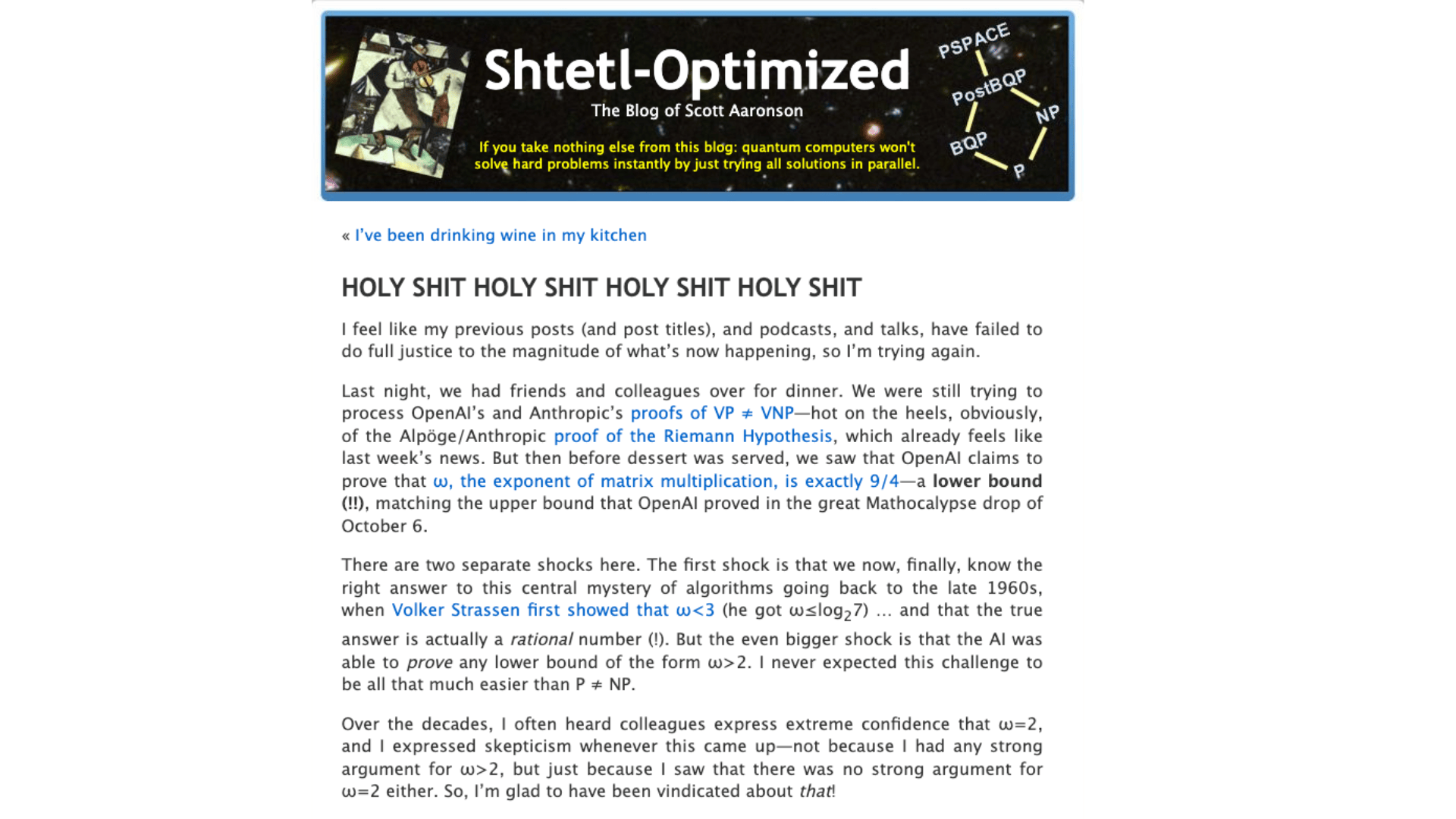
The title of the post sets the tone: “HOLY SHIT”, repeated no less than four times. However, Scott Aaronson is not an enthusiast. A theoretical computer scientist at the University of Texas at Austin and former researcher at OpenAI, he is among the most respected voices in his field, and he has long been one of the most skeptical of sensational announcements, particularly in quantum computing.
In this post published on his Shtetl-Optimized blog on November 25, 2026, the eve of Thanksgiving, he describes a dinner with friends and colleagues. All evening, phones and computers in hand, they followed live the files that OpenAI and Anthropic uploaded to GitHub. The two companies no longer even bother to publish press releases, he notes: they simply put their articles online.
It must be said that the ground was well prepared. On November 20, Levent Alpöge, mathematician at Anthropic, announced that he had proven the Riemann hypothesis with Claude. This 1859 conjecture about the distribution of prime numbers is one of seven Millennium Problems, each worth a million dollars. Its proof, formalized in Lean, software that mechanically checks each step of reasoning, includes more than 17 million lines of code. The researcher even said that a version would exceed 250,000 pages, before specifying on November 23 that he was joking.
On November 22, Alexandr Wang, director of AI at Meta and head of its Superintelligence Labs, drew a conclusion that has the merit of being clear: “ Superintelligence is coming. » He describes evidence obtained with the help of “ of an alien mind that we don’t understand “, and warns that what humanity does in the coming year will have ” big consequences “. And now this new text published by Scott Aaronson has once again shaken this little world.

Black Friday: Proton Pass Plus at -60%
Until November 30, Proton Pass Plus is €1.99 per month for 12 months, or 60% off! Unlimited email address aliases to take advantage of promotional codes without filling your mailbox, unique password per site, encrypted safe. In short, a stress-free Black Friday!
“Almost certain”: explosive revelations about encryption
On November 24, OpenAI and Anthropic each published a proof that VP ≠ VNP, the “algebraic” version of the famous P ≠ NP problem. Then, on the evening of the dinner, OpenAI claimed to have found the exact value of ω, the exponent which measures the speed at which two matrices can be multiplied, the operation at the heart of all AI: 9/4.
For Scott Aaronson, we are witnessing the discovery of “ a whole new continent of mathematical truth », comparable to Galileo pointing his telescope towards the stars. He challenges skeptics who quibble over details of Lean evidence: “ don’t be a raging moron » (“raging doofus”, in the text). It now assumes that any evidence coming from OpenAI or Anthropic is correct, unless proven otherwise, even when other researchers have not yet been able to verify it.
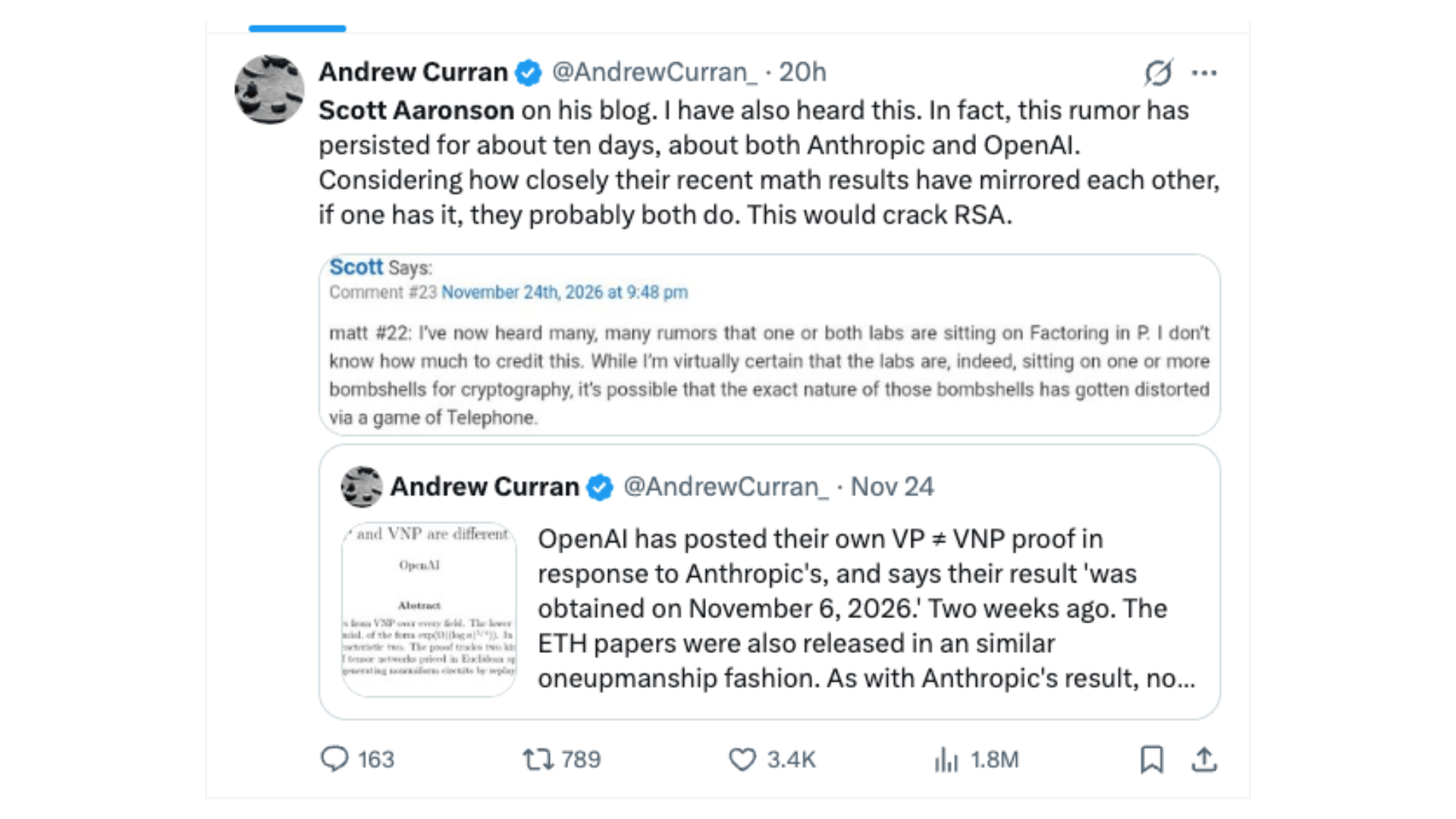
But it was a passage of two paragraphs, almost slipped into the end of the post, which ignited the powder. Scott Aaronson said: almost certain, according to several reliable sources ”, which AI laboratories hold “ one or more explosive revelations » in cryptography.
He immediately multiplies the precautions: he ignores their exact nature, fears that they have been distorted from mouth to mouth and refuses to talk about ECDSA, the algorithm which signs bitcoin transactions. Questioned since, he only specified that he had heard “ many, many rumors » according to which a lab would have proven that factorization is “ in P “. As of the evening of November 25, neither OpenAI nor Anthropic had reacted.
P, NP and Q-Day: why the encryption is shaking
The P = NP problem, open since 1971, asks whether any problem whose solution can be verified quickly, like a completed Sudoku grid, can also be solved quickly. Almost everyone thinks no, without ever having proven it. Scott Aaronson now feels “ viscerally » that a proof of P ≠ NP is not very far away.
This would be good news for crypto. The danger comes from algorithms. RSA encryption, which still protects a large part of the web and payments, bets that finding the two prime numbers that make up a key takes too long. If an AI finds a fast method, RSA falls, even if P ≠ NP.
Until now, the threat came from quantum computers and “Q-Day”, the day when one of them can break RSA and elliptic curve cryptography. Google has set itself a target date of 2029 to prepare for this. The scenario that worries us today is a Q-Day without a quantum computer, triggered by a simple mathematical discovery.
Charles Guillemet, technical director of Ledger, however, calls for us to keep a cool head. In a post on He doesn’t believe it: he wouldn’t be surprised if these systems were a little less robust than expected, but ” very surprised » that they completely collapse. Above all, he notes that a lab that breaks one of these bricks would have great difficulty revealing it without causing massive exploitation. If such a discovery existed, the labs would therefore have every reason to remain silent, and this silence is enough to fuel the rumors.
All the tech news at a glance
Add Numerama to your home screen and stay connected to the future!