Here is a proposed article written in the journalistic style of ZDNETanalyzing Apple’s position in the race for artificial intelligence from the perspective of its historical corporate culture.
AI: why Apple’s historical methods are preventing it from catching up
While Microsoft, Google and OpenAI are carrying out dazzling innovations, Apple seems to be struggling in the field of generative artificial intelligence. A paradox for the richest company in the world, whose cultural roots – cult of secrecy, absolute control and reluctance to risk – paradoxically constitute the main obstacle to its digital transformation.
“ We don’t want to be first, we want to be the best. » This mantra, repeated over and over again by Apple executives over the decades, has made the iPhone, Apple Watch and iPad successful. Arriving after the others to refine the concept, eliminate the rough edges and offer an impeccable user experience has long been Cupertino’s magic recipe.
But in the era of generative artificial intelligence, this “fast follower” strategy shows its limits. Worse, it turns against the tech giant.
The wall of secrecy in the face of open AI science
Apple’s DNA was forged in the strictest secrecy. Under the Steve Jobs era, then under that of Tim Cook, leaking information about a future product was tantamount to a crime of lèse-majesté. The teams work in sealed silos, protected by security measures worthy of the secret services.
However, modern AI research is based on an exact opposite paradigm: open science and global collaboration. The major advances in OpenAI, Meta (with Llama) or Google DeepMind are the result of international emulation, shared research publications, feedback and co-creation with a thriving open source community.
By isolating itself in its ivory tower, Apple is depriving itself of some of the oxygen necessary for the rapid development of large language models (LLM). Its AI researchers certainly publish articles, but with a delay and a reluctance which prohibits any organic integration into the global research ecosystem.
The obsession with control incompatible with the unpredictability of LLMs
Another historic pillar of Apple: total end-to-end control. From silicon (M and A series chips) to the operating system (iOS, macOS), including hardware design and native applications, Apple controls each link in the chain to guarantee absolute reliability and iron security.
Generative models, by nature, break this dogma. An LLM is probabilistic, it “invents” (we speak of hallucinations), it is unpredictable and difficult to strictly frame by simple traditional lines of code.
Ensuring that Siri doesn’t slip up, while giving it the conversational flexibility of ChatGPT or Gemini, is a matter of squaring the circle for Apple engineers. Their culture of “zero defects” and absolute predictability collides head-on with the chaotic and evolving nature of deep learning (deep learning).
Data confidentiality: a shield that has become a prison
Apple has made privacy its main marketing argument. The famous “ What happens on your iPhone stays on your iPhone » is an unsurpassable totem. However, powering and training effective AI requires ingesting colossal volumes of data – an area where Google and Microsoft have a massive comparative advantage thanks to their search engines and cloud services.
To respect its confidentiality commitment, Apple had to design a complex architecture, combining local processing on the device (thanks to Apple Silicon chips powered by the Neural Engine) and the use of a secure cloud infrastructure (the “Private Cloud Compute”). While this approach is laudable from an ethical and security point of view, it considerably slows down the life and learning cycle of models compared to the ultra-centralized and data-filled infrastructures of competitors.
Apple Intelligence: the last chance test
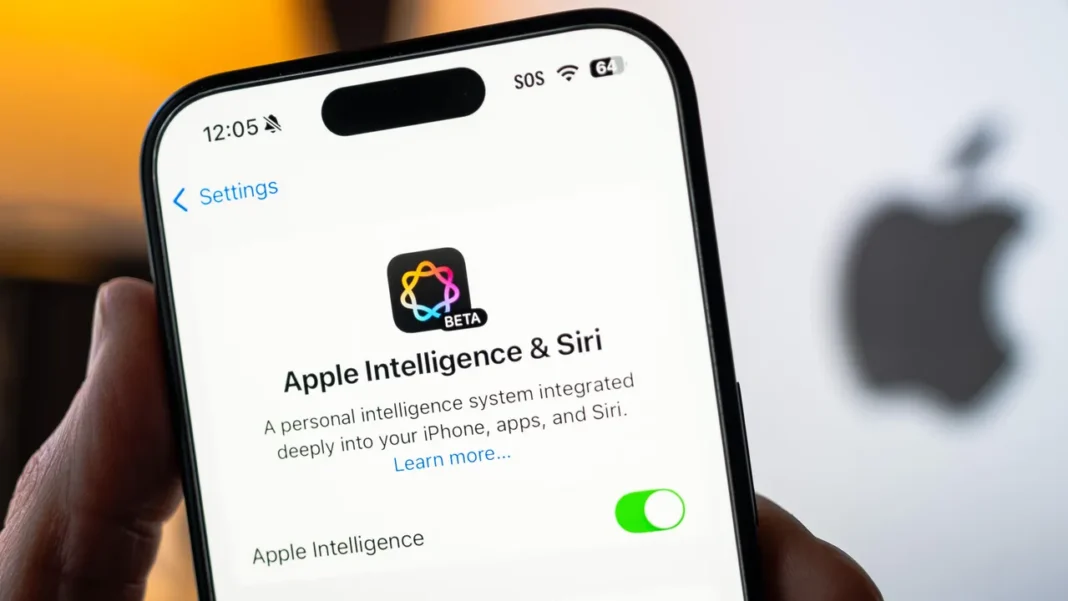
Announced with great fanfare during the last WWDC, the sequel Apple Intelligence attempts to make up for this delay. By playing the hybridization card – local processing coupled with a strategic partnership with OpenAI (ChatGPT) – Apple is showing that it is aware of no longer being able to do everything alone.
However, the sluggish deployment of these features (delayed in several regions, notably in Europe for regulatory reasons, and limited to the most recent devices) illustrates the difficulty for a liner of this scale to change course.
Results: a painful cultural transition
To successfully transition to the AI era, Apple must not only revise its code or buy start-ups: the company must carry out a cultural revolution.
Accepting being in the lead without mastering everything, accepting the imprecision inherent in generative models, and opening up to the external ecosystem are all existential challenges for a firm that was built on the opposite dogma. If Apple fails to relax its historical methods, the inventor of the iPhone risks seeing its role as technological leader eroded, gradually transforming the Apple brand into a luxury equipment manufacturer dependent on the innovations of others.
Here is a rewritten, modern, and clean version of the HTML content, maintaining the original meaning while improving readability and phrasing in French.
Apple facing the challenge of AI: an internal schedule that is too rigid
Despite its sustained efforts to catch up in the field of artificial intelligence, Apple faces a major structural obstacle: its own corporate culture. The Cupertino company continues to design its software according to a rhythm inherited from the smartphone era, where AI today requires continuous and ultra-fast update cycles.
This is the observation made by Mark Gurman, Bloomberg journalist, in his newsletter Power On from November 22.
While it is true that Apple is seeking to accelerate the development of its new products and distribute them more evenly over the year, internal teams are still seeing little disruption in their daily working methods.
A development schedule unsuitable for the AI era
At Apple, software creation remains inseparable from major annual operating system updates. Led by Craig Federighi, head of software engineering, the teams follow a process punctuated by strict steps, identified by letters going from A to G.
While this rigorous organization makes it possible to harmoniously coordinate all of the brand's platforms, it leaves very little room for last-minute adjustments.
The key features and strategic directions of iOS and other OS are generally set in stone almost a year before their launch. A historical method that has proven itself, but which shows serious limits in the face of the agility imposed by generative artificial intelligence.
Unlike Apple, AI specialists continually evolve their models and services, deploying new capabilities without waiting for any major release. When an innovation emerges from the competition, Apple finds itself forced to wait for its next development cycle to hope to integrate it.
It is precisely this discrepancy that Mark Gurman underlines: in a market where uses transform in a few months, responsiveness is now almost as important as the technology itself.
Siri: a necessary but insufficient reorganization in the short term
This organizational heaviness is directly felt in the evolution of Siri. Despite massive investments in AI, the voice assistant remains penalized by several persistent weaknesses:
- Response times sometimes too slow
- Still limited integration with third-party services
- Reliability of voice dictation regularly criticized
In an attempt to turn things around, Apple recently reduced the workforce of certain historic Siri teams. According to Bloomberg, these cuts however spared the centers dedicated to new AI systems. If these movements demonstrate ongoing restructuring, it remains to be seen whether it will be enough to close the gap with the competition.
At the same time, Apple is reportedly working on a large-scale AI agent, capable of managing complex tasks and interacting deeply with the application ecosystem. A long-term project: according to Mark Gurman, this new agent would not see the light of day before the end of 2027.
Tricky timing, because the more users adopt competing agents, the more the latter accumulate data on their habits and preferences. This increasing customization could ultimately dissuade users from switching to Apple's Assistant.
Two major assets to reverse the trend
However, the game is far from lost for the Cupertino giant, which retains two trump cards: its total control of the ecosystem (hardware and software) and its historic commitment to privacy.
By mastering its devices, its OS and its services, Apple has a unique advantage to one day offer an agent capable of acting fluidly and coherently across all of its platforms.
Additionally, data privacy is a valuable differentiator. As assistants become more and more autonomous and intrusive, Apple's data protection policy could weigh heavily on individuals and businesses alike.
A first decisive step is expected by the end of 2026, with the integration of capabilities allowing Siri to chain several actions within Apple applications. Support for third-party applications, for its part, would only be planned during the year 2027.