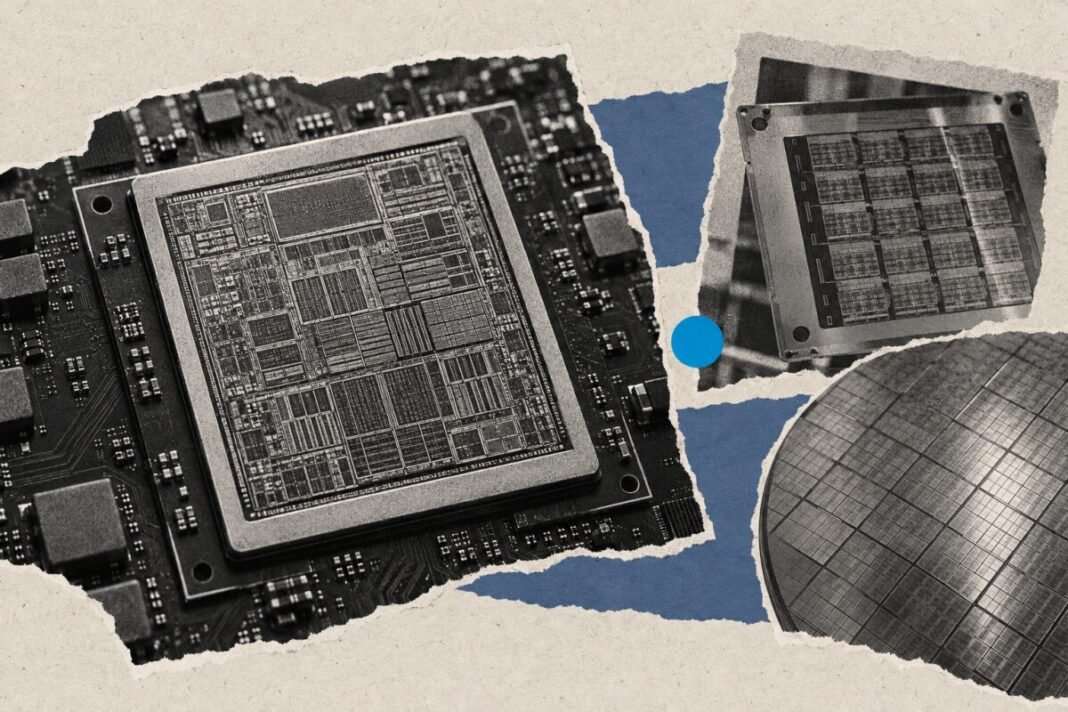
Ljubisa Bajic, co-founder and CEO of Taalas, presented the Toronto company’s first chip in February. Twenty-four people designed it for 30 million dollars, out of more than 200 million raised. On November 17, 2026, AMD finalized the acquisition of Taalas announced in August, and its quarterly report valued the operation at approximately $2.9 billion, in cash and shares. Up to about 1.4 billion of this sum is conditional.
The same document associates Taalas with World Labs, whose all-stock buyout is valued at around $8.2 billion. Both deals are expected to strengthen AMD’s model research, inference capabilities, and development of hardware and systems for “future superintelligence.” At this price, AMD is buying a method and a team. Taalas’ only product, the HC1, is listed on its product page as a technology demonstrator.
Taalas engraves the model weights into the circuit
On a GPU, the weights of a model, these billions of parameters fixed by training, reside in a fast memory placed next to the processor, the HBM, and pass to the calculation units at each token, these word fragments that the model produces one by one. Taalas eliminates this journey by bringing together storage and computing on the same chip. Its design does without HBM as well as liquid cooling, wrote Ljubisa Bajic in the launch post of February 19.
The weights are written in a read only memory programmed by the manufacturing masks. They are burned with the circuit and can no longer be rewritten. Next to it, a rewritable SRAM area keeps the context cache, which avoids recalculating for each token what the model has already read, and the LoRA adapters, these small sets of weights which specialize a model without retraining it, detailed Paresh Kharya, vice president in charge of products, at The Next Platform. A single transistor stores four bits and performs the associated multiplication, says Ljubisa Bajic, who keeps the process to himself.
The HC1, engraved in 6nm at TSMC, measures 815mm², almost the maximum surface area of a single piece chip. He wears Llama 3.1 8B, an open model from Meta that Taalas admits is “clearly not cutting edge.”
17,000 tokens per second come out of Taalas laboratories
Taalas announces 17,000 tokens per second and per user on this model, almost ten times the state of the art, for hardware twenty times cheaper to build and ten times less energy intensive. According to the legend of its graph, the company measured its chip and Nvidia’s B200 GPU in its own laboratories, and used the values for Groq, SambaNova and Cerebras from the independent comparator Artificial Analysis.
On this comparator, heise online noted for the same model approximately 1936 tokens per second at Cerebras, 916 at SambaNova and 609 at Groq. Its journalists reached nearly 16,000 tokens per second on the Taalas demo chatbot, noting that all published benchmarks came from the company. On a small model, the speed advantage is hardly in doubt.
Quality is less documented. The parameters of the engraved model are stored on 3 and 6 bits, a reduced precision which leads to quality losses compared to measurements on GPU, recognizes Taalas, without encrypting them. Its second generation, HC2, must adopt a standard 4-bit floating number format.
Changing model requires manufacturing a new chip
The chip retains a little flexibility: the size of the context window is configurable, and LoRA adapters allow the model to be refined. Beyond that, you have to redo the circuit. “You’re stuck with this model,” summed up The Register on August 6, while new models come out almost every month.
Taalas responds with its own time and cost figures. Two months would be enough to go from weights from an unknown model to cards capable of serving queries, and only two layers of metal change from one model to another. Training a model costs a hundred times more than a custom chip ordered in volume, assured Paresh Kharya in February.
The risk of obsolescence weighs on whoever orders the silicon. The Register expects the technology to be deployed mostly by model developers, their infrastructure providers, and a handful of inference providers. It is the actors who know which model they will serve, and for how long.
AMD wants to combine these chips with its Instinct GPUs
AMD reiterated on November 17 that it would integrate Taalas’ technology into its accelerator roadmap and develop system-wide solutions alongside its Instinct GPUs, without naming a product or date. The Register gave a reading in August that the group did not confirm. AMD would combine its Helios arrays, built on Instinct GPUs, with chips derived from Taalas: the GPUs would process the prompt, the most computationally intensive step, and the Taalas accelerators would produce the tokens. The site also envisaged that customers would first validate a model on GPU before having it engraved.
This sharing of roles already exists at Nvidia, whose LPX systems combine GPUs and Groq chips, noted the same article. Cerebras put so-called disaggregated inference into production on November 17, where AMD Instinct GPUs process the prompts and its CS-3 systems generate the responses. With Taalas, AMD can itself provide the generation stage that Cerebras adds to the Instinct GPUs, with a circuit dedicated to each model.
The bet stands for AMD, whose GPUs remain the tool of those who often change models. The Taalas chip will only sell where a model remains in service long enough to amortize its burn.
Quotes translated from English by ActuIA.
Our articles will be prioritized in Google’s “Featured” section.