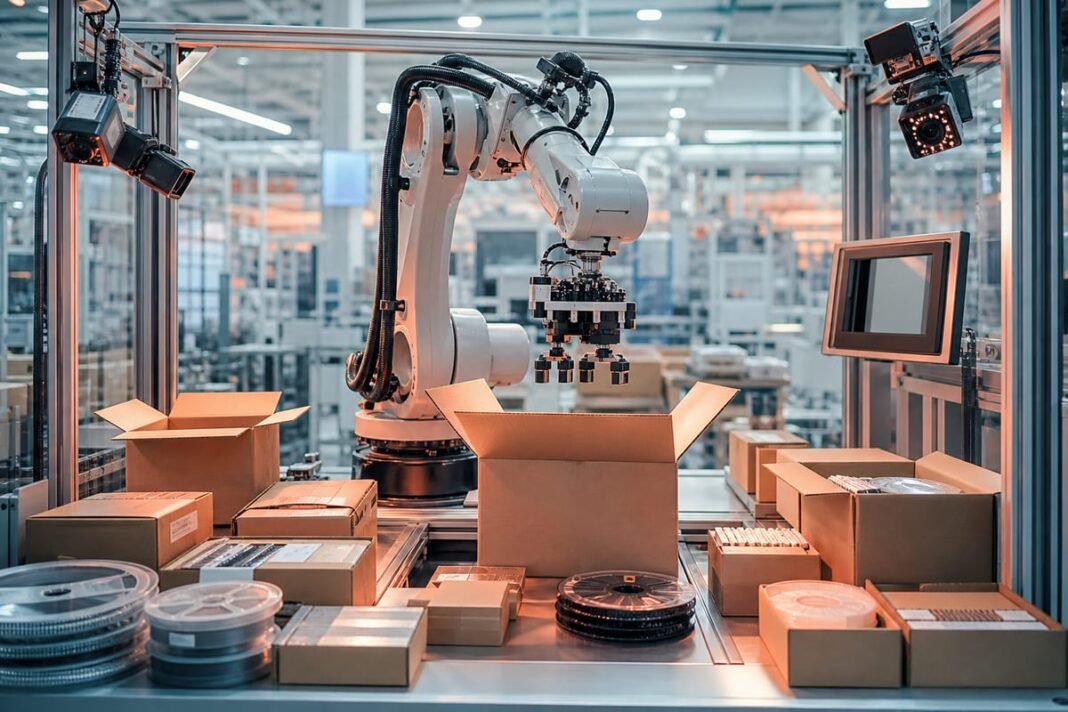
Siemens is developing a robot for its electronics factory in Erlangen, Germany, that unpacks components using AI foundation models. The manufacturer also unveiled a planning tool at the SPS 2026 show in Nuremberg, from which it expects a 70% reduction in manual planning work.
No entry into service date for the robot
No commissioning schedule has been communicated for the robot. In April, a humanoid robot was already tested for eight hours in Erlangen by Siemens and Nvidia. However, paying customers are already using similar AI systems in their warehouses: Warsaw-based Nomagic says its robots need human assistance half as often.
A deal to acquire industrial AI company Cognite was signed in June by Schneider Electric for $3.1 billion.
Variable boxes resist fixed programs
Differences in format and type between boxes prevent fixed robotic programs from handling these deliveries. Their unpacking therefore remains largely manual. The specialist site All About Industries places the factory’s daily flow at between 80 and 200 packages.
The evening letterFree · 7 p.m.
Are you following the race for AI models?
Each output (GPT, Claude, Gemini, Mistral, etc.) decrypted the same evening, in 5 minutes. Free.
Included upon registration: our selection of the best AI guides & comparisons.
Choose your pace
Free · No spam · Unsubscribe in 1 click
Announced Tuesday among Siemens’ AI tools, the project combines cameras observing the manipulation area with models trained in physical tasks, which select the actions to be performed. The device must open the packaging then extract the reels of components.
Learning is based on observing operators controlling the robot remotely. The calculation is carried out by Siemens industrial computers integrating Nvidia chips.
Siemens quantifies its planning expectations
To organize production, the Autonomous Production Planner puts several AI agents to work on developing schedules. Each of the proposals is then tested in a digital replica of the factory. In addition to the expected reduction in manual labor, Siemens estimates that costs could fall by up to 20%.
Rainer Brehm, president of automation at Siemens, attributes the next productivity boost to taking over previously impossible-to-automate tasks.