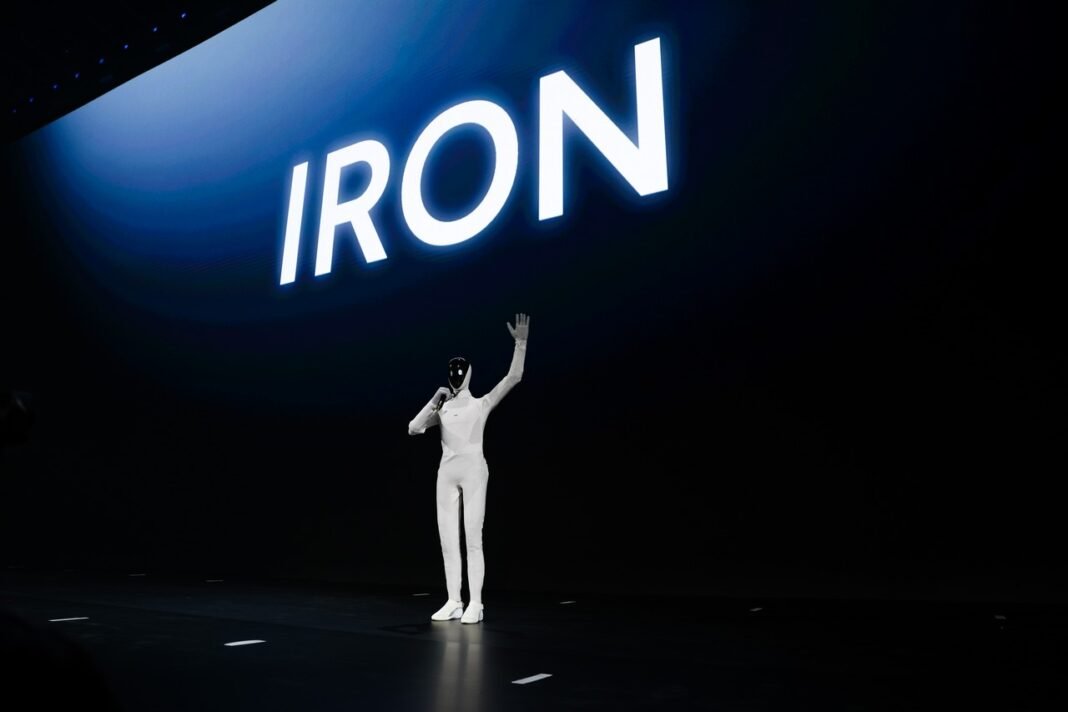
After a notable first appearance in November 2025, IRON returns with a new promise: getting out of demonstration rooms. XPeng presented its latest generation during its AI Day in Guangzhou, with a sales calendar and an order of magnitude of price.
The Chinese manufacturer has indicated that its humanoid robot could cost about as much as an electric car. At this event, IRON appeared on stage alongside He Xiaopeng, Chairman and CEO of XPeng, and answered questions from the audience live.
IRON had already attracted attention during the November 2025 event, with a very natural gait, close to that of a human.
A price close to that of an electric car
On November 26, in an interview with Bloomberg TV, Brian Gu, vice president and co-president of XPeng, said that IRON could be sold around the median selling price of an electric vehicle, without giving a figure. He did not specify whether he was talking about XPeng cars or electric vehicles in general. The manufacturer’s models sell for around 18,000 dollars.

IRON is to be trained as a sales assistant at XPeng dealerships in China in the first quarter of 2027, before being released to the public in the second quarter. XPeng is targeting sales of several tens of thousands of humanoid robots in 2027. This year will therefore be decisive in knowing whether robotics activity can move from technological demonstration to real commercial results. “The industry must go beyond technology demonstrations and prove that robots can create real-world valueHe Xiaopeng said.
A machine designed to perform tasks
IRON doesn’t just look like a human. It has 76 degrees of freedom, including 21 for the hand, more than 1,500 points of tactile perception and three Turing AI chips designed by XPeng, with a power of 2,250 TOPS. They run its onboard AI models and control the entire body.
According to XPeng, the robot navigates autonomously, receives its tasks by voice or through a dedicated application, recharges itself then resumes its work, reports anomalies and monitors its own operating status. It’s designed to perform real tasks, not just stand or move like a human. Its mass production is planned for January 2027, on a line designed to release a robot every 2.5 minutes at full capacity.
From commerce to industry, then home
XPeng plans to expand IRON from businesses to industrial sites, and eventually to homes. Brian Gu judges that it may take another year or two after a successful commercial deployment to consider domestic use. The main challenge: that the robot works safely around children, the elderly and pets.
IRON could therefore one day fold laundry or help with household chores, but it should not enter homes from next year.
Recurring revenue beyond sales
In addition to hardware, XPeng plans to generate regular revenue from software subscriptions, feature updates, training and services. The press release also mentions an open ecosystem, where developers and partners will be able to create and validate skills, and subscription plans based on tokens. The idea is to continue making money after the robot is sold.