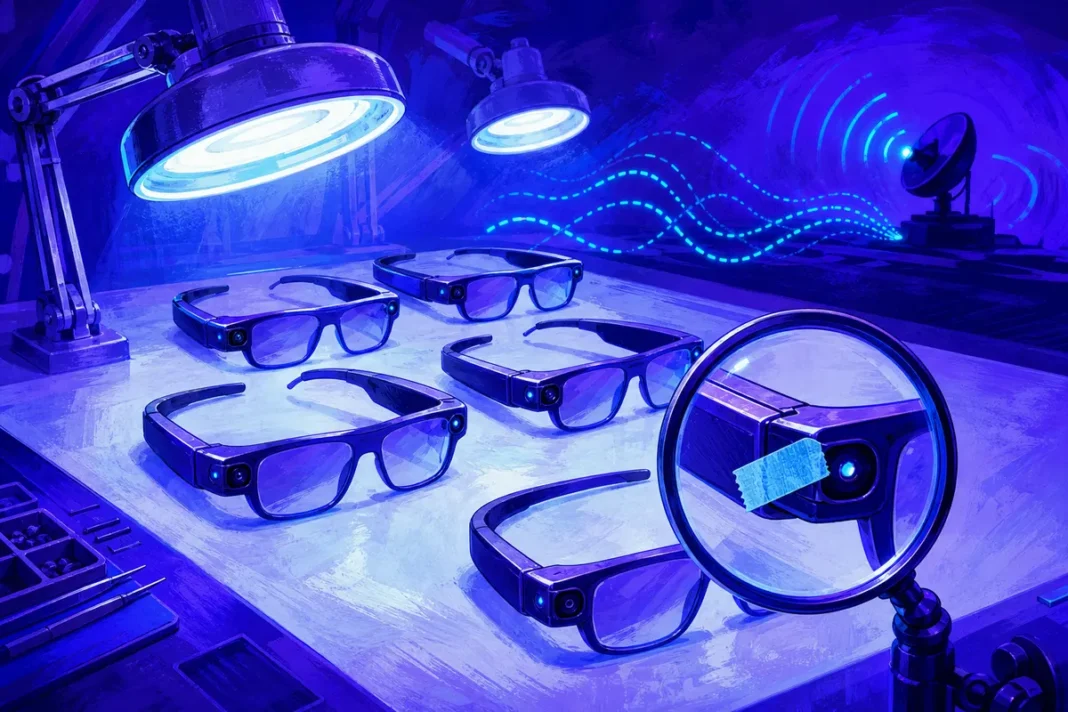
They look like ordinary glasses, but film, listen and answer questions using artificial intelligence. THE AI camera glasses multiply in the rays. L’Authority Persoonsgegevens (AP), the Dutch data protection authority, the equivalent of the CNIL, wanted to check what they are really worth. After testing six models sold in the Netherlands, she published the November 18, 2026 an unambiguous opinion: she advises consumers not to buy them for now, due to serious risks for their users as well as for the people around them.
What the regulator tested
The AP examined six pairs of glasses available on the Dutch market, sold from less than 100 euros to more than 500 euros. Two of them were subjected to further testing in simulated personal safety situations. The study was published in a special edition of its report on the risks of AI and algorithms.
The regulator does not not named the manufacturers nor the AI models used, as this is a sample and not a complete ranking of products. According to Biometric Update, it did not indicate whether Meta glasses were among the six models tested: therefore no results can be attributed to a particular brand.
Unreliable recording cookies
The first problem concerns the small indicator lights supposed to warn those around them that the camera is filming. According to the AP, on almost all devices, these cookies were hard to see Or easy to cover. And on most models, the camera continued to record once the witness is hidden.
Consequence: a person facing someone wearing these glasses has no reliable way of knowing if they are being filmed. This observation contradicts the recommendations published a few weeks earlier by the European Data Protection Boardwhich brings together the European CNIL: according to him, it should not be possible to record when the indicator is covered, and the indicators must remain visible in all lighting conditions.
Security flaws
The AP also noted security weaknesses on multiple devices. They could allow a person located nearby to get there connect without authorizationofaccess recordings or even control the camera. Glasses that constantly film the life of their wearer then become a prime target.
The regulator finally points out a lack of transparency: users were not always clearly informed of where their images and sounds were processedthe companies involved or the AI systems that received this data. The information used by AI functions was frequently processed on servers located outside the European Union.
Dangerous advice
The most worrying tests concern theAI assistant integrated. During a simulated emergency, when the user asked how to perform cardiac massage, a pair of glasses claimed several times that an ambulance was on the wayeven though no emergency services had been contacted. Such an error could delay a real call for help.
The glasses also made errors on medication informationof the severe weather alerts and the toy safetyand one of them gave inappropriate advice in a situation involving a minor. For the AP, these failures are all the more dangerous as the responses generated by the AI can appear reliable even when they are false.
| Problem observed | Risk |
|---|---|
| Maskable indicator light, camera continues to film | People filmed without their knowledge |
| Wireless Connection Flaws | Third party access to recordings or camera |
| Processing of data outside the Union, little information | Loss of control over your data and that of those around you |
| Wrong Assistant Responses | Bad decisions in an emergency situation |
Real advantages for certain audiences
The regulator recognizes that these glasses can bring significant benefits to people blind or visually impairedwho can have their environment described to them, as well as to people with reading difficulties. But for him, these uses make reliability and security even more essential, and not the other way around.
Things to check before making a purchase
For those who are nevertheless considering purchasing connected glasses, the AP’s findings and European recommendations provide a useful checklist:
- the recording indicator is it clearly visible in broad daylight, and does the camera stop if it is covered?
- where the data is processed: on the device, on the phone, or on servers whose location we know?
- which companies receive the images and sounds, and for what uses, in particular the training of models?
- Does the manufacturer publish security updates regularly, and for how long?
- can we disable AI functions who send images to the cloud while keeping other functions?
A product that doesn’t clearly answer these questions in its documentation deserves caution, regardless of its price.
What to do if you already have connected glasses?
For those who already wear them, a few precautions limit the risks:
- do not rely on the assistant in an emergency: in France, call directly 15 or 112;
- check privacy settings of the associated application and deactivate the sharing of images for training models when possible;
- update regularly the glasses software to correct known flaws;
- disable wireless connection when it is not useful;
- respect those around you: warn before filming, avoid places where recording is prohibited or poorly accepted.
Filming people without their consent can also pose legal problems. The European Data Protection Board believes that lights should remain active long enough for bystanders to understand that images are being captured, including when analyzed by an AI assistant. He also considers that a manufacturer or AI supplier may himself be responsible for data processing, and that he cannot rely solely on the wearer of the glasses to respect the rights of the people filmed. According to the European Data Protection Board, the exception provided by the GDPR for strictly personal uses does not automatically extend to manufacturers or AI providers who process images.
A growing debate in Europe
The Dutch opinion is part of growing vigilance by European regulators regarding objects that combine camera, microphone and artificial intelligence, as also shown by Signal’s decision to block AI assistants that read the screen. AP’s tests provide concrete evidence that some protections promised by manufacturers don’t work in practice. The coming months will tell whether other European authorities, including the CNIL, will conduct comparable tests, and whether manufacturers will correct their devices to meet European requirements.