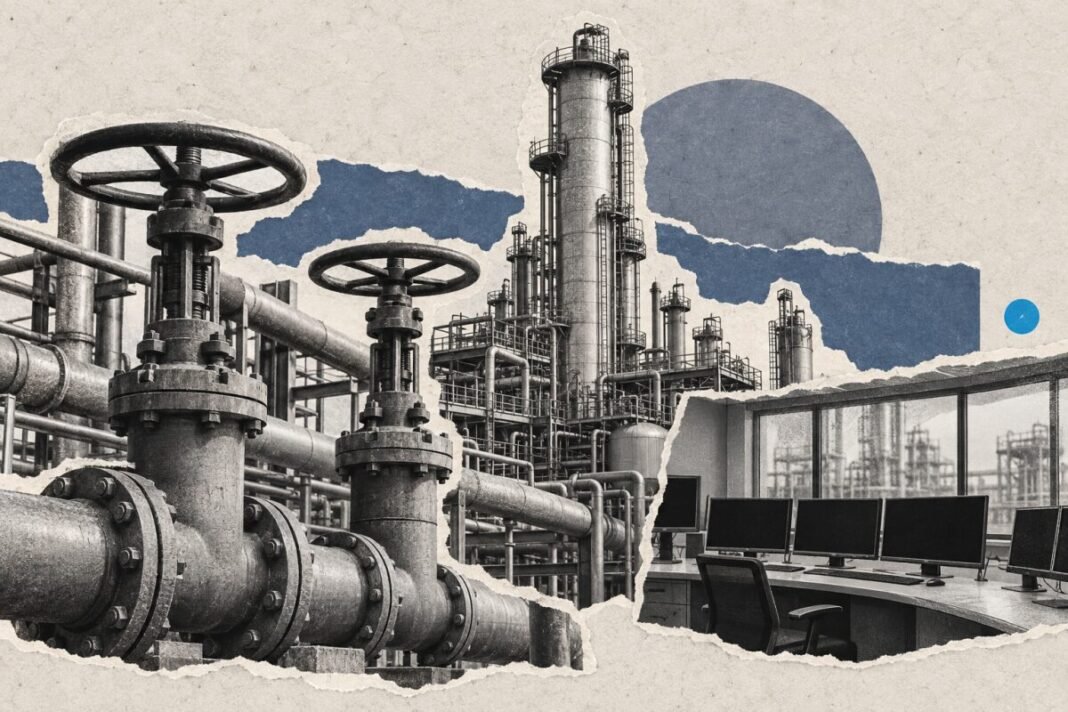
Yokogawa has deployed more than 30,000 CENTUM systems in more than 100 countries since 1975. Version R7.02 of this digital control system (DCS), released on November 19, 2026, includes among its standard functions process control by reinforcement learning, a technique that the Japanese manufacturer has been developing since 2018 and which has been operating a distillation column in a chemical factory in Japan since 2022. Yokogawa announced this release on November 17.
An AI control block joins classic regulators
The function, called AI Control, is installed in the field control station (FCS), the controller that executes the control loops. Its model is produced by FKDPP, a reinforcement learning algorithm developed by Yokogawa and the Nara Institute of Science and Technology (NAIST), then imported into FCS, where an “AI control block” calculates commands based on it, according to the product page. The operator follows it from his usual position, like a PID regulation.
Yokogawa targets operations that neither PID nor advanced control (APC) can automate and that experienced operators still adjust by hand, when it is necessary to arbitrate between quality, product volume and energy consumption. The press release describes this AI as autonomous, capable to a certain point of handling situations that it has not encountered.
The second AI function, AI Estimation, is a software sensor. A model learned on site history estimates a product concentration or quality in real time from temperatures, pressures and flow rates, where the plant otherwise relies on laboratory analyzes or periodic measurements. It runs on a separate station. Its display indicates the weight of each variable in the result.
The technique has been operating a Japanese distillation column since 2022
The first test lasted 35 days, from January 17 to February 21, 2022, at the Yokkaichi plant, in the elastomers activity of JSR which became ENEOS Materials the following April 1. The AI operated two valves of a butadiene distillation column, the raw material for synthetic rubber, to maintain the liquid level by making best use of residual heat. The site’s DCS and APC struggled to automate this adjustment, which operators did by hand, reports the Yokogawa case study. On March 30, 2023, the two companies announced the official adoption of the algorithm on this column, with 40% less steam to hold the level compared to manual driving.
The unit kept its interlocks and safety instrumentation, and a procedure was planned in case the AI failed, according to the March 2022 release. The production team sums it up in the case study: “we can simply shut down the AI and return to normal driving.”
Yokogawa marketed the algorithm for the first time on February 27, 2023, as a service for its e-RT3 Plus controllers, with optional consulting and training. On October 29, 2025, it announced the deployment, in three phases, of several coordinated FKDPP agents on the acid gas removal unit of the Fadhili plant, operated by Aramco in Saudi Arabia. The first results, 10 to 15% less amine and steam and around 5% electricity saved, were then the subject of a detailed evaluation.
R7.02 brings the algorithm into the group’s central system. Mitsuhiro Yamamoto, who heads Yokogawa’s systems division, sees it as “the first step” towards CENTUM Future, the program announced in 2025 to transition factory operation from automation to autonomy.
European regulation does not classify chemistry among critical infrastructures
In Europe, Annex III of the AI regulation classifies security components used in the supply of water, gas, heating or electricity as high risk, sectors that Yokogawa counts among its markets. Chemistry and refining are not included. Since the digital omnibus adopted on July 8, 2026, Article 6 clarifies that a system used solely to optimize performance, automate or control quality is not a safety component unless its failure endangers health and safety. In a gas unit or a power plant, the classification of a block which controls the valves will therefore depend on the risk analysis of each installation.
The high risk requirements will apply from December 2, 2027 for Annex III and from August 2, 2028 for regulated products in Annex I, according to Article 113 amended by Regulation (EU) 2026/1744. ActuIA keeps a record of these deadlines up to date.
The operator evaluates the model himself before commissioning
The November press release describes the method. The AI trains in repeated cycles on a simulator which reproduces the behavior of the process. The customer then evaluates the reliability and validity of the resulting model, which is finally applied to the operation of the installation with safety functions.
Previous projects distributed this work differently. In Yokkaichi, the model was judged on past data and then in real time, with the opinion of the site’s experienced operators. In Fadhili, Yokogawa writes that he built the simulator himself, trained the agents then evaluated their reliability and validity. By delivering the block with the standard software and entrusting the evaluation to the operator, the manufacturer now treats as a product a technique that it has until now offered in the form of a service and projects carried out with its customers.
In Yokkaichi, during the 35 days of 2022, a member of the production team received several calls from operators asking if they could turn off the AI. She operated the floodgates in a way they wouldn’t have thought of. They ended up letting her drive.
Quotes translated from English by ActuIA.
Our articles will be prioritized in Google’s “Featured” section.