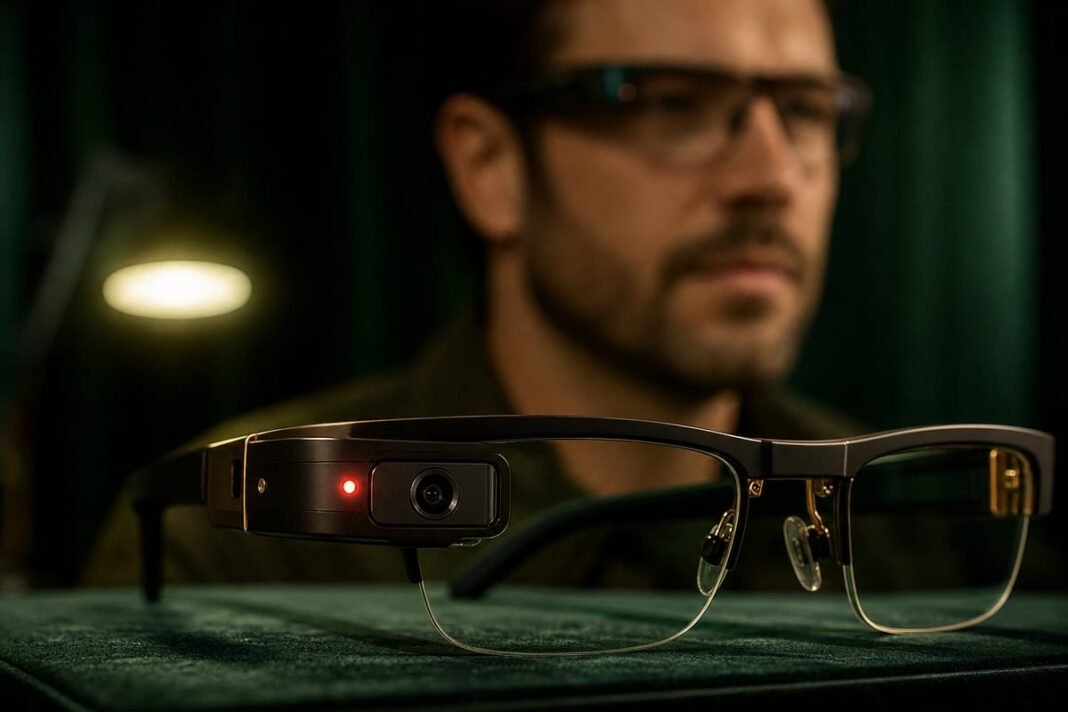
The Dutch Data Protection Authority (DP) advises against purchasing AI-equipped glasses after reviewing six models. His warning, issued this week, targets dangerous responses from assistants as well as the security of the devices and the protection of the people filmed.
Easy-to-hide recording lights
At the British Parliament, a pair made in China, selling for £60 ($78), passed scanners comparable to those at airports during an investigation by The Observer and BBC Radio 4. It could decipher upside-down documents on MPs’ desks. Contact details, including addresses and telephone numbers, could be recorded and then viewed later.
These devices may look like regular glasses. According to the AP, the light indicating a capture was inconspicuous and could easily be hidden on almost all of the devices examined. Some could even be modified to continue filming with this hidden witness, contrary to the assurances often put forward by manufacturers. For the authority, people around can therefore hardly know if a camera is recording them.
Third parties can access devices
The AP’s tests also revealed unauthorized access: a person close to the wearer could connect to the glasses and view recorded sequences. On some devices, she could also take control of the camera.
The authority also states that AI functions are based on data processing by servers located mainly outside the European Union. She considers the explanations given to users on the fate of the data captured and their processing by AI insufficient. In September, she had already recalled everyone’s right to respect for their private life and pointed out risks concerning the GDPR as well as the training of models.
The assistant announces help never called
In a cardiopulmonary resuscitation scenario, a pair assured the wearer that help had been contacted and was arriving. However, no call had taken place, reports the AP. In another trial, dating advice was provided to an adult who expressed interest in a minor.
The evening letterFree · 7 p.m.
Are you interested in AI and its regulation?
Laws, frameworks and decisions that shape AI, deciphered in French. Free.
Included upon registration: our selection of the best AI guides & comparisons.
Choose your pace
Free · No spam · Unsubscribe in 1 click
Other failures concerned the understanding of instructions: warnings accompanying toys were poorly handled, pharmaceutical leaflets misread and extreme weather warnings misinterpreted. Monique Verdier, vice-president of the AP, believes that bad life-threatening advice crosses an additional threshold compared to the problem of recording without people’s knowledge. While recognizing the possibilities of AI, she considers that the devices examined do not, at this stage, justify the necessary trust.
Models tested at all prices
The models selected covered prices ranging from less than €100 ($110) to more than €500 ($550). Two underwent extensive testing in simulated scenarios where life safety was at stake. The AP did not provide any commercial references.
A spokesperson also refused to attribute a specific failure to a device recognizable by its price, particularly in the example of a pair costing €354. He said the research focused on the general risks of these glasses.
These glasses can provide assistance to people who are visually impaired or have difficulty reading, as well as help in understanding the environment. The AP nevertheless considers current products dangerous, both for those who wear them and for people nearby.
Organizations are already banning these glasses
Before its August event, DEF CON announced their ban, using the derogatory nickname “pervert glasses”. The decision was widely welcomed among participants. Eva Galperin, director of cybersecurity at the EFF, had notably approved it publicly.
Monopoly Events, which organizes Comic Cons in the UK, has also imposed similar restrictions, as have pub chain Wetherspoons and Immigration and Customs Enforcement (ICE). In September, the AP itself encouraged organizations to prohibit this equipment when necessary.
Monique Verdier calls on politicians in the Netherlands and Europe to take the trial results into account when making decisions on AI. She defends collective learning in the face of these products which she describes as high risk. In his eyes, a general ban can provide respite without constituting an indefinitely tenable response; it calls for developing awareness, resilience and ethical awareness.