The number displayed was the one written on the back of his bank card. After twenty-one minutes of calling, two fraudulent transfers were executed. The Paris judicial court ordered BNP PARIBAS to reimburse 8,861.34 euros and BOUYGUES TELECOM to guarantee the bank. From the call to the receiving account, the case shows how fraud passes through several control systems before the courts decide who bears the cost.
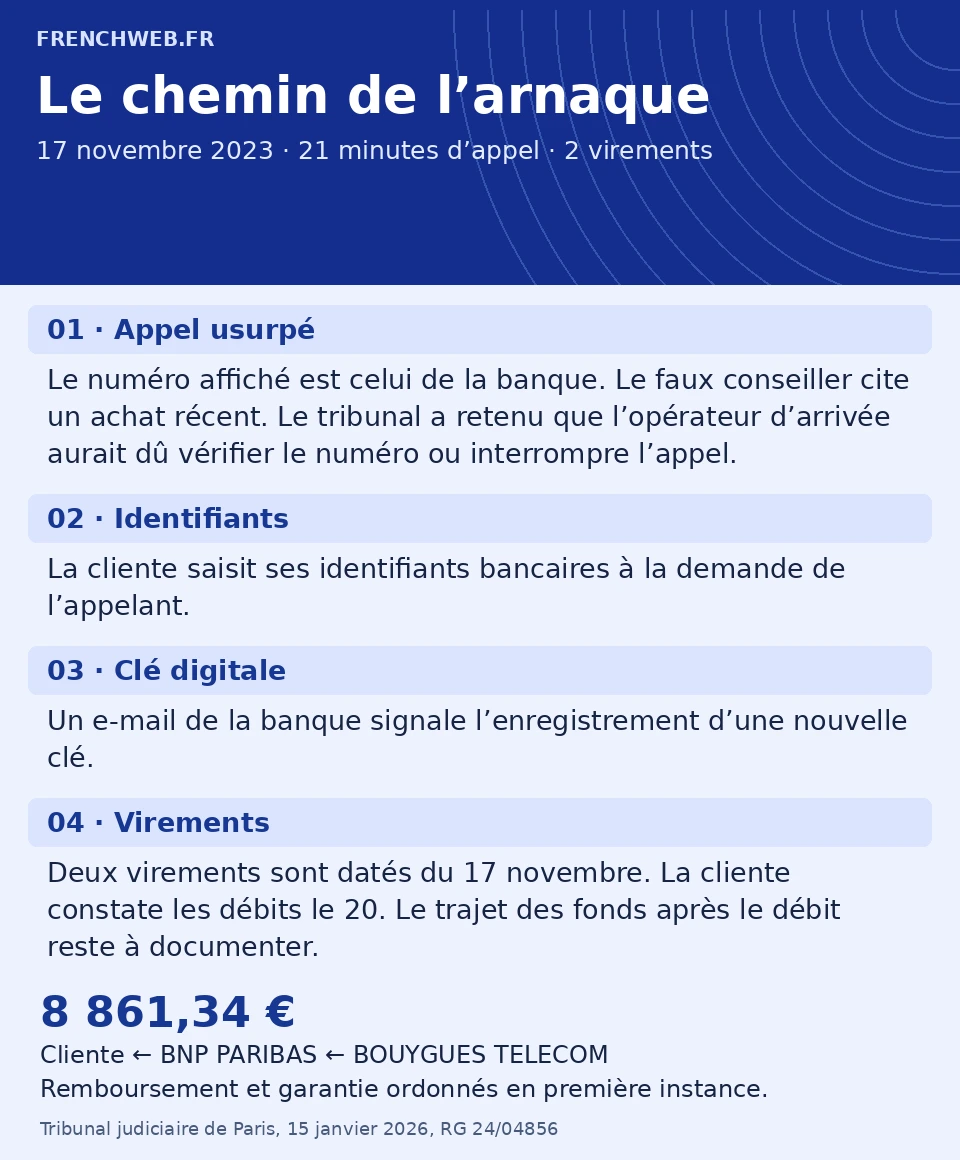
On November 17, 2023, a BNP PARIBAS customer received a call. His interlocutor tells him that a fraudulent payment is in progress. At his request, she enters his customer number and the password for his banking area, thinking of blocking the transaction. An email from the bank then tells him that a new digital key has been registered. The fraudster also mentioned a recent purchase, a detail noted by the court to explain the credibility of the call. After hanging up, the customer calls her bank at the number written on her card, changes her password and opposes it on her advice. The transfers are dated November 17 in the judgment. She notes the two flow rates on November 20. BNP PARIBAS refuses to reimburse it.
The customer summons her bank. The bank in turn involves BOUYGUES TELECOM, the customer’s operator. In its judgment of January 15, 2026, the court linked the banking loss to an event that occurred upstream. The number presented on the screen helped give the customer confidence, and the operator should have verified its authentication or interrupted the call. The scam followed the route of the call then that of the money. The procedure went up the chain in reverse.

From the first call to the protest
| Stage | What should alert the customer | Who can act, and when they can be held responsible |
|---|---|---|
| 1. A call announces fraud in progress | The caller demands immediate action. The number displayed and the mention of an actual purchase can make his story credible. The way to verify your identity is to hang up and call the bank from the app or the number on the card. | Departure, transit or arrival operator. The role of each person depends on the route of the call. A failure to comply with the authentication or interruption obligation may render the operator liable if this failure contributed to the damage. In this case, the court accepted that of the incoming operator. |
| 2. The fake advisor asks for credentials or validation | A request for a password, one-time code or validation in the application during the call is a red flag. In other variations, the scammer offers a transfer to a supposedly secure account or announces that a courier will come to collect the card. | Customer’s bank. Login, device enrollment, and authentication traces help verify what controls have been applied. A failure at this stage must be established from the traces of the operation. |
| 3. A digital key is registered, then the money leaves | An activation notification that the customer did not request calls for immediate verification through an official channel. If a message indicates that a payment is to be validated while the caller is talking about canceling it, interrupt the operation. | Issuing bank. The unauthorized payment reimbursement scheme applies. Authentication data is not sufficient to establish customer consent. The bank must substantiate the fraud or serious negligence that it claims against it. |
| 4. The funds arrive at the beneficiary | When an unknown debit appears, notify the bank immediately and ask it to initiate a fund return request. | Issuing bank and receiving institution. The first transmits the return request. The second occurs according to the state of the funds and the applicable rules. Its responsibility would imply identifying an obligation incumbent upon it, a breach and a link with the loss. The public record does not allow us to decide this point. |
| 5. The victim contests the two transfers | Keeping the time of the call, the bank notification and the transaction references makes it possible to reconstruct the sequence. | Bank, then operator in the event of an appeal. In this case, the court ordered BNP PARIBAS to reimburse the client and BOUYGUES TELECOM to guarantee the bank’s conviction. |

Practical guides · Cybermalveillance.gouv.fr · Banque de France · Public Service
The bank number crossed the network
For a number to appear on the screen, it has first been presented to the telephone network. In the French number authentication mechanism, the originating operator signs its customers’ calls. The operators who transport them and the one who delivers them to the recipient verify the authentication information. In this case, the court identifies BOUYGUES TELECOM as the incoming operator. The number displayed establishes what the customer saw. Tracing the call would require knowing its entry point and the checks carried out on the intermediate networks.
The legal obligation has been in force since July 25, 2023. In practice, the gradual deployment of the system began in October 2024 for calls to landlines, then in January 2025 for mobiles, according to Arcep. BOUYGUES TELECOM cited the complexity of collective deployment. The court noted that the operator had not explained what prevented it from complying with the law on the date of the facts, nor why it had allowed this call to go through. The regulator opened an investigation in January 2026 to establish the route of calls whose numbers were spoofed. It had recorded more than 19,000 reports in 2025, compared to 531 in 2023.
A new digital key, then two transfers
Once the call is made, the alert changes in nature. The number displayed made the interlocutor credible. The email reporting a new digital key indicates that a change has been recorded on the account. The judgment makes it possible to reconstruct this succession. It leaves open the terms of registration of the key and the detailed chronology of operations. These elements would make it possible to determine which signals were visible to the bank when it could still intervene, and whether the orders had already been executed when the client called back. A new device, an added beneficiary and an unusual amount are leads to check in the logs. The judgment does not establish that these three signals were present.
For the bank, the authentication of a payment and the consent of the holder are two separate issues. In the BNP/Bouygues case, the transfers were deemed unauthorized and the bank did not establish serious negligence on the part of the client. In March 2026, in another false advisor case, the Court of Cassation asked the first judges to also examine the message sent by the bank. He said the action was going validate a paymentwhile the false advisor spoke of a cancellation. The number displayed reassured the customer. The content of the bank message could give him reason to doubt.
Another case shows how far staging can go. On March 11, 2026, the Paris judicial court rejected a request for reimbursement after examining the succession of calls and the handing over of the bank card to a courier. The guarantee call by BNP PARIBAS against BOUYGUES TELECOM then became irrelevant. For the victim, the announcement that a courier will come to collect the card is in itself a warning signal.
The account that receives the money enters the equation
Once the transfer has been executed, the issuing bank can request the return of the funds. The public judgment does not specify either the identity of the recipient establishment or whether such a request was made. To assess the possibility of recovery, it would be necessary to reconcile the time of the report, the time of transmission of the request and the moment when the funds left the recipient account, if they left. The return of funds and the reimbursement due to the victim are two separate processes. Since October 2025, a check also takes place earlier in the process of SEPA transfers. Before validation, the service provider checks the match between the name entered and the IBAN holder. The detection of risky accounts and transactions constitutes another project for banks and their suppliers. See also our article on ACORU and the detection of bank fraud. Banque de France, incidents and disputes relating to SEPA transfers
In Limoges, the court was able to identify the recipient bank. It was also that of the victim. After trying to pay a fine on a fake site imitating ANTAI, a BNP PARIBAS customer received a call from an alleged advisor from the fraud department. She had added a beneficiary presented as a secure account and validated the first two transfers herself. On November 3, 2025, the court ordered the reimbursement of the four contested transactions, namely 8,000 euros. He considered that the bank had not established serious negligence and noted, in addition, that it could verify the identity of the recipient account holder since it held it itself.
The timing of the events matters. In December 2025, in a RIB substitution case dating back to 2022, the Paris judicial court ordered a notary to pay 64,891 euros and excluded the responsibility of CIC, the bank of the recipient account. According to the rules then applicable, the CIC could process the transaction on the basis of the IBAN transmitted. The transfer was made three years before the entry into force of beneficiary verification for SEPA transfers.
The UK has given a direct financial interest to the institution receiving the money. Since October 2024, when an eligible domestic transfer has been made by a deceived victim, the issuing service provider has reimbursed them under conditions, with an ordinary ceiling of 85,000 pounds. The receiving service provider bears half the cost. The British regulator counts 316 million pounds repaid between October 7, 2024 and March 31, 2026, i.e. 88% of losses within the measured area. This data concerns all transfer scams covered by this monitoring.

The invoice goes back to the operator
In Paris, BNP PARIBAS obtained BOUYGUES TELECOM to guarantee its conviction for a breach specific to the operator. On the basis of article 1240 of the civil code and article L. 44 of the postal and electronic communications code, the judge found fault and its link with the damage. On the banking side, the customer’s gesture after the call also weighed in the assessment. She called her bank again and followed their instructions. The court found that BNP PARIBAS had not established gross negligence. In another case, judged in November 2025, the court ordered the same bank to reimburse 16,964 euros after fraudulent portability, and FREE MOBILE to be guaranteed 50% convictions. In one case, the fault identified concerns the routing of the call. In the other, it concerns the verification of the identity of the person who requested the transfer of the line. The call from BOUYGUES TELECOM was reported by our colleagues fromWhat to Choose.
Germany, for its part, intervenes upon entry into the network. It requires the masking of German numbers presented by calls from foreign networks, with an exception for mobiles which takes roaming into account. Singapore has set in advance the order in which breaches are reviewed for certain phishing frauds. The financial institution comes first, then the operator, whose obligations relate in particular to SMS. Australia has also included digital platforms in its system, with the bulk of obligations planned for March 2027. The scam can start before the phone rings, for example with a fraudulent ad.
Brussels wants to cover certain transfers authorized under manipulation
In France, fraud by manipulation has reached 516 million euros in 2025either 41.6% of the total amount of payment fraud. This total includes fake advisors, but also other operating methods, including president fraud and IBAN substitution. The European draft regulation on payment services addresses a case that escapes the logic of the Parisian file. A consumer makes a payment himself after being deceived by a scammer posing as his service provider. The Council’s position, published on November 5, provides for reimbursement under conditions. The second reading in Parliament is tentatively scheduled for December 14.
In the BNP/Bouygues file, the number on the back of the card was enough to give credence to the call. The court established the role of this display in the fraud. Arcep’s investigation goes further back, to the networks that carried the call and the controls that could have stopped it before the number appeared on the screen.
Sources and references
Court decisions
- Paris Judicial Court, January 15, 2026, n° 24/04856 · BNP PARIBAS and BOUYGUES TELECOM
- Paris Judicial Court, March 11, 2026, n° 24/03553 · Case of the fake courier
- Limoges Judicial Court, November 3, 2025, n° 24/01340 · Fake ANTAI site and recipient account
- Paris Judicial Court, December 15, 2025, n° 23/03458 · Substitution of RIB
- Paris Judicial Court, November 25, 2025, n° 23/09531 · Fraudulent portability and FREE MOBILE
- Court of Cassation, March 4, 2026, n° 24-19.588 · Payment validation message