CyberLink’s PowerDirector sits halfway between entry-level and professional video editing software. It makes advanced editing accessible to both amateur creators and prosumers, while offering features appreciated by professionals. Best of all, PowerDirector runs on standard hardware, so you don’t need to invest in a high-powered editing machine (like I did with a Mac Studio/M3 Ultra/96GB RAM).
The company has invested in AI-powered workflows, including prompt editing, generative video tools, and automated editing, to create comprehensive video editing software. While the AI features are impressive (I’ll get to that in a moment), I want to focus on the editor itself first, as that’s the core of PowerDirector.
When I first installed PowerDirector, I did it on a virtual machine running Windows 11 and encountered nothing but problems. After switching to my MacBook Pro M1, everything went smoothly. Don’t make this mistake.
Advantages and disadvantages of PowerDirector video editing software
Benefits
- Editing tools do not require in-depth knowledge to master
- Powerful color grading options
- AI integration is seamless and can even be used to edit or grade your videos
- Friendly user interface
Disadvantages
- Using AI Features Can Be Expensive
- Text to AI conversion is hit or miss
- A separate application is required to manage AI licenses and credits.
PowerDirector as editor
The editor is arguably PowerDirector’s main asset. This is mainly due to its simplicity. Add clips to the library, drag a clip to the timeline, start editing, add transitions and effects, add overlays, or whatever you need. While I don’t think PowerDirector is on the same level as DaVinci Resolve, it effectively simplifies tasks that might otherwise be too complex for the average user. Particularly in other less intuitive applications.
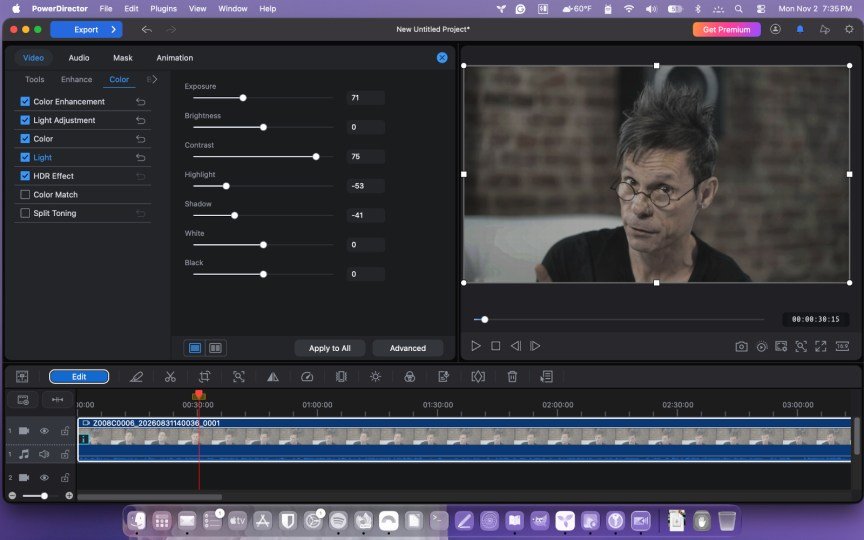
Instead of having to create node trees in DaVinci Resolve, simply load your clip, click on “Light Adjustment” for example and move a few sliders to immediately see the result. There are no complications with PowerDirector, which means that virtually anyone can get started and get used to it. It took me a few years to feel comfortable enough with DaVinci Resolve and really feel like I knew what I was doing. I jumped into PowerDirector and figured out how it worked in seconds.

Jack Wallen/ZDNET
For example, I was able to take Log format footage from my ZCAM E2-F6 and calibrate it quite quickly using the simple color sliders. I increased the saturation, used the built-in auto white balance tool, and within seconds the clip already looked great. I added a transition at the beginning and end, and the clip was ready to export. All this took me barely two minutes.
A multitude of effects, LUTs, transitions, decorations, frames
In addition to this easy-to-use editor, the app offers a host of effects, LUTs, transitions, decorations, frames and other enhancements. You will therefore not need to search for plugins, as would be the case with Final Cut Pro or DaVinci Resolve. I’ve spent way too much money on plugins for Final Cut Pro and DaVinci Resolve, so believe me when I say that the fact that they’re all integrated is a real plus.

Jack Wallen/ZDNET
Even if you’re not going to produce Netflix-worthy videos, you’ll find the PowerDirector editor immediately accessible and intuitive, with enough power to give you considerable room for improvement. I’d even go so far as to say that PowerDirector might be a better first video editing software (seriously) than Final Cut Pro (and certainly DaVinci Resolve).
What PowerDirector achieves with AI
PowerDirector also integrates several AI-based features. Some are excellent. Others are more debatable. Here are some of its abilities:
- Generating videos from text.
- Generating videos from images.
- Interactive chat assistant for timeline edits, frame generation, audio enhancement, and troubleshooting.
- AI narration and auto-editing automatically sync imported folders of raw footage and photos to create a structured, timed rough cut.
- Generate custom, royalty-free backing tracks and musical structures tailored to the exact duration of your project.
- AI background removal and object hiding.
- AI object tracking and face blurring.
- Image interpolation.
- AI audio denoising and wind noise removal.
- Voice cloning and speech synthesis.
- Voice recognition and automatic subtitling.
This is definitely an impressive list of features. But does it work? While I haven’t tested every feature, I reviewed what I consider to be the most important tasks to determine if PowerDirector would be a tool I would add to my digital toolbox.
AI-powered auto-editing
One of the AI features that will appeal to most users (especially those who don’t have much editing or grading experience) is the AI-based auto-editing feature. With this option, you can tell PowerDirector how you want your clip to look, and the software will do its best to follow your description. Granted, I could do this manually (which I would prefer), but if you’re not familiar enough with editing and color grading, this can save you a ton of time.
Another notable AI feature is image generation in video. I found this option more reliable than converting text to video. All I had to do was upload an image, select a style, and PowerDirector generated a short clip from the information provided. Obviously, as with any generative AI, there are limits.
During my testing, I had PowerDirector create multiple videos using its built-in AI tools. In most cases, the clips I was able to make were limited to 30 seconds, which didn’t surprise me since the tool isn’t designed to create feature-length films using AI. I’m going to show you two specific workflows that I tested.
1. From image to video
First, I wanted to see what the “image to video” AI functionality was capable of.
I decided to use the “Horror Movie” template and a photo of a cat under a tree.
For this task, PowerDirector impressed me. He turned this adorable image of a cat under a Christmas tree into a haunting 10-second clip, in which the cat ventures down what looks like an evil passage through the tree, leading to a blood-red abyss. Well done.

Jack Wallen/ZDNET
2. The big AI test
It was time to test the text-to-video AI functionality. I decided to push the AI to its limits to see what it was capable of, so I entered the following instructions:
“A wide-angle, cinematic shot of a huge medieval battlefield at dawn. Two opposing armies clash in a muddy, fog-filled valley. On one side, knights clad in weathered steel plate armor and red surcoats charge on horseback; on the other, an infantry line of spearmen and archers stands firm. Smoke from burning siege towers in the distance hangs in the air; arrows cut through the morning sun with golden orange hues; earth and debris burst out from under the hooves, high level of detail, raw realism, 8K resolution, shot with a 35mm lens, spectacular lighting – 16:9” format.
Once the instructions were entered, I noticed that it would take 266 credits to generate the video. I had enough, so I clicked “Generate”. Given the complexity of the brief, I knew it would take some time for the cloud-based AI to generate the video. Yes, you read correctly: the AI used in PowerDirector is not installed on your local computer. The reason is that unless you spent around $10,000 on your desktop computer, it most likely doesn’t have the memory needed to generate an AI video.
The end result actually wasn’t that bad. No, it wasn’t realistic (especially since the mounted soldiers were walking straight towards their enemies’ sharp pikes, which should have pierced the poor horses), but it wasn’t bad for an AI.

Jack Wallen/ZDNET
What this final test proved to me is that PowerDirector’s AI does indeed work. I asked her to create some pretty complex videos, and she did pretty well.
As with all things AI, using it in video editing software requires you to be very specific in your queries. The more specific you are, the more likely you are to get a usable video. With PowerDirector, I was able to generate useful sequences that could then be edited together, but only those where I provided enough detail to save the AI from having to guess were usable.
Cost and subscription
There are two options for PowerDirector 365 subscription (which includes all features):
- Monthly plan: €24.99 per month (includes 100 AI credits per month).
- Annual plan: 54.99 per year (includes 100 AI credits per month).
- 50 credits: approximately €6 (€0.12 per credit).
- 100 credits: approximately €9 to €10 (€0.09 to €0.10 per credit).
- 200 credits: around €16.
- 500 credits: around €35.
- Larger volume packs (up to 1,000 credits): the price can go down to around €0.06 per credit.
Conclusion
Is PowerDirector the editing software for you? It ultimately depends on what you want to use it for.
If you’re looking for professional-level editing software to create narrative videos that you can submit to streaming services like Netflix, keep looking.
On the other hand, if you’re looking for easy-to-learn software that can create content for corporate videos, interviews, or social media posts, or even help you learn the basics of color grading and editing (without having to delve into the complexity of DaVinci Resolve), PowerDirector is a great option.
CyberLink’s PowerDirector sits halfway between entry-level and professional video editing software. It makes advanced editing accessible to both amateur creators and prosumers, while offering features appreciated by professionals. Best of all, PowerDirector runs on standard hardware, so you don’t need to invest in a high-powered editing machine (like I did with a Mac Studio/M3 Ultra/96GB RAM).
The company has invested in AI-powered workflows, including prompt editing, generative video tools, and automated editing, to create comprehensive video editing software. While the AI features are impressive (I’ll get to that in a moment), I want to focus on the editor itself first, as that’s the core of PowerDirector.
When I first installed PowerDirector, I did it on a virtual machine running Windows 11 and encountered nothing but problems. After switching to my MacBook Pro M1, everything went smoothly. Don’t make this mistake.
Advantages and disadvantages of PowerDirector video editing software
Benefits
- Editing tools do not require in-depth knowledge to master
- Powerful color grading options
- AI integration is seamless and can even be used to edit or grade your videos
- Friendly user interface
Disadvantages
- Using AI Features Can Be Expensive
- Text to AI conversion is hit or miss
- A separate application is required to manage AI licenses and credits.
PowerDirector as editor
The editor is undoubtedly PowerDirector’s main asset. This is mainly due to its simplicity. Add clips to the library, drag a clip to the timeline, start editing, add transitions and effects, add overlays, or whatever you need. While I don’t think PowerDirector is on the same level as DaVinci Resolve, it effectively simplifies tasks that might otherwise be too complex for the average user. Particularly in other less intuitive applications.
Instead of having to create node trees in DaVinci Resolve, simply load your clip, click on “Light Adjustment” for example and move a few sliders to immediately see the result. There are no complications with PowerDirector, which means that virtually anyone can get started and get used to it. It took me a few years to feel comfortable enough with DaVinci Resolve and really feel like I knew what I was doing. I jumped into PowerDirector and figured out how it worked in seconds.
Jack Wallen/ZDNET
For example, I was able to take Log format footage from my ZCAM E2-F6 and calibrate it quite quickly using the simple color sliders. I increased the saturation, used the built-in auto white balance tool, and within seconds the clip already looked great. I added a transition at the beginning and end, and the clip was ready to export. All this took me barely two minutes.
A multitude of effects, LUTs, transitions, decorations, frames
In addition to this easy-to-use editor, the app offers a host of effects, LUTs, transitions, decorations, frames and other enhancements. You will therefore not need to search for plugins, as would be the case with Final Cut Pro or DaVinci Resolve. I’ve spent way too much money on plugins for Final Cut Pro and DaVinci Resolve, so believe me when I say that the fact that they’re all integrated is a real plus.
Jack Wallen/ZDNET
Even if you’re not going to produce Netflix-worthy videos, you’ll find the PowerDirector editor immediately accessible and intuitive, with enough power to give you considerable room for improvement. I’d even go so far as to say that PowerDirector might be a better first video editing software (seriously) than Final Cut Pro (and certainly DaVinci Resolve).
What PowerDirector achieves with AI
PowerDirector also integrates several AI-based features. Some are excellent. Others are more debatable. Here are some of its abilities:
- Generating videos from text.
- Generating videos from images.
- Interactive chat assistant for timeline edits, frame generation, audio enhancement, and troubleshooting.
- AI narration and auto-editing automatically sync imported folders of raw footage and photos to create a structured, timed rough cut.
- Generate custom, royalty-free backing tracks and musical structures tailored to the exact duration of your project.
- AI background removal and object hiding.
- AI object tracking and face blurring.
- Image interpolation.
- AI audio denoising and wind noise removal.
- Voice cloning and speech synthesis.
- Voice recognition and automatic subtitling.
This is definitely an impressive list of features. But does it work? While I haven’t tested every feature, I reviewed what I consider to be the most important tasks to determine if PowerDirector would be a tool I would add to my digital toolbox.
AI-powered auto-editing
One of the AI features that will appeal to most users (especially those who don’t have much editing or grading experience) is the AI-based auto-editing feature. With this option, you can tell PowerDirector how you want your clip to look, and the software will do its best to follow your description. Granted, I could do this manually (which I would prefer), but if you’re not familiar enough with editing and color grading, this can save you a ton of time.
Another notable AI feature is image generation in video. I found this option more reliable than converting text to video. All I had to do was upload an image, select a style, and PowerDirector generated a short clip from the information provided. Obviously, as with any generative AI, there are limits.
During my testing, I had PowerDirector create multiple videos using its built-in AI tools. In most cases, the clips I was able to make were limited to 30 seconds, which didn’t surprise me since the tool isn’t designed to create feature-length films using AI. I’m going to show you two specific workflows that I tested.
1. From image to video
First, I wanted to see what the “image to video” AI functionality was capable of.
I decided to use the “Horror Movie” template and a photo of a cat under a tree.
For this task, PowerDirector impressed me. He turned this adorable image of a cat under a Christmas tree into a haunting 10-second clip, in which the cat ventures down what looks like an evil passage through the tree, leading to a blood-red abyss. Well done.
Jack Wallen/ZDNET
2. The big AI test
It was time to test the text-to-video AI functionality. I decided to push the AI to its limits to see what it was capable of, so I entered the following instructions:
“A wide-angle, cinematic shot of a huge medieval battlefield at dawn. Two opposing armies clash in a muddy, fog-filled valley. On one side, knights clad in weathered steel plate armor and red surcoats charge on horseback; on the other, an infantry line of spearmen and archers stands firm. Smoke from burning siege towers in the distance hangs in the air; arrows cut through the morning sun with golden orange hues; earth and debris burst out from under the hooves, high level of detail, raw realism, 8K resolution, shot with a 35mm lens, spectacular lighting – 16:9” format.
Once the instructions were entered, I noticed that it would take 266 credits to generate the video. I had enough, so I clicked “Generate”. Given the complexity of the brief, I knew it would take some time for the cloud-based AI to generate the video. Yes, you read correctly: the AI used in PowerDirector is not installed on your local computer. The reason is that unless you spent around $10,000 on your desktop computer, it most likely doesn’t have the memory needed to generate an AI video.
The end result actually wasn’t that bad. No, it wasn’t realistic (especially since the mounted soldiers were walking straight towards their enemies’ sharp pikes, which should have pierced the poor horses), but it wasn’t bad for an AI.
Jack Wallen/ZDNET
What this final test proved to me is that PowerDirector’s AI does indeed work. I asked her to create some pretty complex videos, and she did pretty well.
As with all things AI, using it in video editing software requires you to be very specific in your queries. The more specific you are, the more likely you are to get a usable video. With PowerDirector, I was able to generate useful sequences that could then be edited together, but only those where I provided enough detail to save the AI from having to guess were usable.
Cost and subscription
There are two options for PowerDirector 365 subscription (which includes all features):
- Monthly plan: €24.99 per month (includes 100 AI credits per month).
- Annual plan: 54.99 per year (includes 100 AI credits per month).
- 50 credits: approximately €6 (€0.12 per credit).
- 100 credits: approximately €9 to €10 (€0.09 to €0.10 per credit).
- 200 credits: around €16.
- 500 credits: around €35.
- Larger volume packs (up to 1,000 credits): the price can go down to around €0.06 per credit.
Conclusion
Is PowerDirector the editing software for you? It ultimately depends on what you want to use it for.
If you’re looking for professional-level editing software to create narrative videos that you can submit to streaming services like Netflix, keep looking.
On the other hand, if you’re looking for easy-to-learn software that can create content for corporate videos, interviews, or social media posts, or even help you learn the basics of color grading and editing (without having to delve into the complexity of DaVinci Resolve), PowerDirector is a great option.
https://www.zdnet.fr/wp-content/uploads/zdnet/2026/11/pdhero.webp https://www.zdnet.fr/guide-achat/jai-teste-powerdirector-et-cest-un-excellent-logiciel-de-montage-video-pour-debutants-dote-de-quelques-outil-dia-bien-pratiques-508374.htm?utm_source=rss_feed&utm_medium=link&utm_campaign=unknown